


The government and the American Institute in Taiwan (AIT) yesterday released a Talent Circulation Alliance white paper, with the goal to turn the nation into an “international talent hub.”
A ceremony to announce the initiative was attended by President Tsai Ing-wen (蔡英文), Legislative Speaker You Si-kun (游錫堃) and AIT Director Brent Christensen.
White papers are to be published annually, with this year’s offering five suggestions for the nation: “Develop a national strategy for talent circulation, facilitate international academic exchange, leverage foreign talent already in Taiwan, encourage the free circulation of start-up talent and increase the participation of women in Taiwan’s professional life.”
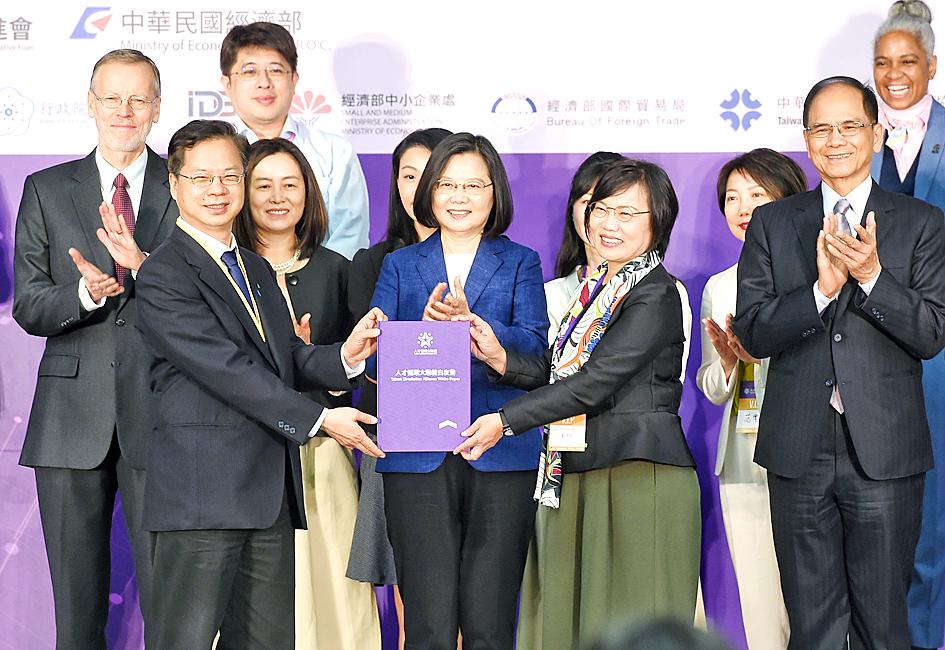
Photo: Fang Pin-chao, Taipei Times
Tsai said in a speech that the COVID-19 pandemic has presented unprecedented challenges, making innovative talent even more important, as evidenced in the nation’s use of contact tracing, smart resource allocation, remote learning and working, and other innovative solutions to fight COVID-19.
The coronavirus has restructured the global supply chain and presented opportunities that can be best captured by improving English proficiency and digital skills among Taiwanese, she said.
Tsai underlined the importance of English-language learning by citing the government’s goal to establish Taiwan as a bilingual nation by 2030 and its increase of research grants to English education centers at universities.
The nation hopes to support young Taiwanese studying or working abroad so that they can introduce new skills when they return, as well as relax restrictions on foreigners wanting to work in Taiwan and offer companies incentives to hire them, she said.
The white paper’s primary goal is to transform the nation into an international talent hub, Christensen said, citing last year’s Talent Circulation Summit, the Fulbright Fellowship and a collaborative project between Microsoft and the Taiwan External Trade Development Council (TAITRA) to train chief executives as examples of US efforts to help Taiwan achieve talent circulation.
The Talent Circulation Alliance aims to help Taiwan replicate its economic success in the digital age by bringing in expertise from the US and other nations, Christensen said.
It also seeks to keep Taiwan’s future anchored in the democratic world, and if the nation’s top talent is deeply connected with the free and open Indo-Pacific region, then its future will also remain centered in the democratic world, he said.
The alliance seeks to help the nation’s talent grow and prevent a brain drain, he said.
“The best way to prevent the loss of talent is to create a viable alternative, namely easy circulation of talent among like-minded economies, in particular the United States,” Christensen said.
The AIT believes that having sufficient talent is a prerequisite for accomplishing all of Taiwan’s policy goals, and that by solving the problem of how to cultivate and manage talent, it will help the nation solve virtually all the other challenges it faces, he said.

Right-wing political scientist Laura Fernandez on Sunday won Costa Rica’s presidential election by a landslide, after promising to crack down on rising violence linked to the cocaine trade. Fernandez’s nearest rival, economist Alvaro Ramos, conceded defeat as results showed the ruling party far exceeding the threshold of 40 percent needed to avoid a runoff. With 94 percent of polling stations counted, the political heir of outgoing Costa Rican President Rodrigo Chaves had captured 48.3 percent of the vote compared with Ramos’ 33.4 percent, the Supreme Electoral Tribunal said. As soon as the first results were announced, members of Fernandez’s Sovereign People’s Party
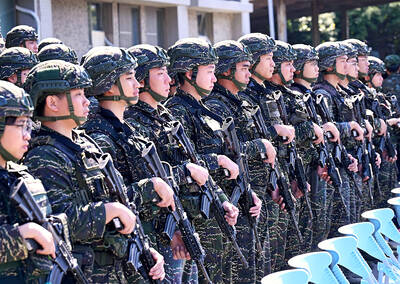
MORE RESPONSIBILITY: Draftees would be expected to fight alongside professional soldiers, likely requiring the transformation of some training brigades into combat units The armed forces are to start incorporating new conscripts into combined arms brigades this year to enhance combat readiness, the Executive Yuan’s latest policy report said. The new policy would affect Taiwanese men entering the military for their compulsory service, which was extended to one year under reforms by then-president Tsai Ing-wen (蔡英文) in 2022. The conscripts would be trained to operate machine guns, uncrewed aerial vehicles, anti-tank guided missile launchers and Stinger air defense systems, the report said, adding that the basic training would be lengthened to eight weeks. After basic training, conscripts would be sorted into infantry battalions that would take
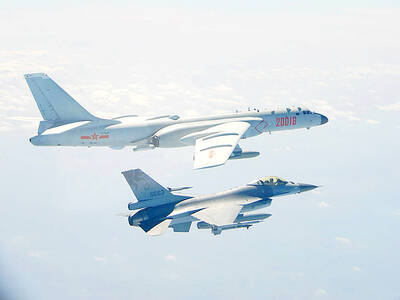
GROWING AMBITIONS: The scale and tempo of the operations show that the Strait has become the core theater for China to expand its security interests, the report said Chinese military aircraft incursions around Taiwan have surged nearly 15-fold over the past five years, according to a report released yesterday by the Democratic Progressive Party’s (DPP) Department of China Affairs. Sorties in the Taiwan Strait were previously irregular, totaling 380 in 2020, but have since evolved into routine operations, the report showed. “This demonstrates that the Taiwan Strait has become both the starting point and testing ground for Beijing’s expansionist ambitions,” it said. Driven by military expansionism, China is systematically pursuing actions aimed at altering the regional “status quo,” the department said, adding that Taiwan represents the most critical link in China’s
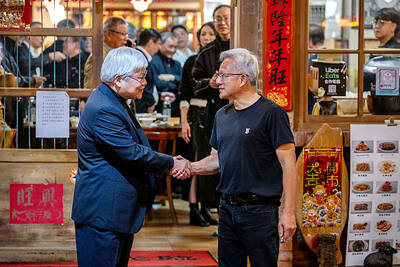
‘REALLY PROUD’: Nvidia would not be possible without Taiwan, Huang said, adding that TSMC would be increasing its capacity by 100 percent Nvidia Corp CEO Jensen Huang (黃仁勳) on Saturday praised and lightly cajoled his major Taiwanese suppliers to produce more to help power strong demand for artificial intelligence (AI), capping a visit to the country of his birth, where he has been mobbed by adoring fans at every step. Speaking at an impromptu press conference in the rain outside a Taipei restaurant, where he had hosted suppliers for a “trillion-dollar dinner,” named after the market capitalization of those firms attending, Huang said this would be another good year for business. “TSMC needs to work very hard this year because I need a lot


 RSS
RSS