


The WHO should directly contact the government about inviting Taiwan to attend this year’s World Health Assembly (WHA) as an observer and accept its full participation in all meetings, mechanisms and activities, a Ministry of Foreign Affairs official said yesterday.
The call was made in response to a 13-point statement issued by WHO spokesman Tarik Jasarevic yesterday when asked by the Central News Agency about a crowd-funded ad published in the New York Times, which argued that Taiwan has been isolated from the global health body, but can help the world in fighting the COVID-19 pandemic.
The WHO’s statement gave eight examples on “how Taiwanese health experts and authorities interact with WHO in the response to the COVID-19 pandemic” and five examples of “regular interactions that have taken place over many years and across many different global health concerns.”
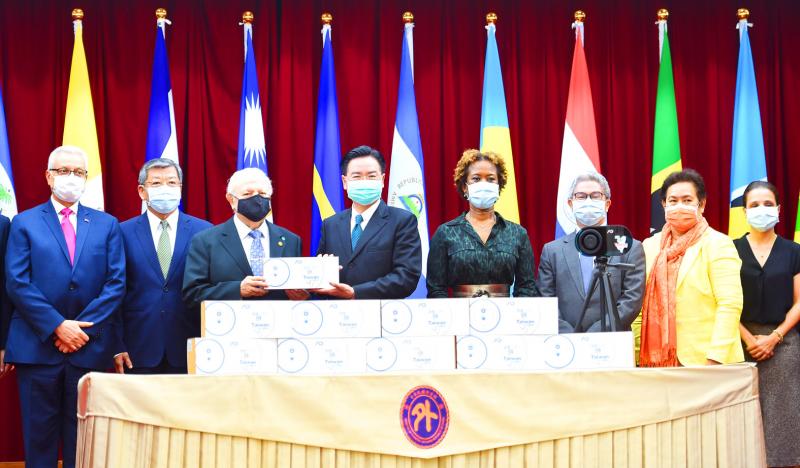
Photo: Liu Hsin-de, Taipei Times
At the Central Epidemic Command Center’s daily news conference yesterday, Department of International Organizations Director-General Bob Chen (陳龍錦) read the ministry’s official response to the WHO’s 13-point statement.
The ministry recognizes that the WHO has started to take Taiwan’s existence seriously and its willingness to openly discuss the issue of Taiwan’s participation, he said.
“However, the WHO has been unable to resist improper political pressure from the Chinese government, and uphold professional and neutrality principles to accept Taiwan’s full participation,” Chen said, adding that the WHO’s disease report still shows Taiwan as a part of China.
WHO Health Emergencies Program executive director Michael Ryan in February claimed that the WHO has been “engaging with technical colleagues on the Taiwanese side over the whole course of this event … in all aspects of technical cooperation,” but in reality, Taiwan has only had very limited participation, Chen said.
“The ministry stresses that Taiwan’s complete and sound healthcare system, as well as its successful experience in disease prevention, makes it an indispensable partner for the WHO in achieving its goal of ‘health for all,’” Chen said.
“However, due to political issues, Taiwan has not been invited to the WHA since 2017,” he added.
Between 2009 and last year, Taiwan applied to attend 187 WHO technical meetings, but was invited to attend only 57, a rejection rate of about 70 percent, and the organization mostly refused to explain the rejected applications, Chen said.
While Taiwan’s location should see it included as part of the Western Pacific, the WHO’s Western Pacific Regional Office has consistently refused to have contact with Taiwan or provide it with any public health information about the region, he said.
While Taiwanese health experts have participated in two WHO networks, the UN agency has never allowed Taiwan access to its laboratory networks, Chen said.
A Taiwanese expert has been appointed to the WHO’s International Health Regulations Committees and Expert Roster, but Taiwanese experts are rarely invited to attend related meetings and the WHO has refused to certify vaccines produced in Taiwan due to political reasons, he said.
Denying Taiwan’s participation in the WHO harms the right to health of its 23 million people, as well as those of people in other nations who cannot benefit from the assistance and experience that Taiwan can share, he added.
“The ministry reiterates that Taiwan can and is willing to participate and contribute to improving the health quality of all human beings, and it has already taken action by donating medical resources and sharing disease prevention experience to help other nations fight the spread of COVID-19,” Chen said.
“Taiwan can help, and Taiwan is helping,” he said.
“The WHO should know that Taiwan is not ruled by China. It has its own independent, sound medical and public health system, and only a government elected by Taiwanese can represent the Taiwanese public,” he added.
Separately yesterday, Minister of Foreign Affairs Joseph Wu (吳釗燮) also urged the WHO to include Taiwan, saying: “The world needs Taiwan and Taiwan will play its part,” as evidenced by its concrete action in the fight against COVID-19.
Wu made the remarks while hosting a ceremony for the donation of thermal imaging cameras to allies.
Taiwan — as a responsible member of the global community — has been excluded from the international health system, but its pre-emptive response and information transparency in containing “Wuhan pneumonia” have won accolades from around the world, Wu said.
The ministry has asked medical personnel to share their experiences in teleconferences and asked representative offices to purchase critical medical supplies for allies prior to the nation making donations, he said.
“Taiwan can help and Taiwan is helping with concrete action,” Wu said, again urging the WHO to fully include Taiwan in its meetings and mechanisms.
Nicaraguan Ambassador William Tapia said that the number of reported COVID-19 cases in Taiwan is low compared with the risk it faces, proving that “Taiwan’s way is the right way.”
“Don’t forget: Taiwan helps, and Taiwan is always by our side,” Tapia said, inviting other ambassadors to continue helping Taipei boost its international outreach.
The nation’s Latin American and Caribbean allies have reported fewer cases than others in the region, partly due to the information relayed by Taiwan, Department of Latin American and Caribbean Affairs Director-General Alexander Yui (俞大㵢) said.
Some former allies have “more or less” pitched to Taiwan their requests for medical aid, he said.
Meanwhile, Palau, Nauru, Tuvalu and the Marshall Islands have not reported any cases of COVID-19, Deputy Minister of Foreign Affairs Hsu Szu-chien (徐斯儉) said at a ceremony marking the donation of masks to the Pacific allies.
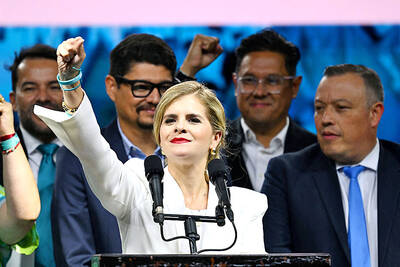
Right-wing political scientist Laura Fernandez on Sunday won Costa Rica’s presidential election by a landslide, after promising to crack down on rising violence linked to the cocaine trade. Fernandez’s nearest rival, economist Alvaro Ramos, conceded defeat as results showed the ruling party far exceeding the threshold of 40 percent needed to avoid a runoff. With 94 percent of polling stations counted, the political heir of outgoing Costa Rican President Rodrigo Chaves had captured 48.3 percent of the vote compared with Ramos’ 33.4 percent, the Supreme Electoral Tribunal said. As soon as the first results were announced, members of Fernandez’s Sovereign People’s Party
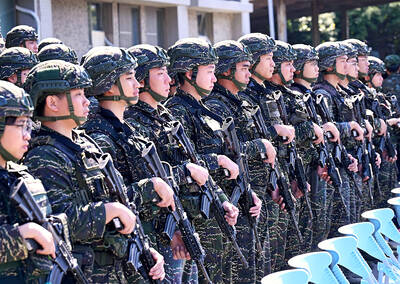
MORE RESPONSIBILITY: Draftees would be expected to fight alongside professional soldiers, likely requiring the transformation of some training brigades into combat units The armed forces are to start incorporating new conscripts into combined arms brigades this year to enhance combat readiness, the Executive Yuan’s latest policy report said. The new policy would affect Taiwanese men entering the military for their compulsory service, which was extended to one year under reforms by then-president Tsai Ing-wen (蔡英文) in 2022. The conscripts would be trained to operate machine guns, uncrewed aerial vehicles, anti-tank guided missile launchers and Stinger air defense systems, the report said, adding that the basic training would be lengthened to eight weeks. After basic training, conscripts would be sorted into infantry battalions that would take
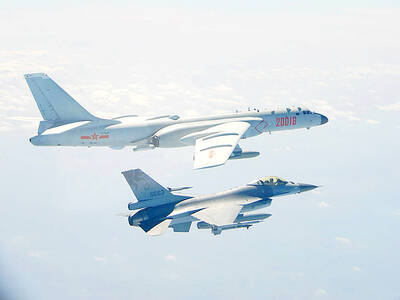
GROWING AMBITIONS: The scale and tempo of the operations show that the Strait has become the core theater for China to expand its security interests, the report said Chinese military aircraft incursions around Taiwan have surged nearly 15-fold over the past five years, according to a report released yesterday by the Democratic Progressive Party’s (DPP) Department of China Affairs. Sorties in the Taiwan Strait were previously irregular, totaling 380 in 2020, but have since evolved into routine operations, the report showed. “This demonstrates that the Taiwan Strait has become both the starting point and testing ground for Beijing’s expansionist ambitions,” it said. Driven by military expansionism, China is systematically pursuing actions aimed at altering the regional “status quo,” the department said, adding that Taiwan represents the most critical link in China’s
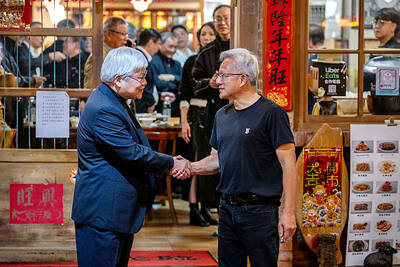
‘REALLY PROUD’: Nvidia would not be possible without Taiwan, Huang said, adding that TSMC would be increasing its capacity by 100 percent Nvidia Corp CEO Jensen Huang (黃仁勳) on Saturday praised and lightly cajoled his major Taiwanese suppliers to produce more to help power strong demand for artificial intelligence (AI), capping a visit to the country of his birth, where he has been mobbed by adoring fans at every step. Speaking at an impromptu press conference in the rain outside a Taipei restaurant, where he had hosted suppliers for a “trillion-dollar dinner,” named after the market capitalization of those firms attending, Huang said this would be another good year for business. “TSMC needs to work very hard this year because I need a lot


 RSS
RSS