


The Central Epidemic Command Center (CECC) yesterday issued a level 2 “alert” travel notice for eight European and two Middle Eastern countries, as well as a level 1 “watch” notice for 16 other European countries as it confirmed a new case of COVID-19 infection in a Taiwanese woman who on Sunday returned from the UK.
The coronavirus outbreak in Europe is getting worse, said Minister of Health and Welfare Chen Shih-chung (陳時中), who heads the center.
The CECC had already issued a level 3 “warning” travel notice — avoid all nonessential travel — for Italy and a level 2 “alert” notice — practice enhanced precautions — for France, Germany and Spain, he said.

Photo: Peter Lo, Taipei Times
“We are issuing a level 2 ‘alert’ travel notice for Iceland, Switzerland, Norway, Sweden, Belgium, the Netherlands, Denmark and Austria, effective as of today,” he added.
“Also, a level 2 travel notice has been issued for Bahrain and Kuwait in the Middle East, as they have the same level of risk,” he said.
“We are also issuing a level 1 ‘watch’ travel notice for Greece, the Czech Republic, Portugal, Finland, Slovenia, Poland, Estonia, Hungary, Luxemburg, Malta, Slovakia, Latvia, Lithuania, Liechtenstein, the UK and Ireland,” whose citizens can move freely within the Schengen area, Chen said
People arriving in Taiwan from these countries are required to practice self-health management for 14 days, the center said.
Chen said that the latest confirmed case — the nation’s 48th — is woman in her 30s living in northern Taiwan.
The woman visited a friend in the UK from Feb. 28 to Sunday, Chen said.
She sought medical treatment at a clinic for dizziness and a headache on Monday, went to hospital the next day after she developed a mild fever and a cough, and was reported for testing, he said, adding that the results came out positive yesterday.
The woman mainly stayed at home after returning from the trip, Centers for Disease Control Director-General Chou Jih-haw (周志浩) said.
Nine people who have had close contact with her in Taiwan have shown no symptoms, Chou said, adding that a contact investigation is being carried out.
In related news, the Regulations Governing the Compensation for Periods of Isolation and Quarantine for Severe Pneumonia with Novel Pathogens (嚴重特殊傳染性肺炎隔離及檢疫期間防疫補償辦法) was promulgated on Tuesday.
Under the regulations, people who are placed under mandatory 14-day home isolation, home quarantine or have asked for disease-prevention family care leave due to COVID-19-related policies can apply for compensation of NT$1,000 per day up to a maximum of NT$14,000 for 14 days.
The budget allocated for the compensation is expected to cover about 130,000 people.
Chou said that the number is only an estimate, adding that an actual epidemic situation is difficult to predict accurately.
The quarantine orders would not stop if the number exceeds 130,000 people, he added.
Asked about concerns that some people might travel abroad with the aim of being placed under home quarantine to receive compensation, Chen said such offenses would be punished in accordance with the law.
As for the center’s online mask purchase program, Chen said that people can start ordering masks from 9am today at the Web site emask.taiwan.gov.tw.

Right-wing political scientist Laura Fernandez on Sunday won Costa Rica’s presidential election by a landslide, after promising to crack down on rising violence linked to the cocaine trade. Fernandez’s nearest rival, economist Alvaro Ramos, conceded defeat as results showed the ruling party far exceeding the threshold of 40 percent needed to avoid a runoff. With 94 percent of polling stations counted, the political heir of outgoing Costa Rican President Rodrigo Chaves had captured 48.3 percent of the vote compared with Ramos’ 33.4 percent, the Supreme Electoral Tribunal said. As soon as the first results were announced, members of Fernandez’s Sovereign People’s Party
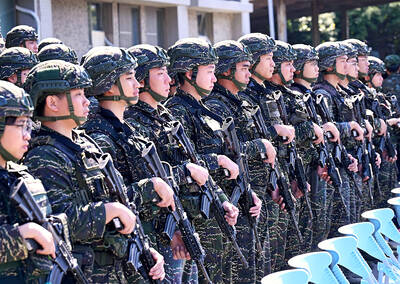
MORE RESPONSIBILITY: Draftees would be expected to fight alongside professional soldiers, likely requiring the transformation of some training brigades into combat units The armed forces are to start incorporating new conscripts into combined arms brigades this year to enhance combat readiness, the Executive Yuan’s latest policy report said. The new policy would affect Taiwanese men entering the military for their compulsory service, which was extended to one year under reforms by then-president Tsai Ing-wen (蔡英文) in 2022. The conscripts would be trained to operate machine guns, uncrewed aerial vehicles, anti-tank guided missile launchers and Stinger air defense systems, the report said, adding that the basic training would be lengthened to eight weeks. After basic training, conscripts would be sorted into infantry battalions that would take
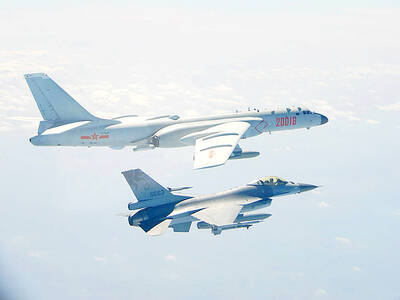
GROWING AMBITIONS: The scale and tempo of the operations show that the Strait has become the core theater for China to expand its security interests, the report said Chinese military aircraft incursions around Taiwan have surged nearly 15-fold over the past five years, according to a report released yesterday by the Democratic Progressive Party’s (DPP) Department of China Affairs. Sorties in the Taiwan Strait were previously irregular, totaling 380 in 2020, but have since evolved into routine operations, the report showed. “This demonstrates that the Taiwan Strait has become both the starting point and testing ground for Beijing’s expansionist ambitions,” it said. Driven by military expansionism, China is systematically pursuing actions aimed at altering the regional “status quo,” the department said, adding that Taiwan represents the most critical link in China’s
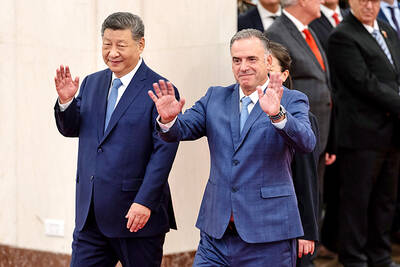
EMERGING FIELDS: The Chinese president said that the two countries would explore cooperation in green technology, the digital economy and artificial intelligence Chinese President Xi Jinping (習近平) yesterday called for an “equal and orderly multipolar world” in the face of “unilateral bullying,” in an apparent jab at the US. Xi was speaking during talks in Beijing with Uruguayan President Yamandu Orsi, the first South American leader to visit China since US special forces captured then-Venezuelan president Nicolas Maduro last month — an operation that Beijing condemned as a violation of sovereignty. Orsi follows a slew of leaders to have visited China seeking to boost ties with the world’s second-largest economy to hedge against US President Donald Trump’s increasingly unpredictable administration. “The international situation is fraught


 RSS
RSS