


A Chinese doctor who was punished after raising the alarm about the 2019 novel coronavirus (2019-nCoV) yesterday died from the pathogen, sparking an outpouring of grief and anger over a worsening crisis that has killed more than 630 people.
At least 31,000 people have been infected by a virus that ophthalmologist Li Wenliang (李文亮) and colleagues first brought to light in late December.
The disease has since spread across China, prompting the Chinese government to lock down cities of tens of millions of people, and panic has spiraled around the globe as more than 240 cases have emerged in two dozen countries.
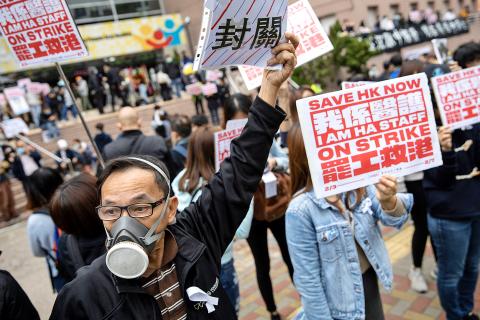
Photo: EPA-EFE
Li, 34, died early yesterday, Wuhan Central Hospital said in an online post, an announcement that triggered grief on social media — over a doctor who was hailed a hero — and anger over the government’s handling of the crisis.
“He is a hero who warned others with his life,” a fellow Wuhan doctor wrote.
“Those fat officials who live on public money, may you die from a snowstorm,” wrote a netizen in a comment that has since been censored.
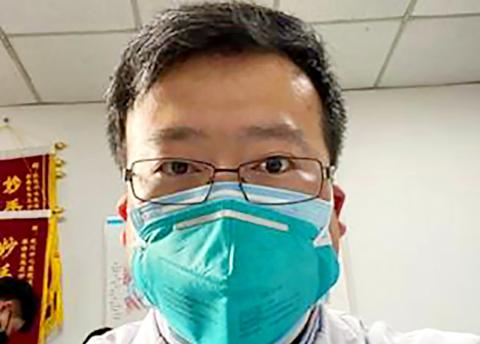
Photo: AFP / Li Wenliang
In a sign that the criticism has shaken the government, its anti-graft agency announced that it was sending a team to Wuhan to “conduct a comprehensive investigation into issues involving Dr Li Wenliang reported by the masses.”
Li’s death has also highlighted the enormous risks that front line doctors have taken to treat people in overwhelmed and under-equipped hospitals in Wuhan, the quarantined city of 11 million people where the virus emerged.
Li on Dec. 30 sent out a message about the virus to colleagues in Wuhan, but was later among eight whistle-blowers summoned by police for “rumormongering.”
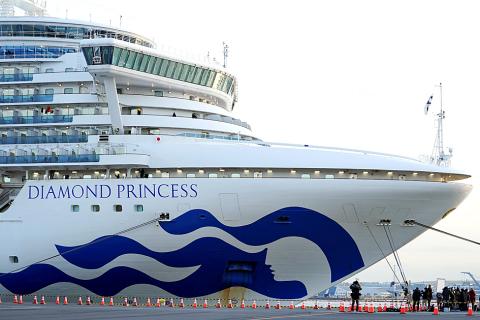
Photo: EPA-EFE
He later contracted the disease while treating a patient.
In Japan, at least 61 people onboard a cruise ship have tested positive for 2019-nCoV, the Japanese government said, as thousands of passengers and crew face a two-week quarantine.
An additional 41 passengers yesterday were found to have contracted the virus.
Japanese authorities had tested 273 people onboard the Diamond Princess, which was quarantined after a former passenger, who disembarked in Hong Kong last month, was diagnosed with the virus.
“The results of the remaining 171 tests came out and 41 tested positive,” Japanese Minister of Health, Labor and Welfare Katsunobu Kato told reporters. “Today [yesterday] they will be sent to hospitals in several prefectures, and we are now preparing for that.”
Those newly diagnosed included 21 Japanese, as well as Americans, Canadians, Australians, an Argentine and a Briton. A Taiwanese was among the passengers earlier confirmed to have the virus.
The Ministry of Health and Welfare as of yesterday had reported 16 cases in Taiwan.
The viral outbreak had infected more than 31,400 people globally, health authorities in Beijing said yesterday.
In China there were 636 deaths and 31,161 confirmed cases on the mainland, with 22 cases, including one death, in Hong Kong and 10 cases in Macau.
Cases elsewhere were Japan (86); Singapore (30); Thailand (25); South Korea (24); Australia (14); Germany (13); Malaysia (14); the US and Vietnam (12 each); France (six); Canada and the United Arab Emirates (five each); the UK and India (three each); the Philippines (three cases, including one death); Russia and Italy (two each); and one each in Belgium, Nepal, Sri Lanka, Sweden, Spain, Cambodia and Finland.

A signaling system malfunction disrupted high-speed rail (HSR) services beginning at 8am today, with trains temporarily reduced to three northbound and three southbound trains per hour as authorities conduct inspections. The malfunction occurred on a section of track in Miaoli County during pre-operation checks early this morning, forcing northbound and southbound trains to use a single track, the HSR operator said. The regular schedule has been replaced with three hourly trains offering only nonreserved seating in each direction, stopping at every station, it said, adding that business class cars would still have reserved seating. Departures from terminal stations are scheduled at the top

DRONE CENTRAL: Taiwan aims to become Asia’s democratic hub for drones, with most exports focused on high-quality military-grade models, an official said Taiwan’s drone industry is expected to expand significantly by 2030, producing 100,000 units per month and exporting half of them, the Ministry of Economic Affairs said yesterday. Current drone production capacity is about 15,000 units per month, but the industry can quickly scale up as demand increases, Industrial Development Administration Director-General Chiou Chyou-huey (邱求慧) told a news conference in Taipei. Taiwan’s drone output grew 2.5-fold last year to NT$12.9 billion (US$408.3 million) under a government program to develop the uncrewed vehicle sector, he said. The Executive Yuan in October last year approved plans to invest NT$44.2 billion into domestic production of uncrewed aerial

VERBOSE VESSELS: A CGA cutter and a China Coast Guard exchanged verbal barbs for more than a day in Taiwanese-controlled waters before the Chinese vessel left The Taiwanese and Chinese coast guards had a standoff near the strategically located Pratas Islands (Dongsha Islands, 東沙群島) in the north of the South China Sea, the Coast Guard Administration (CGA) said yesterday. The two sides engaged in intense radio exchanges over sovereignty claims during the 33-hour standoff. China Coast Guard vessel 3501 eventually left the restricted waters, 26.6 nautical miles (49.2km) west of the Pratas Islands, at 5pm yesterday, the CGA said. Lying approximately between southern Taiwan and Hong Kong, the Taiwan-controlled Pratas are seen by some security experts as vulnerable to Chinese attack due to their distance — more than
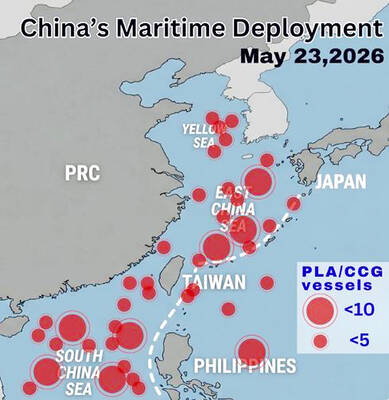
WARNING: China should stop engaging in actions that undermine regional peace and stability, as it would only build resentment among people across the Strait, the CGA said China has deployed more than 100 navy, coast guard and other vessels in waters from the Yellow Sea to the South China Sea and the western Pacific since US President Donald Trump and Chinese President Xi Jinping (習近平) met in Beijing, National Security Council Secretary-General Joseph Wu (吳釗燮) said yesterday. “In this part of the world, #China is the one & only PROBLEM wrecking the #StatusQuo & threatening regional peace & stability,” Wu wrote on X. In a separate post, he said Beijing was coercing Taiwan’s maritime domain, calling it illegal and provocative, after the Coast Guard Administration (CGA) expelled a


 RSS
RSS