


Chief of the General Staff General Shen Yi-ming (沈一鳴), who was killed yesterday in a helicopter crash in New Taipei City, had been in charge of the Ministry of National Defense’s General Staff Headquarters since July last year, succeeding retiring admiral Lee Hsi-ming (李喜明).
The 62-year-old air force general and his entourage were on a routine pre-Lunar New Year mission to visit troops at Dongaoling Base (東澳嶺) in Yilan County.
Prior to his taking up the General Staff Headquarters post, he had served for 15 months as vice minister of national defense, and from Feb. 1, 2015, to March 1 last year as air force commander-general. He was administrative deputy minister of defense before that.
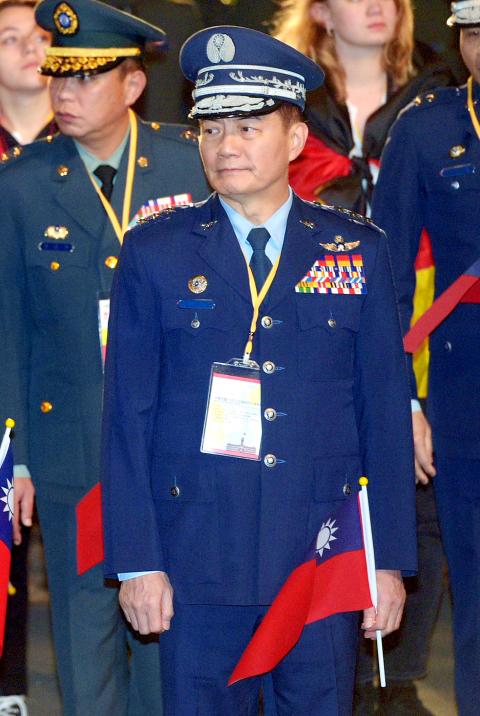
Photo: Chang Chia-ming, Taipei Times
As air force commander, Shen promoted joint operations training, and disaster prevention and rescue.
After graduating from the Republic of China Air Force Academy in 1979, Shen was posted to the Great Desert Program, working with the Saudi Arabian government in Yemen Arab Republic until the Saudi Arabian government transferred diplomatic recognition from the Republic of China to the People’s Republic of China in 1990.
At the time of his death, Shen was the officer from that program still on active duty.
He graduated from the Air Command and Staff College in 1992, and following France’s sale of Mirage 2000-5 jets to Taiwan in the late 1990s, Shen was among the first group of Taiwanese pilots sent to France for training. He later served as instructor for other air force pilots.
He went on to study at the US Air Force’s Air War College in Montgomery, Alabama, graduating in 2002.
Alexander Huang (黃介正), a strategic studies professor at Tamkang University who had known Shen for a decade, yesterday told The Associated Press that the general had stood out as a pilot and an officer.
“He was very calm and very stable, and unlike other army guys he was always smiling, so he [had] got a specific leadership style that also made him a popular leader in the entire military,” Huang said.
Shen was very disciplined, well-versed in knowledge of modern digital devices, to the extent that he could show his younger subordinates a trick or two, and was physically fit, receiving full marks during his annual physicals as air force commander, sources said.
Those familiar with Shen said that he valued the importance of scientific proof and professional analysis.
A military source said Shen’s fluency in foreign languages, as well as his knowledge of military affairs and diplomatic relations, made him a great choice as chief of general staff and to help promote the government’s Indo-Pacific strategy.
Deputy Chief of General Staff General Liu Chih-pin (劉志斌) last night was named acting chief of general staff to ensure the military’s capability to continue its operations as normal.
Additional reporting by CNA

SILENCING CRITICS: In addition to blocking Taiwan, China aimed to prevent rights activists from speaking out against authoritarian states, a Cabinet department said The Ministry of Foreign Affairs (MOFA) yesterday condemned transnational repression by Beijing after RightsCon, a major digital human rights conference scheduled to be held in Zambia this week, was abruptly canceled due to Chinese pressure over Taiwanese participation. This year’s RightsCon, the world’s largest conference discussing issues “at the intersection of human rights and technology,” was scheduled to take place from tomorrow to Friday in Lusaka, and expected to draw 2,600 in-person attendees from 150 countries, along with 1,100 online participants. However, organizers were forced to cancel the event due to behind-the-scenes pressure from China, the ministry said, expressing its “strongest condemnation”
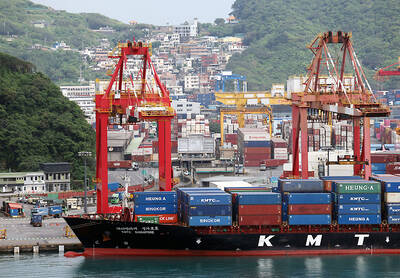
Taiwan’s economy grew far faster than expected in the first quarter, as booming demand for artificial intelligence (AI) applications drove a surge in exports, spilling over into investment and consumption, the Directorate-General of Budget, Accounting and Statistics (DGBAS) said yesterday. GDP growth was 13.69 percent year-on-year during the January-to-March period, beating the DGBAS’ February forecast by 2.23 percentage points and marking the most robust growth in nearly four decades, DGBAS senior official Chiang Hsin-yi (江心怡) told a news conference in Taipei. The result was powered by exports, which remain the backbone of Taiwan’s economy, Chiang said. Outbound shipments jumped 51.12 percent year-on-year to
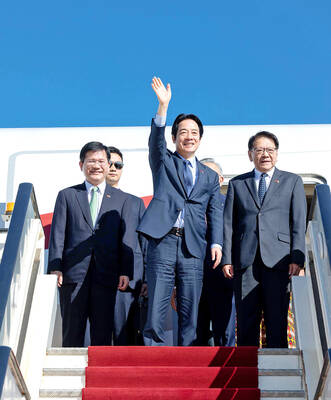
DELAYED BUT DETERMINED: The president’s visit highlights Taiwan’s right to international engagement amid regional pressure from China President Willaim Lai (賴清德) yesterday arrived in Eswatini, more than a week after his planned visit to Taiwan’s sole African ally was suspended because of revoked overflight permits. “The visit, originally scheduled for April 22, was postponed due to unforeseen external factors,” Lai wrote on social media. “After several days of careful arrangements by our diplomatic and national security teams, we successfully arrived today.” Lai said he looked forward to further deepening Taiwan-Eswatini relations through closer cooperation in the economy, agriculture, culture and education, as well as advancing the nation’s international partnerships. The president was initially scheduled to arrive in time to celebrate
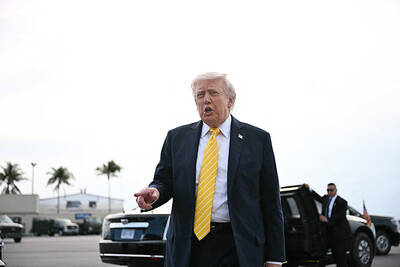
Iran’s Islamic Revolutionary Guard Corp (IRGC) yesterday said the US faced a choice between an “impossible” military operation or a “bad deal” with Tehran, after US President Donald Trump disparaged Iran’s latest peace proposal. Negotiations between the two countries have been deadlocked since a ceasefire came into effect on April 8, with only one round of direct peace talks held so far. Iran’s Tasnim and Fars news agencies reported that Tehran had submitted a 14-point proposal to mediator Pakistan, but Trump was quick to cast doubt on it. “I will soon be reviewing the plan that Iran has just sent to us, but


 RSS
RSS