


Most of the food products sold at convenience stores that claim to contain fresh strawberries instead contain food additives and not the actual fruit, an investigative report by the Chinese-language Liberty Times (sister newspaper of the Taipei Times) has found.
Capitalizing on the strawberry season, which lasts from December to April, many convenience stores and food producers have launched products that purportedly contain fresh strawberries.
Of the nation’s four major convenience store chain operators, President Chain Store Corp’s (統一超商) 7-Eleven and Taiwan FamilyMart Co (全家便利商店) each sell about 40 products claiming to contain strawberries.

Photo: Liu Hsiao-hsin, Taipei Times
However, none of the products sold at 7-Eleven stores and only two at Taiwan FamilyMart stores actually contained strawberries, while of the 18 strawberry food products sold at Pxmart (全聯實業), only half contained the fruit, the report found.
The products’ ingredients include food additives such as spices, food coloring, thickeners and sweeteners, in addition to other common ingredients, while ingredients related to strawberries are actually derivatives of the fruit, such as syrup, jam or powdered strawberries, it said.
7-Eleven on Friday said that its strawberry products clearly list their ingredients on their labels, adding that none of them contravene the regulations.
Taiwan FamilyMart said that it is normal practice to promote products that are in season and consumers are free to purchase products according to their needs.
Pxmart said that all of its strawberry products contain strawberries, adding that while the fruit might be processed into different forms, its strawberry products are all authentic.
The Executive Yuan’s Department of Consumer Protection Officer Wang Te-ming (王德明) said that labels should be clear, as consumers have the right to know what the products contain.
Consumer Protection Foundation chairman Yu Kai-hsiung (游開雄) said products promoting seasonal fruits should include the fruit, adding that the foundation has long criticized a discrepancy between product names and their contents.
Food additives do not have a serious effect on health, doctors said, but drew attention to the overconsumption of sugar, fats and starch.
The nation’s food labeling regulations are strict, said Chiang Chih-kang (姜至剛), a doctor at National Taiwan University Hospital, adding that as long as the food industry follows the regulations, the public need not worry about acute poisoning or bodily harm.
The consumption of sugar is the main issue, Taiwan Adventist Hospital nutritionist Liu Yi-li (劉怡里) said, as its overconsumption could lead to obesity, a high percentage of body fat, high levels of triglyceride or metabolic syndromes.
Children are likely consume more processed food than vegetables and fruits, National Taiwan University’s Institute of Food Science and Technology professor Sheen Lee-yan (沈立言) said, adding that parents should feed their children more fruits and teach them the difference between natural and processed food.

Japan has deployed long-range missiles in a southwestern region near China, the Japanese defense minister said yesterday, at a time when ties with Beijing are at their lowest in recent years. The missiles were installed in Kumamoto in the southern region of Kyushu, as Japan is attempting to shore up its military capacity as China steps up naval activity in the East China Sea. “Standoff defense capabilities enable us to counter the threat of enemy forces attempting to invade our country ... while ensuring the safety of our personnel,” Japanese Minister of Defense Shinjiro Koizumi said. “This is an extremely important initiative for

The nation’s fastest supercomputer, Nano 4 (晶創26), is scheduled to be launched in the third quarter, and would be used to train large language models in finance and national defense sectors, the National Center for High-Performance Computing (NCHC) said. The supercomputer, which would operate at about 86.05 petaflops, is being tested at a new cloud computing center in the Southern Taiwan Science Park in Tainan. The exterior of the server cabinet features chip circuitry patterns overlaid with a map of Taiwan, highlighting the nation’s central position in the semiconductor industry. The center also houses Taiwania 2, Taiwania 3, Forerunner 1 and
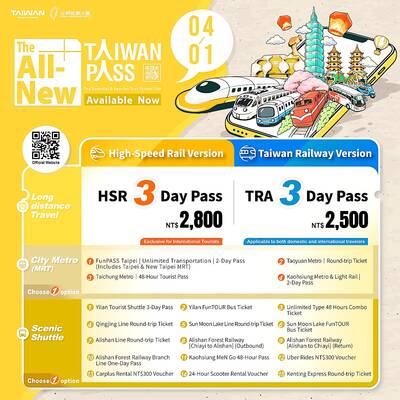
MORE POPULAR: Taiwan Pass sales increased by 59 percent during the first quarter compared with the same period last year, the Tourism Administration said The Tourism Administration yesterday said that it has streamlined the Taiwan Pass, with two versions available for purchase beginning today. The tourism agency has made the pass available to international tourists since 2024, allowing them to access the high-speed rail, Taiwan Railway Corp services, four MRT systems and four Taiwan Tourist Shuttles. Previously, five types of Taiwan Pass were available, but some tourists have said that the offerings were too complicated. The agency said only two types of Taiwan Pass would be available, starting from a three-day pass with the high-speed rail and a three-day pass with Taiwan Railway Corp. The former costs NT$2,800
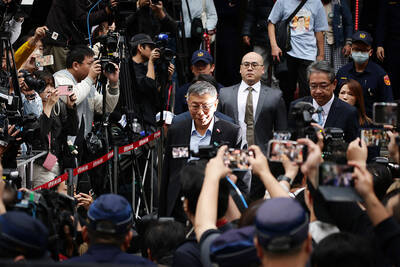
FIRST TRIAL: Ko’s lawyers sought reduced bail and other concessions, as did other defendants, but the bail judge denied their requests, citing the severity of the sentences Former Taipei mayor Ko Wen-je (柯文哲) was yesterday sentenced to 17 years in prison and had his civil rights suspended for six years over corruption, embezzlement and other charges. Taipei prosecutors in December last year asked the Taipei District Court for a combined 28-year, six-month sentence for the four cases against Ko, who founded the Taiwan People’s Party (TPP). The cases were linked to the Core Pacific City (京華城購物中心) redevelopment project and the mismanagement of political donations. Other defendants convicted on separate charges included Chinese Nationalist Party (KMT) Taipei City Councilor Angela Ying (應曉薇), who was handed a 15-year, six-month sentence; Core Pacific


 RSS
RSS