


About 2,800 fishers from Pingtung and Yilan counties yesterday marched in Taipei to protest against stricter regulations, while civic groups called on the government not to loosen regulations barring illegal fishing activities.
Since Taiwan was given a “yellow card” about illegal, unreported and unregulated (IUU) fishing activities by the EU in October 2015, the Council of Agriculture has been trying to get the nation removed from the list by tightening regulations.
Since January last year, when the Act Governing Distant Water Fisheries (遠洋漁業條例), the Act to Govern Investment in the Operation of Foreign Flag Fishing Vessels (投資經營非我國籍漁船管理條例) and amendments to the Fisheries Act (漁業法) took effect, the council has issued fines of more than NT$120 million (US$3.9 million) as of Oct. 25.
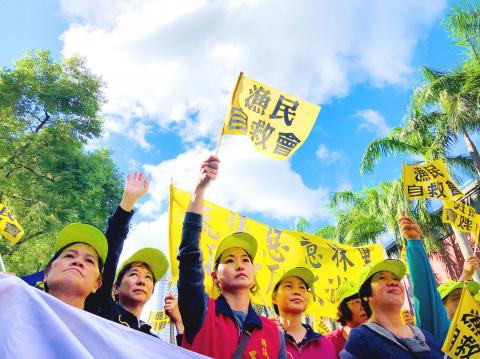
Photo: CNA
The protesters marched from the council building to the Legislative Yuan, demanding that the government retract the “irrational” regulations, pass legislation to specifically govern fishers’ labor standards and increase maritime patrols in the nation’s exclusive economic zones.
It was the largest-ever protest by local fishers, who cannot but take to the streets because they have no other way to oppose the government’s oppression, said Wang Hsin-chan (王新展), director of a self-help group of fishers from Donggang.
Due to the government’s failure to protect the nation’s exclusive economic zones, local fishers can hardly work in waters near Parece Vela (沖之鳥, known as the Okinotori Islands in Japan), Itu Aba Island (Taiping Island, 太平島) and the Pratas Islands (Dongsha Islands, 東沙群島), Siaoliouciou Fishers’ Union chairman Tsai Pao-hsing (蔡寶興) said.
Regarding the council’s plan to include fishers’ working regulations in the Labor Standards Act (勞動基準法), Tsai said the move is unfeasible, as the working conditions of distant-water fishers are different from those of regular workers.
Fisheries Agency Deputy Director Lin Kuo-ping (林國平) told reporters that the agency would discuss with the Ministry of Labor and fishers’ groups to see if distant-water fishers could be covered by Article 84-1 of the act, which governs flexible working hours.
Other regulations are not likely to be loosened, as they follow international standards, Lin said.
A coalition of migrant worker advocate groups, including Greenpeace Taiwan, the Taiwan International Workers’ Association and the UK-based Environmental Justice Foundation’s Taiwan branch, yesterday issued a joint statement urging the government to keep cracking down on illegal fishing activities.
While the government’s implementation of the law has some room for improvement, it should not cave in to pressure or loosen the regulations, otherwise the nation might be given a “red card” by the EU, they said.

A signaling system malfunction disrupted high-speed rail (HSR) services beginning at 8am today, with trains temporarily reduced to three northbound and three southbound trains per hour as authorities conduct inspections. The malfunction occurred on a section of track in Miaoli County during pre-operation checks early this morning, forcing northbound and southbound trains to use a single track, the HSR operator said. The regular schedule has been replaced with three hourly trains offering only nonreserved seating in each direction, stopping at every station, it said, adding that business class cars would still have reserved seating. Departures from terminal stations are scheduled at the top

Taiwan is still in the process of assessing the possibility of recruiting workers from Eswatini, the Ministry of Foreign Affairs said yesterday, adding that its goal is to help Eswatini upgrade its vocational training centers. If there are plans to recruit workers from Eswatini, safeguarding national security, protecting public health and ensuring the employment rights of Taiwanese would be prerequisites, Department of West Asian and African Affairs Director-General Yen Chia-liang (顏嘉良) told a news conference. Key considerations would also include filling labor shortages in specific industries, and fostering bilateral professional and technical exchanges, he said. Yen was asked about the progress of labor

A US uncrewed surface vessel (USV) encountered multiple Chinese warships during an autonomous transit of the Taiwan Strait, US defense company Seasats said in a statement on Wednesday. Seasats announced that a Lightfish USV had completed the first autonomous transit of the Taiwan Strait. Over five days, the USV traversed the entire length of the Strait while constantly monitoring surface vessel traffic, the company said. The Lightfish encountered multiple Chinese warships, one of which was a Chinese People’s Liberation Army Navy (PLAN) Type 056 corvette, it said. The Chinese vessels were operating “well within Taiwan’s exclusive economic zone without transmitting their identity via the

VERBOSE VESSELS: A CGA cutter and a China Coast Guard exchanged verbal barbs for more than a day in Taiwanese-controlled waters before the Chinese vessel left The Taiwanese and Chinese coast guards had a standoff near the strategically located Pratas Islands (Dongsha Islands, 東沙群島) in the north of the South China Sea, the Coast Guard Administration (CGA) said yesterday. The two sides engaged in intense radio exchanges over sovereignty claims during the 33-hour standoff. China Coast Guard vessel 3501 eventually left the restricted waters, 26.6 nautical miles (49.2km) west of the Pratas Islands, at 5pm yesterday, the CGA said. Lying approximately between southern Taiwan and Hong Kong, the Taiwan-controlled Pratas are seen by some security experts as vulnerable to Chinese attack due to their distance — more than


 RSS
RSS