


Nearly 140,000 people from home and abroad yesterday marched through the streets of Taipei in support of better protection of lesbian, gay, bisexual and transgender (LGBT) rights, calling on Taiwanese voters to “vote for equality” in the five LGBT-related referendums tied to next month’s local elections.
Taipei’s skies were filled with rainbow flags, as participants departed from Ketagalan Boulevard at 2:30pm and headed in three different directions, before congregating back on the boulevard.
According to the rally’s organizers, Taiwan LGBT Pride, the march, now in its 16th year, attracted about 137,000 people, up from last year’s 123,000.

Photo: CNA
Due to the annual parade’s growing popularity in Asia and the world, there has been increasing racial, age and occupational diversity among the participants, the organizers said.
The theme this year was “Tell your story, vote for equality,” as the organizers wanted to draw attention to the importance of gender equality education, while urging young Taiwanese to vote in the referendums on Nov. 24 “to safeguard the rainbow,” said a Taiwan LGBT Pride Community general coordinator, who only identified himself as “Hsiao Pai” (小白).
The five referendums, three of which were initiated by anti-LGBT groups, could decide whether the government would legalize same-sex marriage and whether LGBT-inclusive education will be taught in elementary and junior-high schools.
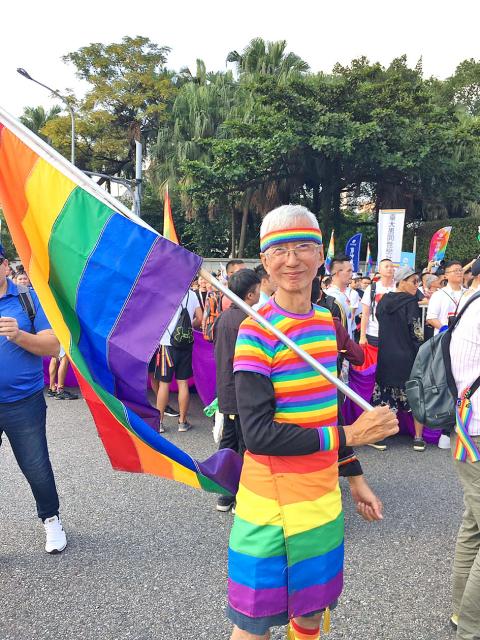
Photo: Yang Mian-chieh, Taipei Times
Mickey Liu (柳皓恩), 26, who joined the march from Hsinchu, said his parents have known he is gay since he was 19.
“When they found out, our relationship went through a rough period. However, as they learned more about the LGBT community, they came to understand and accept it,” Liu said.
A 48-year-old Japanese man who declined to disclose his name said that he came to Taiwan just for the parade and that he found Taiwanese to be “very nice and open” to people with different sexual orientations.
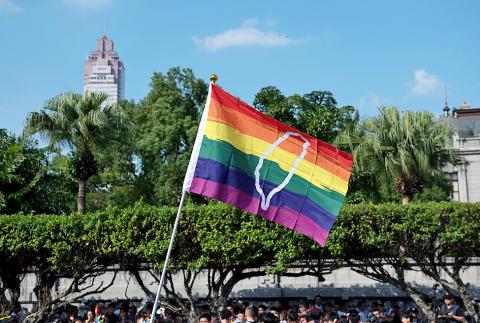
Photo: EPA / Dave Mark Meguiso
Asked whether he hopes to attend such a parade in his country one day, he said that Japan “is not there yet.”
Liam Arne, a 22-year-old American who has been living in Taiwan for three months, said he is happy to see the progress the nation has made in improving LGBT rights.
European Economic and Trade Office Director Madeleine Majorenko said it was her fourth time attending the Taiwan LGBT Pride Parade, which she called “the greatest party ever.”

Photo: CNA
British Representative to Taiwan Catherine Nettleton said Taiwan is a progressive society in various aspects, with a thriving democracy and media.
She said she hopes the progress made on the issue of marriage equality will evolve into a solid result.
German Institute Taipei Director-General Thomas Prinz said the parade alone is a symbol for a free and democratic society, adding that changes take time and that Taiwan is headed in the right direction.
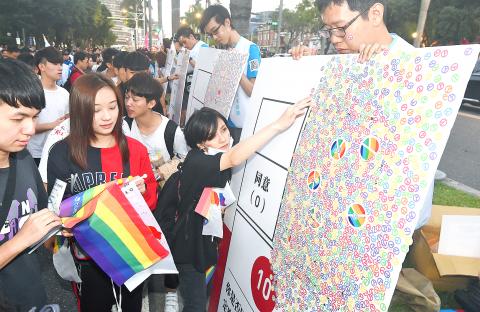
Photo: Liao Chen-huei, Taipei Times
Prior to the start of the parade, more than 30 church leaders, pastors and theologians from 13 nations, including the US, the Philippines, India, South Korea and Singapore, gathered on the boulevard to voice support for the nation’s lesbian, gay, bisexual, transgender, intersex and questioning (LGBTIQ) community, expressing the hope that the nation sets an example by liberating people who are being oppressed due to their sexual orientation.
The participants included US bishop Yvette Flunder, Malaysian Pastor Ngeo Boon Lin, who is Asia’s first openly gay clergy member with a doctorate in theology, Japanese transgender priest Ambrosia Goto Kaori and Indian intersex social activist Daniel Medonca.
Flunder said people would know that the spirit of God is upon them when they choose to liberate people from bondage, choose relationships over religion, and set people free instead of putting them in chains.
“To all of those who are suffering from the oppression of the church, let me be a witness to you today... I have been in a relationship with my partner for 34 years. She and I got married in the US as soon as we could,” Flunder said.
The participants read out a statement expressing their belief that the heart of the gospel of Jesus Christ is radical love, justice and inclusion, and that each person is precious to God because they are all created in His image.
“We recognize there are people with diverse sexual orientations, gender identities, gender expressions and sex characteristics. We affirm that being LGBTIQ is not a psychological disorder, a mental illness, immoral, evil, sinful or depraved — it is simply a reflection of the amazing diversity that God has created,” they said.
Taiwan LGBT Family Rights Advocacy executive secretary Li Jui-ping (黎璿萍) said that she has been a Christian since junior-high school.
"However, I later left the church because after the pastor found out about my sexuality, he told my parents that I was abnormal,” Li said.
Despite the incident, Li said she has remained a Christian because what she believes in is Jesus Christ and that through him, she sees a family.
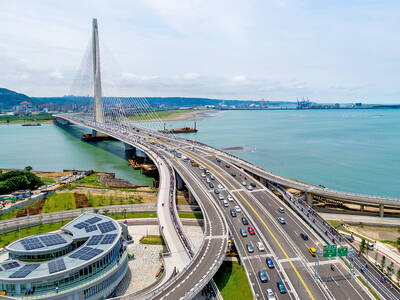
The Ministry of Transportation and Communications yesterday inaugurated the Danjiang Bridge across the Tamsui River in New Taipei City, saying that the structure would be an architectural icon and traffic artery for Taiwan. Feted as a major engineering achievement, the Danjiang Bridge is 920m long, 211m tall at the top of its pylon, and is the longest single-pylon asymmetric cable-stayed bridge in the world, the government’s Web site for the structure said. It was designed by late Iraqi-British architect Zaha Hadid. The structure, with a maximum deck of 70m, accommodates road and light rail traffic, and affords a 200m navigation channel for boats,
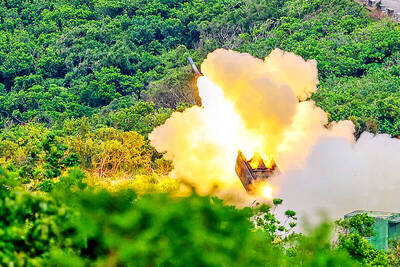
PRECISION STRIKES: The most significant reason to deploy HIMARS to outlying islands is to establish a ‘dead zone’ that the PLA would not dare enter, a source said A High Mobility Artillery Rocket System (HIMARS) would be deployed to Penghu County and Dongyin Island (東引) in Lienchiang County (Matsu) to force the Chinese military to retreat at least 100km from the coastline, a military source said yesterday. Taiwan has been procuring HIMARS and Army Tactical Missile Systems (ATACMS) from the US in batches. Once all batches have been delivered, Taiwan would possess 111 HIMARS units and 504 ATACMS, which have a range of 300km. Considering that “offense is the best defense,” the military plans to forward-deploy the systems to outlying islands such as Penghu and Dongyin so that
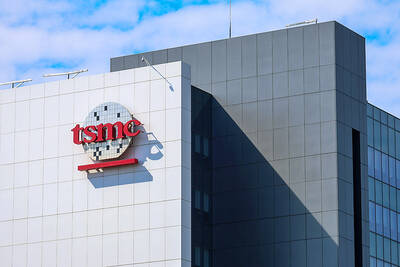
Taiwan Semiconductor Manufacturing Co (TSMC, 台積電), the world’s largest foundry service provider, yesterday said that global semiconductor revenue is projected to hit US$1.5 trillion in 2030, after the figure exceeds US$1 trillion this year, as artificial intelligence (AI) demand boosts consumption of token and compute power. “We are still at the beginning of the AI revolution, but we already see a significant impact across the whole semiconductor ecosystem,” TSMC deputy cochief operating officer Kevin Zhang (張曉強) said at the company’s annual technology symposium in Hsinchu City. “It is fair to say that in the past decade, smartphones and other mobile devices were
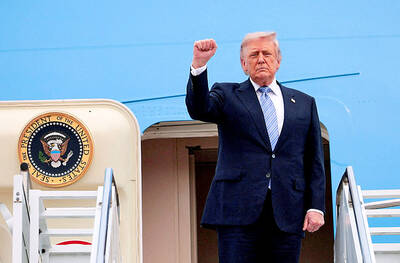
US-CHINA SUMMIT: MOFA welcomed US reassurance of no change in its Taiwan policy; Trump said he did not comment when Xi talked of opposing independence US President Donald Trump yesterday said he has not made a decision on whether to move forward with a major arms package for Taiwan after hearing concerns about it from Chinese President Xi Jinping (習近平). Trump’s comments on Taiwan came as he flew back to Washington after wrapping up critical talks in which both leaders said important progress was made in stabilizing US-China relations even as deep differences persist between the world’s two biggest powers on Iran and Taiwan. “I will make a determination,” Trump said, adding: “I’ll be making decisions. But, you know, I think the last thing we need right


 RSS
RSS