


China’s rubber-stamp lawmakers yesterday passed a historic constitutional amendment abolishing a presidential two-term limit that will enable Chinese President Xi Jinping (習近平) to rule indefinitely.
The amendment upends a system enacted by former Chinese leader Deng Xiaoping (鄧小平) in 1982 to prevent a return to the bloody excesses of a lifelong dictatorship typified by Mao Zedong’s (毛澤東) chaotic Cultural Revolution.
“This marks the biggest regression in China’s legal system since the reform and opening-up era of the 1980s,” said Zhang Lifan (章立凡), an independent Beijing-based political commentator.
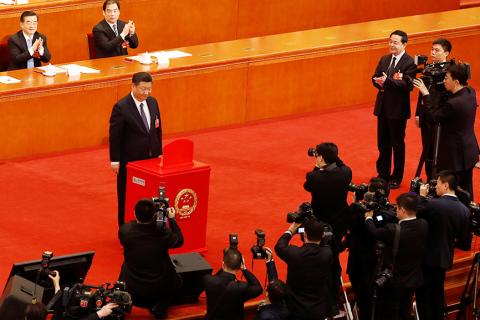
Photo: Reuters
“I’m afraid that this will all be written into our history in the future,”’ Zhang said.
Voting by the National People’s Congress’ nearly 3,000 hand-picked delegates began in the mid-afternoon, with Xi leading members of the Chinese Communist Party’s (CCP) seven-member all-powerful Politburo Standing Committee in casting their votes.
He placed his orange ballot paper in a red box bearing the official seal of state placed front and center on the stage inside the cavernous hall.
Rank-and-file deputies then rose to vote on the floor of the hall as jaunty instrumental music played.
Ten minutes later, the process had ended and delegates were asked to return to their seats while the votes were counted.
Shortly after 3:50pm, the results were read out over the public address system and flashed briefly on a screen in the hall. The delegates had voted 2,958 in favor, with two opposed, three abstaining and one vote invalidated.
The 64-year-old Xi appeared to show little emotion, remaining in his seat with other deputies to listen to a report on the work of the congress delivered by its chairman.
Officials have said the abolishment of the presidential term limits is aimed only at bringing the office of the president in line with Xi’s other positions in the CCP and the Central Military Commission.
The package of amendments included major provisions to inscribe Xi’s eponymous political mantra in the constitution, give the CCP an even larger role in the country’s affairs and expand the president’s anti-corruption campaign.
“Xi Jinping has presided over so many important projects such as economic reforms and the fight against corruption. There was a consensus that we supported him having more time to finish his work,” said Dou Yanli, a delegate from Shandong Province.
Additional reporting by AFP
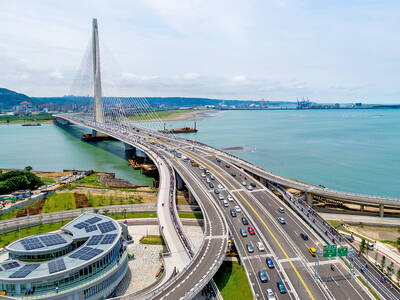
The Ministry of Transportation and Communications yesterday inaugurated the Danjiang Bridge across the Tamsui River in New Taipei City, saying that the structure would be an architectural icon and traffic artery for Taiwan. Feted as a major engineering achievement, the Danjiang Bridge is 920m long, 211m tall at the top of its pylon, and is the longest single-pylon asymmetric cable-stayed bridge in the world, the government’s Web site for the structure said. It was designed by late Iraqi-British architect Zaha Hadid. The structure, with a maximum deck of 70m, accommodates road and light rail traffic, and affords a 200m navigation channel for boats,
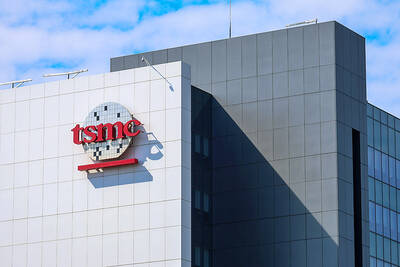
Taiwan Semiconductor Manufacturing Co (TSMC, 台積電), the world’s largest foundry service provider, yesterday said that global semiconductor revenue is projected to hit US$1.5 trillion in 2030, after the figure exceeds US$1 trillion this year, as artificial intelligence (AI) demand boosts consumption of token and compute power. “We are still at the beginning of the AI revolution, but we already see a significant impact across the whole semiconductor ecosystem,” TSMC deputy cochief operating officer Kevin Zhang (張曉強) said at the company’s annual technology symposium in Hsinchu City. “It is fair to say that in the past decade, smartphones and other mobile devices were
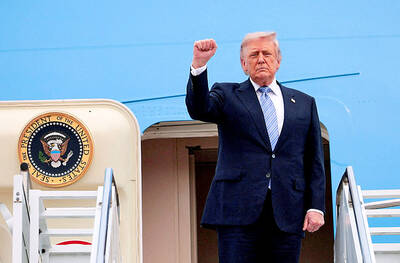
US-CHINA SUMMIT: MOFA welcomed US reassurance of no change in its Taiwan policy; Trump said he did not comment when Xi talked of opposing independence US President Donald Trump yesterday said he has not made a decision on whether to move forward with a major arms package for Taiwan after hearing concerns about it from Chinese President Xi Jinping (習近平). Trump’s comments on Taiwan came as he flew back to Washington after wrapping up critical talks in which both leaders said important progress was made in stabilizing US-China relations even as deep differences persist between the world’s two biggest powers on Iran and Taiwan. “I will make a determination,” Trump said, adding: “I’ll be making decisions. But, you know, I think the last thing we need right

TAIWAN ISSUE: US treasury secretary Scott Bessent said on the first day of meetings that ‘it wouldn’t be a US-China summit without the Taiwan issue coming up’ There were no surprises on the first day of the summit between US President Donald Trump and Chinese President Xi Jinping (習近平), the Mainland Affairs Council (MAC) said yesterday, as the government reiterated that cross-strait stability is crucial to the Asia-Pacific region, as well as the world. As the two presidents met for a highly anticipated summit yesterday, Chinese state media reported that Xi warned Trump that missteps regarding Taiwan could push their two countries into “conflict.” Trump arrived in China with accolades for his host, calling Xi a “great leader” and “friend,” and extending an invitation to visit the White House


 RSS
RSS