


Chinese Nationalist Party (KMT) chairman-elect Wu Den-yih (吳敦義) yesterday reached an agreement with outgoing KMT Chairwoman Hung Hsiu-chu (洪秀柱) to postpone the party’s Central Committee and Central Standing Committee (CSC) elections until after its national congress on Aug. 20, when Wu is to become chairman.
CSC member Yao Chiang-lin (姚江臨), who is responsible for negotiations on the leadership handover, said the two sides reached the conclusion at a meeting yesterday.
The elections were scheduled for July 8 and July 29, but 26 CSC members proposed to have them in September, after Wu takes office.
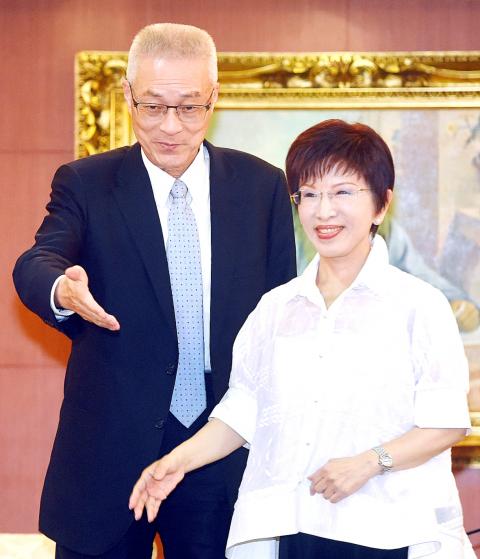
Photo: Liao Chen-huei, Taipei Times
The KMT has booked Chungshan Hall in Yangmingshan in Taipei’s Beitou District (北投) as the venue for the congress.
The Chinese-language United Daily News quoted Yao as saying that Wu had agreed to share with Hung nomination rights for Central Committee members.
Wu and Hung are to jointly propose a list of Central Committee nominees next week, Yao said.
The two had been at loggerheads over the nomination rights for weeks.
Yao said that 163 of the 210 Central Committee members had announced re-election bids.
According to standard practice for the party, those 163 members would be nominated automatically.
Citing an estimate by her aides, Hung on Wednesday said that among the remaining 47 seats, about 38 would be secured by nonpartisan members.
That would leave nine nominations for Hung and Wu to make.
Wu on Wednesday said CSC members who sought to postpone the elections should consult the KMT agencies in charge of polls, but the date had not been determined.
Hung’s camp said yesterday’s meeting meeting did not touch on the date of the national congress or when the elections would be held.
The issues require further negotiations, KMT Culture and Communications Committee deputy director Hu Wen-chi (胡文琦) said.
The two sides agreed that Central Committee members and candidates for KMT party representative seats reserved for party members running businesses in China are to be jointly nominated by Hung and Wu, Hu said.
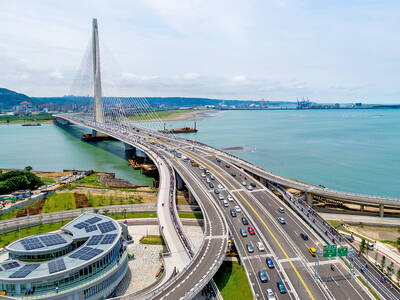
The Ministry of Transportation and Communications yesterday inaugurated the Danjiang Bridge across the Tamsui River in New Taipei City, saying that the structure would be an architectural icon and traffic artery for Taiwan. Feted as a major engineering achievement, the Danjiang Bridge is 920m long, 211m tall at the top of its pylon, and is the longest single-pylon asymmetric cable-stayed bridge in the world, the government’s Web site for the structure said. It was designed by late Iraqi-British architect Zaha Hadid. The structure, with a maximum deck of 70m, accommodates road and light rail traffic, and affords a 200m navigation channel for boats,
Taiwan Semiconductor Manufacturing Co (TSMC, 台積電), the world’s largest foundry service provider, yesterday said that global semiconductor revenue is projected to hit US$1.5 trillion in 2030, after the figure exceeds US$1 trillion this year, as artificial intelligence (AI) demand boosts consumption of token and compute power. “We are still at the beginning of the AI revolution, but we already see a significant impact across the whole semiconductor ecosystem,” TSMC deputy cochief operating officer Kevin Zhang (張曉強) said at the company’s annual technology symposium in Hsinchu City. “It is fair to say that in the past decade, smartphones and other mobile devices were
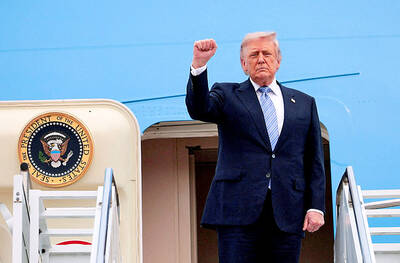
US-CHINA SUMMIT: MOFA welcomed US reassurance of no change in its Taiwan policy; Trump said he did not comment when Xi talked of opposing independence US President Donald Trump yesterday said he has not made a decision on whether to move forward with a major arms package for Taiwan after hearing concerns about it from Chinese President Xi Jinping (習近平). Trump’s comments on Taiwan came as he flew back to Washington after wrapping up critical talks in which both leaders said important progress was made in stabilizing US-China relations even as deep differences persist between the world’s two biggest powers on Iran and Taiwan. “I will make a determination,” Trump said, adding: “I’ll be making decisions. But, you know, I think the last thing we need right
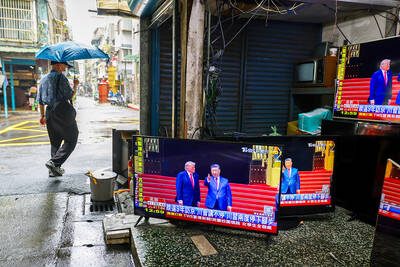
TAIWAN ISSUE: US treasury secretary Scott Bessent said on the first day of meetings that ‘it wouldn’t be a US-China summit without the Taiwan issue coming up’ There were no surprises on the first day of the summit between US President Donald Trump and Chinese President Xi Jinping (習近平), the Mainland Affairs Council (MAC) said yesterday, as the government reiterated that cross-strait stability is crucial to the Asia-Pacific region, as well as the world. As the two presidents met for a highly anticipated summit yesterday, Chinese state media reported that Xi warned Trump that missteps regarding Taiwan could push their two countries into “conflict.” Trump arrived in China with accolades for his host, calling Xi a “great leader” and “friend,” and extending an invitation to visit the White House


 RSS
RSS