


Taiwan’s world competitiveness ranking held steady this year at 14th, as it gained headway in economic performance and business efficiency, but lost points in government efficiency and infrastructure, the International Institute for Management Development (IMD) said in an annual report released on Wednesday.
That made Taiwan the third-best performer in the Asia-Pacific region after Hong Kong and Singapore, which scored first and second place among 63 rated economic entities, according to this year’s World Competitiveness Yearbook compiled by the Lausanne, Switzerland-based institute.
“The challenges for Taiwan is to pursue a new economic model for sustainable development based on the core ideas of innovation, employment and distribution,” the widely tracked report said.

Photo: CNA
Toward that aim, the nation has to accelerate industrial innovation and structuring; expand labor participation and recruitment of talent; foster social cohesion; and enhance environmental sustainability, including carbon reduction and energy saving, it said.
Although Taiwan saw improved GDP growth and foreign investment flows last year, the pace of increase lagged behind its peers, and showed a continued overconcentration on a few export destinations and products, the report said.
Electronic components, mainly semiconductors, underpinned the nation’s outbound shipments to major trading partners, with China taking up a 40 percent share, official trade data showed.
The nation’s rankings on tax policy, business regulation and social stability dropped, as corporate executives voiced concerns over political and social instability, as well as unfavorable rules for recruitment of foreign professionals, the report said.
The IMD said upgraded Taiwan’s business efficiency by one notch, thanks to higher labor market and corporate management scores, despite the decline in productivity and production efficiency.
The financial sector remained a drag on business efficiency, as corporate managers said there was room for improvement on the part of banking institutions, capital markets and related regulations, the institute said, adding that Taiwan had fewer merger and acquisition deals, and lower credit card penetration.
The IMD also cited inadequate water conservation and development of alternative energy resources as the main reason for the two-notch decline in infrastructure ranking, the report said.
Carbon emissions and PM2.5 density highlighted the nation’s lack of infrastructure readiness, the report said, adding that related legal compliance costs would affect corporate competitiveness.
The Ministry of Economic Affairs yesterday said the government would continue its deregulation efforts by amending the Company Act (公司法) and the Statute For Investment By Foreign Nationals (外國人投資條例), and reducing investment barriers to attract more foreign investment.
The government is stepping up efforts to improve infrastructure and remove investment hurdles, National Development Council Deputy Minister Kung Ming-hsin (龔明鑫) said.
The council also plans to ease tax burdens for foreign professionals, but the issue does not appear to be on the Ministry of Finance’s priority agenda.
The finance ministry is due to draw up a tax reform plan later this month on whether to cut the levy on stock dividends.
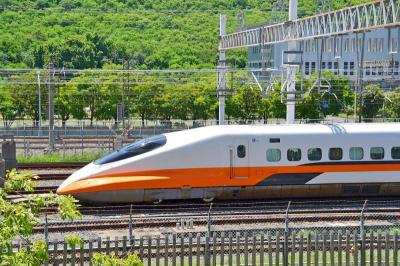
A signaling system malfunction disrupted high-speed rail (HSR) services beginning at 8am today, with trains temporarily reduced to three northbound and three southbound trains per hour as authorities conduct inspections. The malfunction occurred on a section of track in Miaoli County during pre-operation checks early this morning, forcing northbound and southbound trains to use a single track, the HSR operator said. The regular schedule has been replaced with three hourly trains offering only nonreserved seating in each direction, stopping at every station, it said, adding that business class cars would still have reserved seating. Departures from terminal stations are scheduled at the top

DRONE CENTRAL: Taiwan aims to become Asia’s democratic hub for drones, with most exports focused on high-quality military-grade models, an official said Taiwan’s drone industry is expected to expand significantly by 2030, producing 100,000 units per month and exporting half of them, the Ministry of Economic Affairs said yesterday. Current drone production capacity is about 15,000 units per month, but the industry can quickly scale up as demand increases, Industrial Development Administration Director-General Chiou Chyou-huey (邱求慧) told a news conference in Taipei. Taiwan’s drone output grew 2.5-fold last year to NT$12.9 billion (US$408.3 million) under a government program to develop the uncrewed vehicle sector, he said. The Executive Yuan in October last year approved plans to invest NT$44.2 billion into domestic production of uncrewed aerial
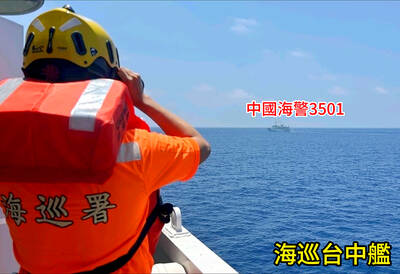
VERBOSE VESSELS: A CGA cutter and a China Coast Guard exchanged verbal barbs for more than a day in Taiwanese-controlled waters before the Chinese vessel left The Taiwanese and Chinese coast guards had a standoff near the strategically located Pratas Islands (Dongsha Islands, 東沙群島) in the north of the South China Sea, the Coast Guard Administration (CGA) said yesterday. The two sides engaged in intense radio exchanges over sovereignty claims during the 33-hour standoff. China Coast Guard vessel 3501 eventually left the restricted waters, 26.6 nautical miles (49.2km) west of the Pratas Islands, at 5pm yesterday, the CGA said. Lying approximately between southern Taiwan and Hong Kong, the Taiwan-controlled Pratas are seen by some security experts as vulnerable to Chinese attack due to their distance — more than
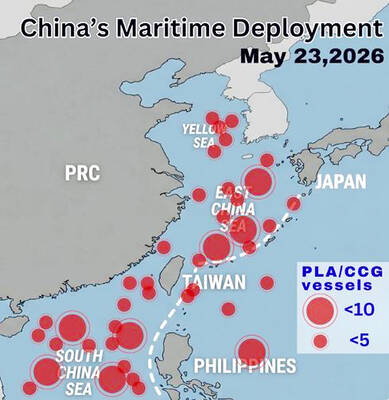
WARNING: China should stop engaging in actions that undermine regional peace and stability, as it would only build resentment among people across the Strait, the CGA said China has deployed more than 100 navy, coast guard and other vessels in waters from the Yellow Sea to the South China Sea and the western Pacific since US President Donald Trump and Chinese President Xi Jinping (習近平) met in Beijing, National Security Council Secretary-General Joseph Wu (吳釗燮) said yesterday. “In this part of the world, #China is the one & only PROBLEM wrecking the #StatusQuo & threatening regional peace & stability,” Wu wrote on X. In a separate post, he said Beijing was coercing Taiwan’s maritime domain, calling it illegal and provocative, after the Coast Guard Administration (CGA) expelled a


 RSS
RSS