


Yoshinori Ohsumi of Japan yesterday won the Nobel Prize in Medicine for his pioneering work on autophagy — a process whereby cells “eat themselves” — which, when disrupted, can cause Parkinson’s disease and diabetes.
A fundamental process in cell physiology, autophagy is essential for the orderly recycling of damaged cell parts and understanding it better has major implications for health and disease, including cancer.
Ohsumi’s discoveries “have led to a new paradigm in the understanding of how the cell recycles its contents,” the jury said.
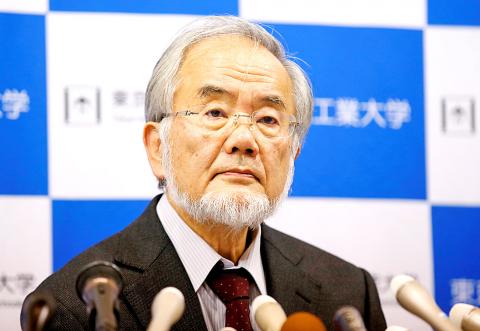
Photo: Reuters
“Mutations in autophagy genes can cause disease, and the autophagic process is involved in several conditions, including cancer and neurological disease,” the jury added.
Researchers first observed during the 1960s that the cell could destroy its own contents by wrapping them up in membranes and transporting them to a recycling compartment called the lysosome — a discovery that earned Belgian scientist Christian de Duve a Nobel Prize in Medicine in 1974.
It was de Duve who coined the term “autophagy,” which comes from Greek, meaning “self-eating.”
In what the jury described as a “series of brilliant experiments in the early 1990s,” Ohsumi used baker’s yeast to identify genes essential for autophagy.
He then went on to explain the underlying mechanisms for autophagy in yeast and showed that similar sophisticated machinery is used in human cells.
Ohsumi’s findings opened the path to understanding the importance of autophagy in many physiological processes, such as how the body adapts to starvation or responds to infection.
When autophagy breaks down, links have been established to Parkinson’s disease, type 2 diabetes and other disorders that appear in elderly people.
Intense research is now under way to develop drugs that target autophagy in various diseases.
Ohsumi, 71, received a doctoral degree from the University of Tokyo in 1974. He is a professor at the Tokyo Institute of Technology.
He is the 23rd Japanese to win a Nobel prize, and the sixth Japanese medicine laureate.
The prize comes with 8 million Swedish kronor (US$936,000).
“This is the highest honor for a researcher,” Ohsumi told Japan’s public broadcaster NHK.
“My motto is to do what others do not want to do. I thought [cellular breakdown] was very interesting. This is where it all begins. It did not draw much attention in the past, but we are now in a time when there is a bigger focus on it,” Ohsumi added.
The medicine prize is awarded by the Nobel Assembly at the Karolinska Institute, which has seen its reputation tarnished over a recent scandal involving Italian surgeon Paolo Macchiarini.
In 2011, while working as a visiting professor at Karolinska, Macchiarini soared to fame for inserting the first synthetic trachea, or windpipe, using patients’ stem cells.
His work was initially hailed as a game-changer for transplant medicine. However, two patients died and a third was left severely ill.
Allegations ensued that the risky procedure had been carried out on at least one individual who had not, at the time, been critically ill.
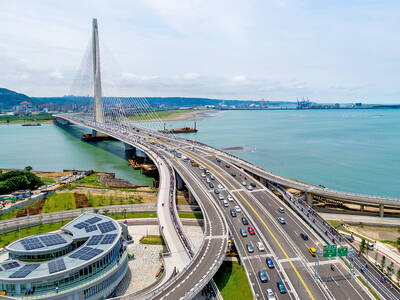
The Ministry of Transportation and Communications yesterday inaugurated the Danjiang Bridge across the Tamsui River in New Taipei City, saying that the structure would be an architectural icon and traffic artery for Taiwan. Feted as a major engineering achievement, the Danjiang Bridge is 920m long, 211m tall at the top of its pylon, and is the longest single-pylon asymmetric cable-stayed bridge in the world, the government’s Web site for the structure said. It was designed by late Iraqi-British architect Zaha Hadid. The structure, with a maximum deck of 70m, accommodates road and light rail traffic, and affords a 200m navigation channel for boats,

Taiwan Semiconductor Manufacturing Co (TSMC, 台積電), the world’s largest foundry service provider, yesterday said that global semiconductor revenue is projected to hit US$1.5 trillion in 2030, after the figure exceeds US$1 trillion this year, as artificial intelligence (AI) demand boosts consumption of token and compute power. “We are still at the beginning of the AI revolution, but we already see a significant impact across the whole semiconductor ecosystem,” TSMC deputy cochief operating officer Kevin Zhang (張曉強) said at the company’s annual technology symposium in Hsinchu City. “It is fair to say that in the past decade, smartphones and other mobile devices were
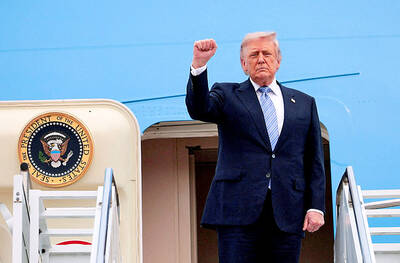
US-CHINA SUMMIT: MOFA welcomed US reassurance of no change in its Taiwan policy; Trump said he did not comment when Xi talked of opposing independence US President Donald Trump yesterday said he has not made a decision on whether to move forward with a major arms package for Taiwan after hearing concerns about it from Chinese President Xi Jinping (習近平). Trump’s comments on Taiwan came as he flew back to Washington after wrapping up critical talks in which both leaders said important progress was made in stabilizing US-China relations even as deep differences persist between the world’s two biggest powers on Iran and Taiwan. “I will make a determination,” Trump said, adding: “I’ll be making decisions. But, you know, I think the last thing we need right
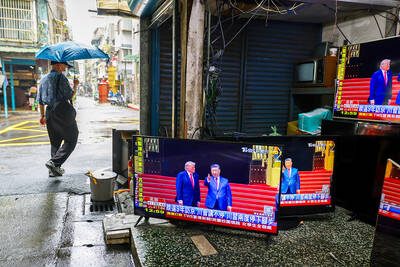
TAIWAN ISSUE: US treasury secretary Scott Bessent said on the first day of meetings that ‘it wouldn’t be a US-China summit without the Taiwan issue coming up’ There were no surprises on the first day of the summit between US President Donald Trump and Chinese President Xi Jinping (習近平), the Mainland Affairs Council (MAC) said yesterday, as the government reiterated that cross-strait stability is crucial to the Asia-Pacific region, as well as the world. As the two presidents met for a highly anticipated summit yesterday, Chinese state media reported that Xi warned Trump that missteps regarding Taiwan could push their two countries into “conflict.” Trump arrived in China with accolades for his host, calling Xi a “great leader” and “friend,” and extending an invitation to visit the White House


 RSS
RSS