


The TAIEX yesterday dropped 1.67 percent, or 144.25 points, to 8,513.3 as the local bourse caught up with declines in advanced markets and reacted to the government’s plan to pull out the National Stabilization Fund next week.
Stock market turnover enlarged to NT$96.54 billion (US$2.98 billion), representing a 43.66 percent pickup from NT$67.2 billion on Friday last week, Taiwan Stock Exchange data showed, as investors returned from the Tomb Sweeping Day holiday.
“The decline came in line with global bourses overnight and merited caution as foreign funds started to flow out,” Yuanta Securities Investment Consulting Co (元大投顧) said in a client note.
Foreign investors trimmed holdings in local shares by NT$6.69 billion net, while mutual funds slashed positions by net NT$510.98 billion, according to stock exchange statistics. Proprietary traders, by contrast, raised stakes by NT$24.33 million.
Minister of Finance Chang Sheng-ford’s (張盛和) comments that the National Stabilization Fund plans to exit on Tuesday helped weigh on the local bourse to sink to a one-month low.
“It is time the fund pulls out and it will do so in the absence of surprise when panelists meet on Tuesday next week,” Chang told the legislature’s Finance Committee yesterday.
The fund has poured more than NT$20 billion to shore up local shares since Aug. 25 last year, the longest streak of intervention since 2000, and helped elevate the TAIEX by 16.83 percent, ministry data showed.
The Executive Yuan has recently appointed new members to oversee the fund of NT$500 billion and the new panel can authorize intervention if it sees fit afterward, Chang said.
On the local bourse, semiconductor firms took the biggest hit with a 2.72 percent fall yesterday.
Shares in Taiwan Semiconductor Manufacturing Co (TSMC, 台積電), the world’s largest contract chipmaker and the top pick of foreign investors, fell 3.15 percent to NT$153.5, stock exchange tallies indicated.
As of Tuesday, TSMC had gained 10.84 percent this year, outperforming the TAIEX’s 3.83 percent bounce and thereby putting it under more pressure for correction once foreign funds change preference, Yuanta Securities said.
Hon Hai Precision Industry Co (鴻海) shares tumbled 2.17 percent to NT$81.2, as concerns build up over likely diluted cash dividend payouts this year following the company’s offer to buy Japan’s cash-strapped Sharp Corp.
Meanwhile, the insider trading scandal over OBI Pharma Inc (台灣浩鼎) pulled shares in the drug developer down by 6.56 percent to NT$406, bucking the 0.6 percent rise in the TPEX, the benchmark index for shares with small and medium capitalization.
Analysts advised a close watch on fund flows that would dominate market directions.

PROVOCATIVE: Chinese Deputy Ambassador to the UN Sun Lei accused Japan of sending military vessels to deliberately provoke tensions in the Taiwan Strait China denounced remarks by Japan and the EU about the South China Sea at a UN Security Council meeting on Monday, and accused Tokyo of provocative behavior in the Taiwan Strait and planning military expansion. Ayano Kunimitsu, a Japanese vice foreign minister, told the Council meeting on maritime security that Tokyo was seriously concerned about the situation in the East China and South China seas, and reiterated Japan’s opposition to any attempt to change the “status quo” by force, and obstruction of freedom of navigation and overflight. Stavros Lambrinidis, head of the EU delegation to the UN, also highlighted South China Sea

SILENCING CRITICS: In addition to blocking Taiwan, China aimed to prevent rights activists from speaking out against authoritarian states, a Cabinet department said The Ministry of Foreign Affairs (MOFA) yesterday condemned transnational repression by Beijing after RightsCon, a major digital human rights conference scheduled to be held in Zambia this week, was abruptly canceled due to Chinese pressure over Taiwanese participation. This year’s RightsCon, the world’s largest conference discussing issues “at the intersection of human rights and technology,” was scheduled to take place from tomorrow to Friday in Lusaka, and expected to draw 2,600 in-person attendees from 150 countries, along with 1,100 online participants. However, organizers were forced to cancel the event due to behind-the-scenes pressure from China, the ministry said, expressing its “strongest condemnation”

Taiwan Semiconductor Manufacturing Co (TSMC, 台積電), the world’s largest contract chipmaker, said it expects its 2-nanometer (2nm) chip capacity to grow at a compound annual rate of 70 percent from this year to 2028. The projection comes as five fabs begin volume production of 2-nanometer chips this year — two in Hsinchu and three in Kaohsiung — TSMC senior vice president and deputy cochief operating officer Cliff Hou (侯永清) said at the company’s annual technology symposium in Silicon Valley, California, last week. Output in the first year of 2-nanometer production, which began in the fourth quarter of last year, is expected to
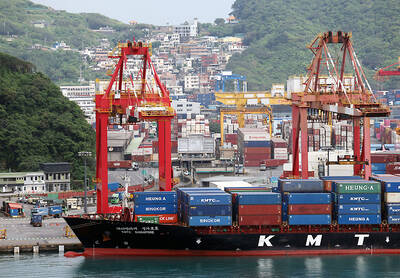
Taiwan’s economy grew far faster than expected in the first quarter, as booming demand for artificial intelligence (AI) applications drove a surge in exports, spilling over into investment and consumption, the Directorate-General of Budget, Accounting and Statistics (DGBAS) said yesterday. GDP growth was 13.69 percent year-on-year during the January-to-March period, beating the DGBAS’ February forecast by 2.23 percentage points and marking the most robust growth in nearly four decades, DGBAS senior official Chiang Hsin-yi (江心怡) told a news conference in Taipei. The result was powered by exports, which remain the backbone of Taiwan’s economy, Chiang said. Outbound shipments jumped 51.12 percent year-on-year to


 RSS
RSS