


Hon Hai Precision Industry Co (鴻海精密) chairman Terry Gou (郭台銘) and Sharp Corp president Kozo Takahashi yesterday formally signed a merger deal in Osaka, Japan, ending a takeover drama that spanned four years of often difficult negotiations.
Flanked by the flags of Taiwan and Japan, the two men shook hands in front of more than 300 reporters gathered at the Osaka-based company’s Sakai plant. Hon Hai, known as Foxconn Technology Group (富士康) outside Taiwan, is to pay ¥388.8 billion (US$3.5 billion) for a 66 percent stake in Sharp.
This marks the first time a Taiwanese company has acquired a large Japanese manufacturer. It is also the first foreign takeover of a major Japanese electronics company.
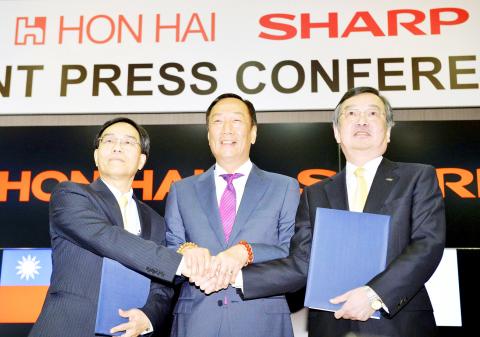
Photo: Reuters / Kyodo
“I have deep respect for Sharp’s 105-year history, its technological innovation and leadership,” Gou said at the briefing.
Gou said his company, best known for making Apple’s iPhones, would be a catalyst for change at Sharp, which is a leading maker of flat-screen televisions and consumer appliances.
The deal’s consummation caps weeks of drama, when the acquisition repeatedly looked like it could fall apart. Gou had appeared on the verge of grasping his prize a month ago, when Sharp’s board chose Hon Hai over a rival bid from the state-backed Innovation Network Corp of Japan.
However, after learning about liabilities at Sharp, Gou pushed back the final agreement to negotiate a lower price. The Taiwanese company paid a ¥100 billion deposit on Thursday.
Sharp on Friday announced that it would cut borrowing costs for the current fiscal year by ¥7.2 billion, after reaching new debt deals with its main banks.
Mizuho Financial Group Inc and Mitsubishi UFJ Financial Group Inc agreed to amend the terms of existing loans, Sharp said in a statement.
The cash infusion could not have come soon enough. Sharp on Wednesday said it expects an operating loss of ¥170 billion for the fiscal year that ended on Thursday, reversing an earlier forecast of a profit. The company is also to report a net loss for the just-ended fiscal year, bringing total losses over the past five years to more than US$10 billion.
“We faced an increasingly difficult business environment as the display market conditions worsened, leading us to consider drastic reforms,” Takahashi said at the briefing. “This agreement will not only contribute to expansion of our business, but it will also improve our financial standing, creating vast synergies for both companies.”
Sharp said its display business would be the biggest beneficiary of the Hon Hai infusion. About ¥200 billion is to be used to launch production of next-generation screens using organic light-emitting diodes.
Another ¥60 billion is to be spent to improve yield and increase production volumes of the existing LCD operations.
Combining Hon Hai’s manufacturing prowess as the world’s largest assembler with Sharp’s electronics know-how could allow the companies to take the lead in the emerging market for Internet of Things devices, Gou said.
He also praised the quality of Sharp’s existing products.
“A friend of mine bought a Sharp fridge in 1986,” Gou said. “Thirty years later, it is still running at his Beijing home.”
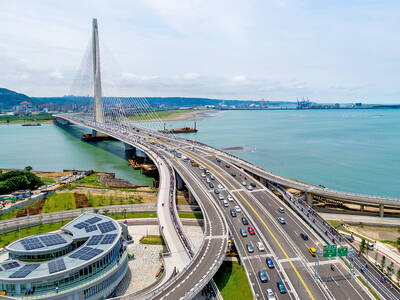
The Ministry of Transportation and Communications yesterday inaugurated the Danjiang Bridge across the Tamsui River in New Taipei City, saying that the structure would be an architectural icon and traffic artery for Taiwan. Feted as a major engineering achievement, the Danjiang Bridge is 920m long, 211m tall at the top of its pylon, and is the longest single-pylon asymmetric cable-stayed bridge in the world, the government’s Web site for the structure said. It was designed by late Iraqi-British architect Zaha Hadid. The structure, with a maximum deck of 70m, accommodates road and light rail traffic, and affords a 200m navigation channel for boats,
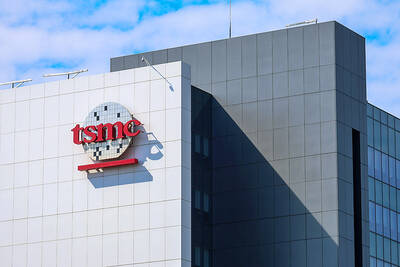
Taiwan Semiconductor Manufacturing Co (TSMC, 台積電), the world’s largest foundry service provider, yesterday said that global semiconductor revenue is projected to hit US$1.5 trillion in 2030, after the figure exceeds US$1 trillion this year, as artificial intelligence (AI) demand boosts consumption of token and compute power. “We are still at the beginning of the AI revolution, but we already see a significant impact across the whole semiconductor ecosystem,” TSMC deputy cochief operating officer Kevin Zhang (張曉強) said at the company’s annual technology symposium in Hsinchu City. “It is fair to say that in the past decade, smartphones and other mobile devices were
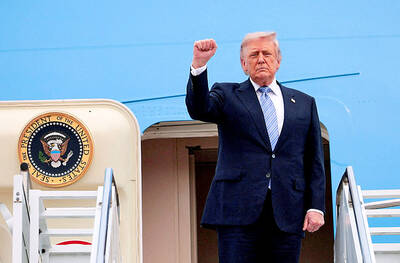
US-CHINA SUMMIT: MOFA welcomed US reassurance of no change in its Taiwan policy; Trump said he did not comment when Xi talked of opposing independence US President Donald Trump yesterday said he has not made a decision on whether to move forward with a major arms package for Taiwan after hearing concerns about it from Chinese President Xi Jinping (習近平). Trump’s comments on Taiwan came as he flew back to Washington after wrapping up critical talks in which both leaders said important progress was made in stabilizing US-China relations even as deep differences persist between the world’s two biggest powers on Iran and Taiwan. “I will make a determination,” Trump said, adding: “I’ll be making decisions. But, you know, I think the last thing we need right
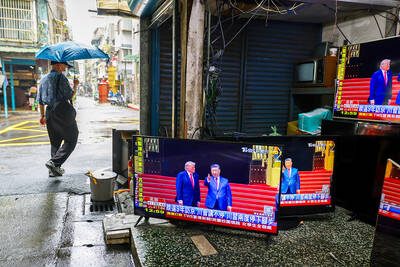
TAIWAN ISSUE: US treasury secretary Scott Bessent said on the first day of meetings that ‘it wouldn’t be a US-China summit without the Taiwan issue coming up’ There were no surprises on the first day of the summit between US President Donald Trump and Chinese President Xi Jinping (習近平), the Mainland Affairs Council (MAC) said yesterday, as the government reiterated that cross-strait stability is crucial to the Asia-Pacific region, as well as the world. As the two presidents met for a highly anticipated summit yesterday, Chinese state media reported that Xi warned Trump that missteps regarding Taiwan could push their two countries into “conflict.” Trump arrived in China with accolades for his host, calling Xi a “great leader” and “friend,” and extending an invitation to visit the White House


 RSS
RSS