


Taipei Mayor Ko Wen-je (柯文哲) yesterday said he had agreed to lend his support to an eight-member alliance consisting of independent, third-force party and Democratic Progressive Party (DPP) candidates to boost their electoral chances in the capital.
According to a report by Chinese-language online news outlet Storm Media Group, the coalition — called the Capital Forward Alliance (首都進步大聯盟) — was formed following an agreement that the DPP would only nominate two legislative candidates — Taipei City Councilor Rosalia Wu (吳思瑤), who is running in Beitou-Shilin (北投-士林), and Legislator Pasuya Yao (姚文智), who is seeking re-election in Shilin-Datong (士林-大同) — while giving six other third-force and independent candidates the priority to run in the other six electoral districts.
The move was meant to follow the model Ko set in last year’s nine-in-one elections, in which Ko, an independent, beat his rival, the Chinese Nationalist Party’s (KMT) Sean Lien (連勝文), and overturned the political landscape in the traditional KMT stronghold, the report said.
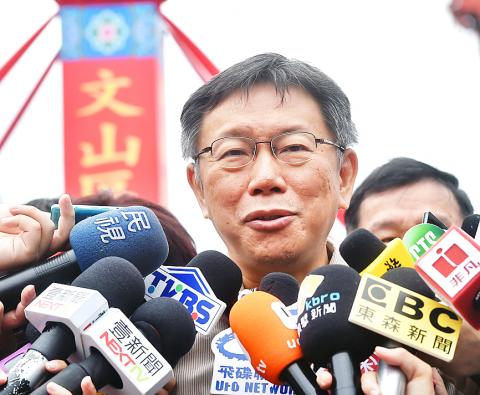
Photo: Fang Pin-chao, Taipei Times
Aside from Wu and Yao, the six other alliance members are New Power Party’s Freddy Lim (林昶佐), Green Party-Social Democratic Party Alliance’s Fan Yun (范雲), People First Party Taipei City Councilor Vivian Huang (黃珊珊) and three independent candidates — Yang Shih-chiu (楊實秋), Billy Pan (潘建志) and Lee Ching-yuan (李慶元).
Although the DPP had courted Ko’s support, the Taipei mayor said the party did not force the decision on him, as he also felt a need to “topple the lofty walls of bipartisan politics” dominated by the pan-green and pan-blue camps.
Ko said he would like to see whether Taipei could break away from conflicts caused by political polarization and the practice of voting for certain parties, and promote support for candidates who are actively engaged in social issues.
“I have been pondering which path Taiwanese politics will take after last year’s elections. Should we go back to bipartisan politics?” he asked.
“Maybe Taiwan will be a more mature place for bipartisan politics in 20 to 30 years, but we have learned from the past 20 years that politics has been beset by ideological conflicts,” Ko said.
Commenting on the list of candidates, Ko said: “This is an interesting roster. There are DPP members, a KMT outcast and self-proclaimed ‘independents.’ It will make the elections more interesting.”
Ko said that the eight candidates present better choices than their peers, but he has not yet decided how he would show his support.
“Allow me a few days to think it over,” he said.
In related news, DPP presidential candidate Tsai Ing-wen (蔡英文) said she had not heard of the alliance.
“There are several constituencies in Taipei where we did not nominate candidates, and our campaign strategy committee will soon decide whether we should support particular candidates in these districts. If we decide to do so, we hope that these candidates would work with us in the future to promote reforms in the capital,” Tsai said. “If Mayor Ko would like to help, we would of course welcome his assistance.”
Meanwhile, Social Democratic Party Secretary-General Yeh Hung-ling (葉虹靈) said her party would wait to see how Ko would campaign for DPP-endorsed candidates before issuing an official response.
Additional reporting by Loa Iok-sin and Abraham Gerber
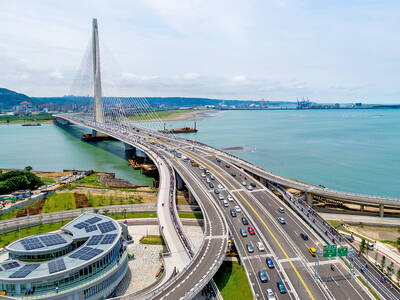
The Ministry of Transportation and Communications yesterday inaugurated the Danjiang Bridge across the Tamsui River in New Taipei City, saying that the structure would be an architectural icon and traffic artery for Taiwan. Feted as a major engineering achievement, the Danjiang Bridge is 920m long, 211m tall at the top of its pylon, and is the longest single-pylon asymmetric cable-stayed bridge in the world, the government’s Web site for the structure said. It was designed by late Iraqi-British architect Zaha Hadid. The structure, with a maximum deck of 70m, accommodates road and light rail traffic, and affords a 200m navigation channel for boats,
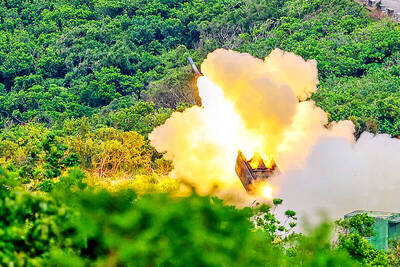
PRECISION STRIKES: The most significant reason to deploy HIMARS to outlying islands is to establish a ‘dead zone’ that the PLA would not dare enter, a source said A High Mobility Artillery Rocket System (HIMARS) would be deployed to Penghu County and Dongyin Island (東引) in Lienchiang County (Matsu) to force the Chinese military to retreat at least 100km from the coastline, a military source said yesterday. Taiwan has been procuring HIMARS and Army Tactical Missile Systems (ATACMS) from the US in batches. Once all batches have been delivered, Taiwan would possess 111 HIMARS units and 504 ATACMS, which have a range of 300km. Considering that “offense is the best defense,” the military plans to forward-deploy the systems to outlying islands such as Penghu and Dongyin so that
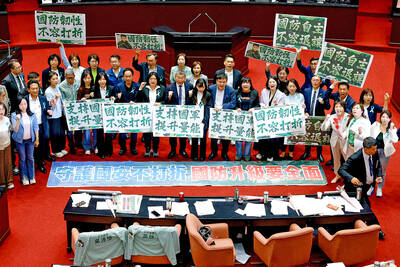
WHAT WAS ALL THAT FOR? Jaw Shaw-kong said that Cheng Li-wen had pushed for more drastic cuts and attacked him, just for the outcome to be nearly identical to his bill The legislature yesterday passed a supplementary budget bill to fund the purchase of separate packages of US military equipment, with the combined amount of spending capped at NT$780 billion (US$24.8 billion). The Chinese Nationalist Party (KMT) and Taiwan People’s Party (TPP) used their legislative majority to pass the bill, which runs until 2033 and has two main funding provisions. One was for NT$300 billion of arms sales already approved by the US for Taiwan on Dec. 17 last year, the other was for NT$480 billion for another arms package expected to be announced by Washington. The bill, which fell short of the NT$1.25
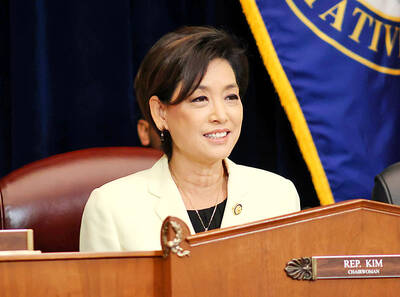
‘CLEAR MESSAGE’: The bill would set up an interagency ‘tiger team’ to review sanctions tools and other economic options to help deter any Chinese aggression toward Taiwan US Representative Young Kim has introduced a bill to deter Chinese aggression against Taiwan, calling for an interagency “tiger team” to preplan coordinated sanctions and economic measures in response to possible Chinese military or political action against Taiwan. “[Chinese President] Xi Jinping [習近平] has directed the People’s Liberation Army to be ready to invade Taiwan by 2027. China has a plan. America should have one too,” Kim said in a news release on Thursday last week. She introduced the “Deter PRC [People’s Republic of China] aggression against Taiwan act” to “ensure the US has a coordinated sanctions strategy ready should


 RSS
RSS