


An unusually high number of protests targeting statues of former president Chiang Kai-shek (蔣介石) have been reported across the nation in the wake of the 68th anniversary of the 228 Incident on Saturday.
A statue of Chiang erected in Taichung City’s Jhongjheng Park (中正公園) was found yesterday morning covered with white and red paint as well as ghost money, with the Chinese characters for “killer” and “villain” spray-painted on its pedestal.
Police said it was the second defacement of the stone statue in two days. On Saturday morning, it was discovered with the Chinese character for “murderer” spray-painted on its base. City workers removed the graffiti later that day.
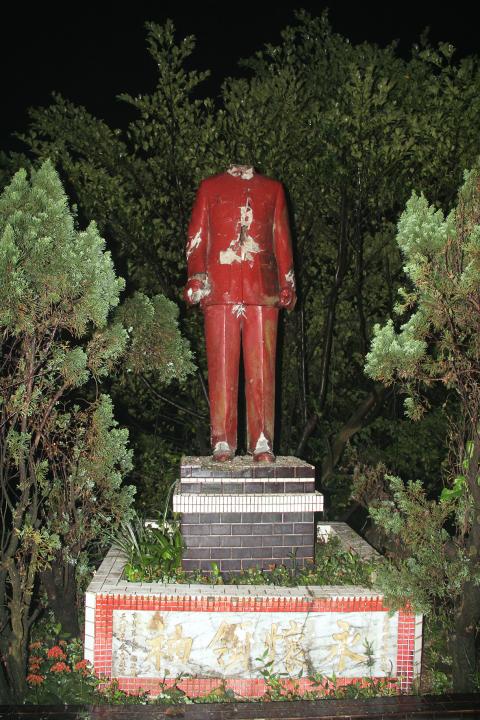
Photo: Wu Cheng-feng, Taipei Times
Taichung’s Construction Bureau director Huang Yu-lin (黃玉霖) said the agency has teamed up with the city’s Education Bureau in investigating if other statues of Chiang have been vandalized.
The city government said that just four of the city’s approximately 400 parks have statues of Chiang and that it would consider whether to keep or relocate them once the investigation has been concluded.
It said no charges would be filed against whoever is responsible, as the spray-painted slogans are considered to be equivalent to stains, but that police presence in the areas involved would be increased.
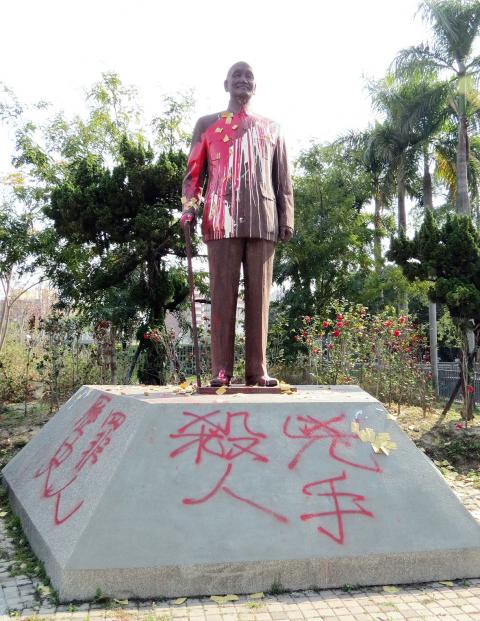
Photo: Chang Ching-ya, Taipei Times
Meanwhile, in northern Taiwan, a beheaded statue of Chiang depicted in two photographs posted on a Facebook page titled “Indefinite Support to Art Installations Featuring Chiang” (無限期支持—全台裝置藝術蔣) on Saturday has been confirmed to be located in a park in Keelung.
Investigators said the fiberglass-based statue’s head was smashed to pieces, and the statue’s torso and ankles were damaged. They added that the perpetrators apparently attempted to knock the sculpture down before realizing that its legs are made of steel and concrete.
Statues of Chiang erected within Taoyuan’s Jhongjheng Park and in front of the Taoyuan Railway Station were also vandalized.
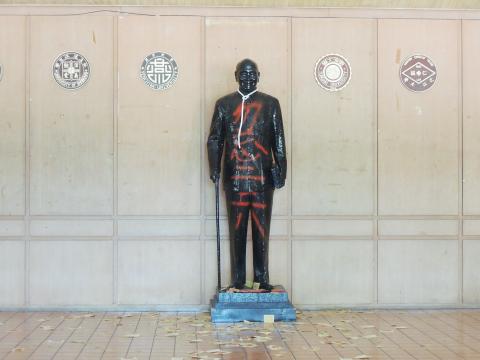
Photo: Tsai Shu-yuan, Taipei Times
In addition, sculptures of Chiang on campuses nationwide have been defaced over the past few days, including ones at Taipei First Girls’ High School, Taipei Municipal Daan Vocational High School, National Chutung Senior High School, Tunghai University and National Taipei University of Technology.
Tunghai University chief secretary Lu Ping-kuan (呂炳寬) said the school’s statue of Chiang and the Chiang Kai-shek Memorial Hall have existed for nearly three decades and carry historical significance to the university.
“While the school respects students’ opinions and is open to discussions regarding the hall’s renaming and the statue’s removal, they must be expressed in a rational manner,” Lu said, adding that vandalism would be dealt with in accordance with school regulations.
Taiwan is gearing up to celebrate the New Year at events across the country, headlined by the annual countdown and Taipei 101 fireworks display at midnight. Many of the events are to be livesteamed online. See below for lineups and links: Taipei Taipei’s New Year’s Party 2026 is to begin at 7pm and run until 1am, with the theme “Sailing to the Future.” South Korean girl group KARA is headlining the concert at Taipei City Hall Plaza, with additional performances by Amber An (安心亞), Nick Chou (周湯豪), hip-hop trio Nine One One (玖壹壹), Bii (畢書盡), girl group Genblue (幻藍小熊) and more. The festivities are to

Auckland rang in 2026 with a downtown fireworks display launched from New Zealand’s tallest structure, Sky Tower, making it the first major city to greet the new year at a celebration dampened by rain, while crowds in Taipei braved the elements to watch Taipei 101’s display. South Pacific countries are the first to bid farewell to 2025. Clocks struck midnight in Auckland, with a population of 1.7 million, 18 hours before the famous ball was to drop in New York’s Times Square. The five-minute display involved 3,500 fireworks launched from the 240m Sky Tower. Smaller community events were canceled across New Zealand’s
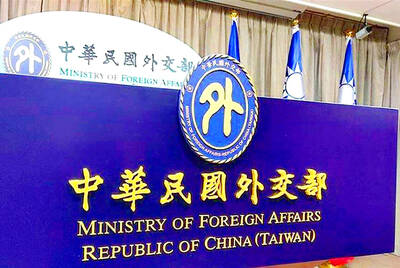
The Ministry of Foreign Affairs (MOFA) yesterday said it is closely monitoring developments in Venezuela, and would continue to cooperate with democratic allies and work together for regional and global security, stability, and prosperity. The remarks came after the US on Saturday launched a series of airstrikes in Venezuela and kidnapped Venezuelan President Nicolas Maduro, who was later flown to New York along with his wife. The pair face US charges related to drug trafficking and alleged cooperation with gangs designated as terrorist organizations. Maduro has denied the allegations. The ministry said that it is closely monitoring the political and economic situation
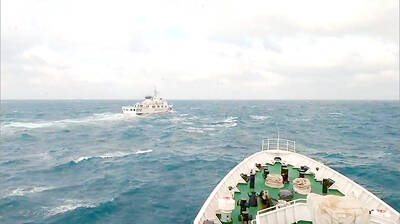
‘SLICING METHOD’: In the event of a blockade, the China Coast Guard would intercept Taiwanese ships while its navy would seek to deter foreign intervention China’s military drills around Taiwan this week signaled potential strategies to cut the nation off from energy supplies and foreign military assistance, a US think tank report said. The Chinese People’s Liberation Army (PLA) conducted what it called “Justice Mission 2025” exercises from Monday to Tuesday in five maritime zones and airspace around Taiwan, calling them a warning to “Taiwanese independence” forces. In a report released on Wednesday, the Institute for the Study of War said the exercises effectively simulated blocking shipping routes to major port cities, including Kaohsiung, Keelung and Hualien. Taiwan would be highly vulnerable under such a blockade, because it


 RSS
RSS