


A senior Hong Kong lawmaker was expelled from a prestigious Chinese government body yesterday, in a sign that Beijing will not tolerate dissent from loyalists over pro-democracy protests in the semi-autonomous territory.
James Tien (田北俊) had his “qualifications revoked” as a member of the Chinese People’s Political Consultative Conference (CPPCC), state-run China News Service said.
The prominent businessman and politician had criticized Hong Kong Chief Executive Leung Chun-ying (梁振英) for failing to put an end to more than a month of pro-democracy protests — an unusual move for a pro-Beijing lawmaker.
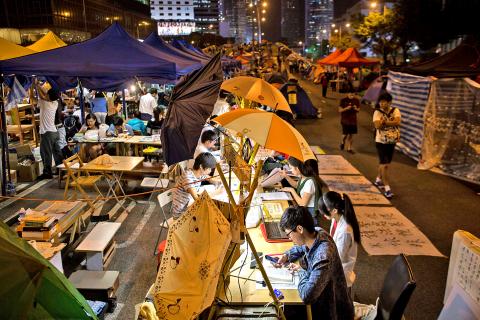
Photo: EPA
The CPPCC voted to pass the “decision on revoking Tian Beijun’s membership in the 12th Chinese People’s Political Consultative Conference,” the government body said, using Tien’s name in Mandarin and without providing further details.
In a brief statement after the decision, Tien said he accepted the CPPCC ruling and that he would resign as leader of the Liberal Party.
“I just remembered I am a lawmaker in Hong Kong, neglecting my role as a CPPCC member. Maybe that was inappropriate,” Tien said of his comments about Leung.
Hong Kong demonstrators have staged street rallies for more than a month, calling for free leadership elections for the former British colony in 2017.
The demonstrations present the most concerted challenge to Beijing’s authority since the bloody 1989 Tiananmen Square protests.
James Tien’s younger brother, Michael (田北辰), another Hong Kong lawmaker, said ahead of the announcement that his brother was being punished for perceived disloyalty to Leung.
“The decision is definitely based on my brother’s comments about C.Y. [Leung],” Michael Tien said.
James Tien is a senior member of the territory’s pro-business Liberal Party. He said last week that Leung should consider resigning for failing to clear the protesters from the streets.
“Residents are ignoring court injunctions and pan-democrats are being uncooperative. How is he going to govern?” James Tien asked on Friday last week, according to the South China Morning Post.
Despite hailing from Hong Kong’s pro-Beijing camp, the 67-year-old politician is no stranger to ruffling political feathers. In 2003, he withdrew his party’s support for a government-backed national security bill amid large street protests, leading to the legislation’s collapse and the eventual resignation of then-Hong Kong chief executive Tung Chee-hwa (董建華).
He backed Leung’s opponent Henry Tang (唐英年) in the 2012 race to be the territory’s chief executive.
Leung’s popularity has taken a nosedive since the protests began last month. A poll this week by the Chinese University of Hong Kong showed he now has a 38.6 percent voter approval rating — his lowest since taking office.
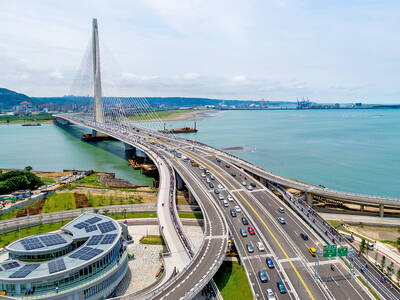
The Ministry of Transportation and Communications yesterday inaugurated the Danjiang Bridge across the Tamsui River in New Taipei City, saying that the structure would be an architectural icon and traffic artery for Taiwan. Feted as a major engineering achievement, the Danjiang Bridge is 920m long, 211m tall at the top of its pylon, and is the longest single-pylon asymmetric cable-stayed bridge in the world, the government’s Web site for the structure said. It was designed by late Iraqi-British architect Zaha Hadid. The structure, with a maximum deck of 70m, accommodates road and light rail traffic, and affords a 200m navigation channel for boats,
Taiwan Semiconductor Manufacturing Co (TSMC, 台積電), the world’s largest foundry service provider, yesterday said that global semiconductor revenue is projected to hit US$1.5 trillion in 2030, after the figure exceeds US$1 trillion this year, as artificial intelligence (AI) demand boosts consumption of token and compute power. “We are still at the beginning of the AI revolution, but we already see a significant impact across the whole semiconductor ecosystem,” TSMC deputy cochief operating officer Kevin Zhang (張曉強) said at the company’s annual technology symposium in Hsinchu City. “It is fair to say that in the past decade, smartphones and other mobile devices were
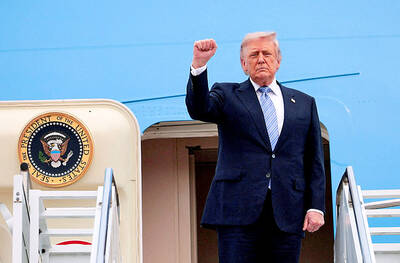
US-CHINA SUMMIT: MOFA welcomed US reassurance of no change in its Taiwan policy; Trump said he did not comment when Xi talked of opposing independence US President Donald Trump yesterday said he has not made a decision on whether to move forward with a major arms package for Taiwan after hearing concerns about it from Chinese President Xi Jinping (習近平). Trump’s comments on Taiwan came as he flew back to Washington after wrapping up critical talks in which both leaders said important progress was made in stabilizing US-China relations even as deep differences persist between the world’s two biggest powers on Iran and Taiwan. “I will make a determination,” Trump said, adding: “I’ll be making decisions. But, you know, I think the last thing we need right
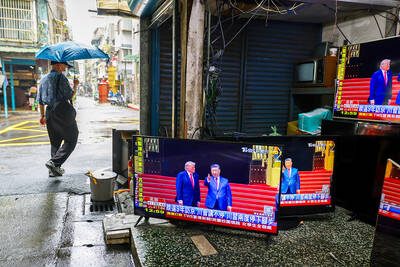
TAIWAN ISSUE: US treasury secretary Scott Bessent said on the first day of meetings that ‘it wouldn’t be a US-China summit without the Taiwan issue coming up’ There were no surprises on the first day of the summit between US President Donald Trump and Chinese President Xi Jinping (習近平), the Mainland Affairs Council (MAC) said yesterday, as the government reiterated that cross-strait stability is crucial to the Asia-Pacific region, as well as the world. As the two presidents met for a highly anticipated summit yesterday, Chinese state media reported that Xi warned Trump that missteps regarding Taiwan could push their two countries into “conflict.” Trump arrived in China with accolades for his host, calling Xi a “great leader” and “friend,” and extending an invitation to visit the White House


 RSS
RSS