


Hong Kong democracy activists yesterday marked one month of mass protests by unfurling a sea of umbrellas as student leaders called for direct talks with Beijing officials, the first time such a request has been made.
At an evening rally at the main protest camp, thousands raised umbrellas to mark the moment a month ago when police fired tear gas at largely peaceful crowds — beginning the most concerted challenge to Beijing since the bloody 1989 Tiananmen Square protests.
As protesters streamed into the site, Alex Chow (周永康) — president of leading protest group the Hong Kong Federation of Students — said he would seek a meeting with Chinese Premier Li Keqiang (李克強) if the Hong Kong government failed to relay protesters’ demands to mainland authorities.
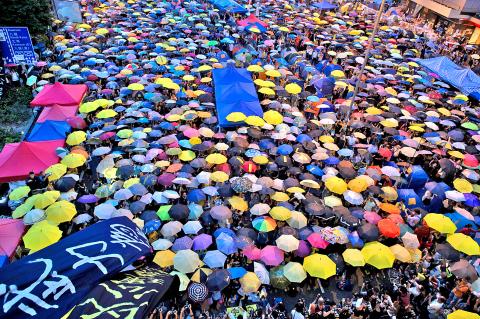
Photo: AFP
Parts of the semi-autonomous Chinese territory, an Asian financial hub, have been paralyzed by a month of mass rallies and roadblocks.
Protesters want China to rescind its decision in August that all candidates in elections for the territory’s leader in 2017 must be vetted by a loyalist committee — an arrangement demonstrators derided as “fake democracy.”
Talks between the government and student leaders last week made little headway. The government offered to write a report to Beijing on events since protests began and to set up a committee with demonstrators to discuss further constitutional reform, but Chow yesterday said any report must include a direct request from the territory authorities calling on mainland authorities to withdraw their August decision.
“If the Hong Kong government has difficulty meeting our demands, we sincerely hope that arrangements could be made for us to directly meet with Premier Li Keqiang as soon as possible,” Chow said.
It is the first time students have broadcast the idea of going straight to Beijing to negotiate.
Their request echoes the Tiananmen protests, when student leaders eventually met then-Chinese premier Li Peng (李鵬) for what turned out to be fruitless talks.
On June 3 and June 4 the movement was brutally crushed.
The protests have been dubbed the “umbrella revolution” following the creative ways demonstrators used them to shelter from the heat, torrential rain, pepper spray and police batons.
Yesterday’s rally opposite the territory’s government headquarters in Admiralty District started with an 87-second silence at 5:57pm. At that time on Sept. 28, riot police shot the first of 87 canisters of tear gas at crowds who had taken over a highway near government buildings.
That decision backfired, drawing tens of thousands of sympathizers onto the streets.
Protest leaders are also aware that the disruption caused by their roadblocks has sparked mounting public frustration.
Occupy’s co-founder and university professor Benny Tai (戴耀廷) said he planned to spend more time away from the protest sites and return to teaching, but insisted it was not a retreat.
However, many of those at the rally said they could not leave the streets until genuine democratic progress was made.
“We can’t retreat because we haven’t got anything yet,” 52-year-old computer programmer Any Ho said. “Democracy cannot be taken for granted. We have to be persistent for it to come.”

The nation’s fastest supercomputer, Nano 4 (晶創26), is scheduled to be launched in the third quarter, and would be used to train large language models in finance and national defense sectors, the National Center for High-Performance Computing (NCHC) said. The supercomputer, which would operate at about 86.05 petaflops, is being tested at a new cloud computing center in the Southern Taiwan Science Park in Tainan. The exterior of the server cabinet features chip circuitry patterns overlaid with a map of Taiwan, highlighting the nation’s central position in the semiconductor industry. The center also houses Taiwania 2, Taiwania 3, Forerunner 1 and
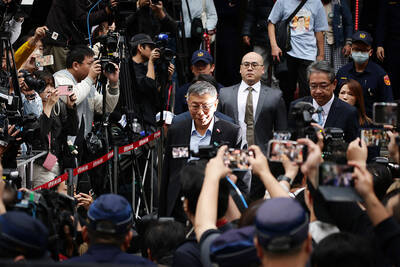
FIRST TRIAL: Ko’s lawyers sought reduced bail and other concessions, as did other defendants, but the bail judge denied their requests, citing the severity of the sentences Former Taipei mayor Ko Wen-je (柯文哲) was yesterday sentenced to 17 years in prison and had his civil rights suspended for six years over corruption, embezzlement and other charges. Taipei prosecutors in December last year asked the Taipei District Court for a combined 28-year, six-month sentence for the four cases against Ko, who founded the Taiwan People’s Party (TPP). The cases were linked to the Core Pacific City (京華城購物中心) redevelopment project and the mismanagement of political donations. Other defendants convicted on separate charges included Chinese Nationalist Party (KMT) Taipei City Councilor Angela Ying (應曉薇), who was handed a 15-year, six-month sentence; Core Pacific

J-6 REMODEL: The converted drones are part of Beijing’s expanding mix of airpower weapons, including bombers with stand-off missiles and UAV swarms, the report said China has stationed obsolete supersonic fighters converted to attack drones at six air bases close to the Taiwan Strait, a report published this month by the Arlington, Virginia-based Mitchell Institute for Aerospace Studies said. Satellite imagery of the airfields from the institute’s “China Airpower Tracker” shows what appear to be lines of stubby, swept-winged aircraft matching the shape of J-6 fighters that first flew with the Chinese People’s Liberation Army (PLA) Air Force in the 1960s. Since their conversion to drones, the aircraft have been identified at five bases in China’s Fujian Province and one in Guangdong Province, the report said. J.

China used fake LinkedIn profiles to harvest sensitive data from NATO and EU institutions by soliciting information from staff, a European security source said on Friday. The operation, allegedly orchestrated by the Chinese Ministry of State Security, targeted dozens of employees at the military alliance or EU organizations through fictitious accounts, the source said, confirming reports in French and Belgian media. Posing as recruiters on the online professional networking platform, Chinese spies would initially request paid reports before later soliciting non-public or even classified information. One particularly active fake profile used the name “Kevin Zhang,” claiming to be the head


 RSS
RSS