


A Chinese court yesterday sentenced one of the country’s most prominent rights advocates to four years in prison after he campaigned for the rights of children from rural areas to be educated in cities and for officials to disclose their assets.
Xu Zhiyong’s (許志永) jailing is a stark warning to activists that the Chinese Communist Party will crush any challenge to its rule, especially from those who seek to organize campaigns. It also diminishes hopes for meaningful political change, even as Beijing pledges to embark on economic reforms.
Separately, one of China’s most prominent dissidents, Hu Jia (胡佳), who frequently accuses authorities of infringing civil liberties, said police had summoned him on a charge of “suspicion of causing a disturbance.”
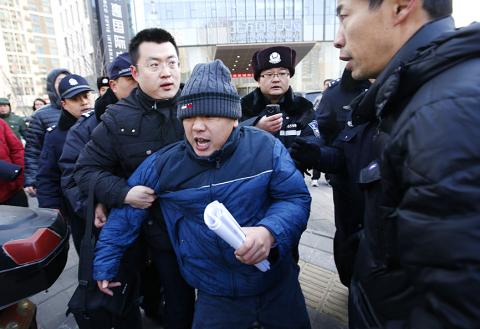
Photo: Reuters
The Beijing No. 1 Intermediate People’s Court found Xu guilty of “gathering a crowd to disturb public order,” the court said on its official microblog.
The rights activist was tried on Wednesday last week.
Xu’s lawyer, Zhang Qingfang (張慶方), said he would meet his client within the next two days to determine whether to lodge an appeal.
“He said [in court] that the last remaining dignity of the Chinese legal system has been destroyed,” Zhang told reporters. “It’s not that we can’t bear this result, but that, fundamentally, the guilty conviction is illegal, is unreasonable and unfair.”
There were chaotic scenes outside the court as police harassed foreign reporters, while Zhang was briefly taken away by police after the hearing. He said police were still tailing him after he was released.
The government has waged a 10-month drive against Xu’s “New Citizens’ Movement,” which advocates working within the system to press for change. Hundreds of citizens have participated in activities related to the movement, rights activists say.
“This is a shameful, but sadly predictable, verdict. The Chinese authorities have once again opted for the rule of fear over the rule of law,” Amnesty International East Asia Research director Roseann Rife said in a statement. “The persecution of those associated with the New Citizens Movement demonstrates how fearful the Chinese leadership are of public calls for change.”
Hu said he was prepared to face detention.
“It’s because I’ve participated in many street protests,” Hu told reporters by telephone as police waited outside his door to take him away. “I’ve asked for officials to publicly disclose their assets and have expressed solidarity with those who’ve been arrested. I’ve appealed to many people to watch and promote these street protests.”
Hu was jailed in 2008 for 3.5 years on subversion charges for criticizing human rights restrictions. Some supporters saw him as a potential recipient of the Nobel Peace Prize before it went to another jailed Chinese dissident, Liu Xiaobo (劉曉波), in 2010.
China has detained at least 20 activists involved in pressing for asset disclosure by officials, although not all are from the New Citizens’ Movement. Three activists went on trial last month and face more than 10 years in prison if convicted, two stood trial on Thursday last week and four others will be tried today.
“Instead of ‘putting power’ within a ‘cage of regulations,’ as [Chinese President] Xi Jinping (習近平) has promised, the new leadership appears to be more interested in consolidating power,” Human Rights Watch Asia director Brad Adams said. “Staging show trials of critics is wholly at odds with Xi’s self-proclaimed reformist agenda.”
Xu’s verdict is also a rebuff to Western governments who have expressed concern about his case.
“We are concerned that today’s conviction is retribution for Xu’s public campaign to expose official corruption and for the peaceful expression of his views,” said Daniel Delk, second secretary of the political section at the US embassy.
Xu pushed for officials to disclose their assets and campaigned for the rights of children from rural areas to be educated in cities.
During his trial, the court rejected the 68 witnesses the defense had applied to testify. It also barred diplomats from attending.
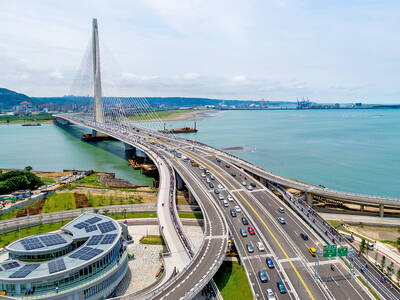
The Ministry of Transportation and Communications yesterday inaugurated the Danjiang Bridge across the Tamsui River in New Taipei City, saying that the structure would be an architectural icon and traffic artery for Taiwan. Feted as a major engineering achievement, the Danjiang Bridge is 920m long, 211m tall at the top of its pylon, and is the longest single-pylon asymmetric cable-stayed bridge in the world, the government’s Web site for the structure said. It was designed by late Iraqi-British architect Zaha Hadid. The structure, with a maximum deck of 70m, accommodates road and light rail traffic, and affords a 200m navigation channel for boats,
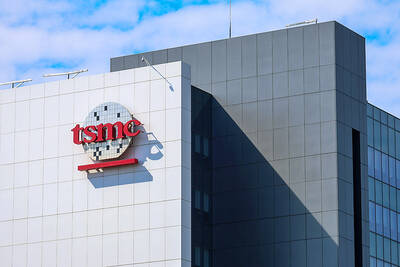
Taiwan Semiconductor Manufacturing Co (TSMC, 台積電), the world’s largest foundry service provider, yesterday said that global semiconductor revenue is projected to hit US$1.5 trillion in 2030, after the figure exceeds US$1 trillion this year, as artificial intelligence (AI) demand boosts consumption of token and compute power. “We are still at the beginning of the AI revolution, but we already see a significant impact across the whole semiconductor ecosystem,” TSMC deputy cochief operating officer Kevin Zhang (張曉強) said at the company’s annual technology symposium in Hsinchu City. “It is fair to say that in the past decade, smartphones and other mobile devices were
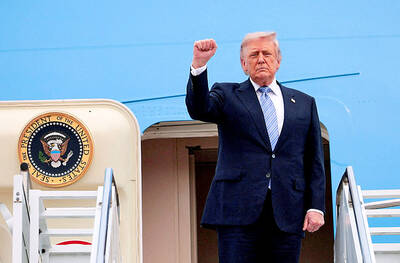
US-CHINA SUMMIT: MOFA welcomed US reassurance of no change in its Taiwan policy; Trump said he did not comment when Xi talked of opposing independence US President Donald Trump yesterday said he has not made a decision on whether to move forward with a major arms package for Taiwan after hearing concerns about it from Chinese President Xi Jinping (習近平). Trump’s comments on Taiwan came as he flew back to Washington after wrapping up critical talks in which both leaders said important progress was made in stabilizing US-China relations even as deep differences persist between the world’s two biggest powers on Iran and Taiwan. “I will make a determination,” Trump said, adding: “I’ll be making decisions. But, you know, I think the last thing we need right
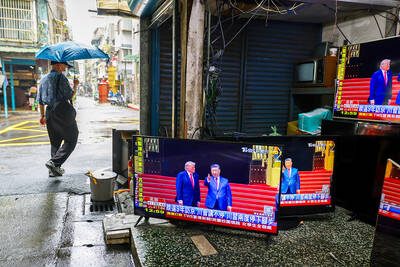
TAIWAN ISSUE: US treasury secretary Scott Bessent said on the first day of meetings that ‘it wouldn’t be a US-China summit without the Taiwan issue coming up’ There were no surprises on the first day of the summit between US President Donald Trump and Chinese President Xi Jinping (習近平), the Mainland Affairs Council (MAC) said yesterday, as the government reiterated that cross-strait stability is crucial to the Asia-Pacific region, as well as the world. As the two presidents met for a highly anticipated summit yesterday, Chinese state media reported that Xi warned Trump that missteps regarding Taiwan could push their two countries into “conflict.” Trump arrived in China with accolades for his host, calling Xi a “great leader” and “friend,” and extending an invitation to visit the White House


 RSS
RSS