


CPC Corp, Taiwan (CPC, 台灣中油) has deceived the public with its claim that the nation enjoys the lowest fuel prices among its neighbors, because there are several “untold secrets” in its pricing calculations, a think tank said yesterday.
A Taiwan Thinktank study conducted by several academics says that fuel prices had been underestimated because the state-run oil refiner has left out the fuel tax in its pricing calculation and its floating pricing mechanism is not adjusted based on global oil prices.
In contrast to other countries, fuel prices in Taiwan do not include the fuel tax, which is collected separately and is calculated on a per vehicle rather than a fuel consumption basis, making prices seem lower, National Taipei University professor Wang To-far (王塗發) told a press conference.
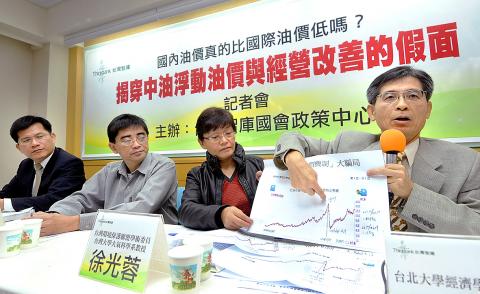
Photo: Fang Pin-chao, Taipei Times
CPC’s operations have drawn public attention since President Ma Ying-jeou (馬英九) announced increases in fuel and electricity prices in April to make up for the huge losses at the state-run oil company and electricity provider Taiwan Power Co (Taipower, 台電).
CPC published a 300-page report in June stating that its huge losses in the past were a direct result of its price subsidy under the government’s policy of freezing fuel costs.
Wang dismissed this claim, saying that freezing prices did not contribute to CPC’s losses, which reached a historic high of NT$138.7 billion (US$4.76 billion) in 2008.
Taking into account global oil prices in 2008 reaching their highest point ever at more than US$140 per barrel in July and then dropping to about US$30 per barrel by the end of the year, along with the first fuel price increase under Ma announced in May, it was not possible for CPC to suffer the NT$138.7 billion loss, Wang said.
“Quite the opposite, CPC has made huge profits from the weekly floating pricing mechanism because the price was not adjusted in accordance with the global market. It is CPC’s poor operational efficiency that is likely the biggest cause of its losses,” Wang said.
Additionally, CPC, which exports between 20 percent and 30 percent of its products overseas at low prices, has used its profits from the domestic market to make up for its export losses, he said, adding that if the refiner did not keep export prices artificially low, it could not compete in the global market.
According to data compiled by National Taiwan University professor Hsu Kuang-jung (徐光蓉), the prices of CPC’s exports were between 10 percent and 60 percent lower than their domestic counterparts.
CPC was not the only one to blame for making people suffer from the fuel price increase and the ensuing general commodity price hike, National Central University professor Chiu Chun-jung (邱俊榮) said.
Ma had chosen to announce the fuel price hike at the worst possible time: in May 2008 and April of this year, Chiu said.
Both times coincided with global economic downturns and the price hikes had demonstrably worsened the nation’s stagflation, Chiu said.
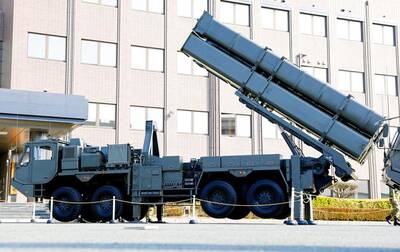
Japan has deployed long-range missiles in a southwestern region near China, the Japanese defense minister said yesterday, at a time when ties with Beijing are at their lowest in recent years. The missiles were installed in Kumamoto in the southern region of Kyushu, as Japan is attempting to shore up its military capacity as China steps up naval activity in the East China Sea. “Standoff defense capabilities enable us to counter the threat of enemy forces attempting to invade our country ... while ensuring the safety of our personnel,” Japanese Minister of Defense Shinjiro Koizumi said. “This is an extremely important initiative for
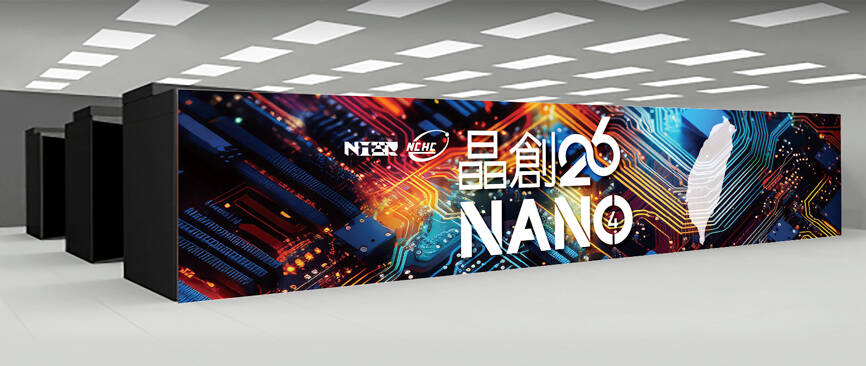
The nation’s fastest supercomputer, Nano 4 (晶創26), is scheduled to be launched in the third quarter, and would be used to train large language models in finance and national defense sectors, the National Center for High-Performance Computing (NCHC) said. The supercomputer, which would operate at about 86.05 petaflops, is being tested at a new cloud computing center in the Southern Taiwan Science Park in Tainan. The exterior of the server cabinet features chip circuitry patterns overlaid with a map of Taiwan, highlighting the nation’s central position in the semiconductor industry. The center also houses Taiwania 2, Taiwania 3, Forerunner 1 and
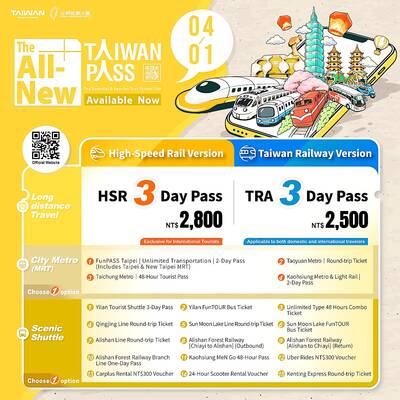
MORE POPULAR: Taiwan Pass sales increased by 59 percent during the first quarter compared with the same period last year, the Tourism Administration said The Tourism Administration yesterday said that it has streamlined the Taiwan Pass, with two versions available for purchase beginning today. The tourism agency has made the pass available to international tourists since 2024, allowing them to access the high-speed rail, Taiwan Railway Corp services, four MRT systems and four Taiwan Tourist Shuttles. Previously, five types of Taiwan Pass were available, but some tourists have said that the offerings were too complicated. The agency said only two types of Taiwan Pass would be available, starting from a three-day pass with the high-speed rail and a three-day pass with Taiwan Railway Corp. The former costs NT$2,800
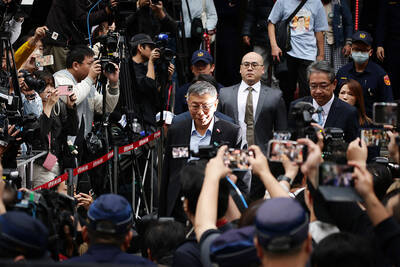
FIRST TRIAL: Ko’s lawyers sought reduced bail and other concessions, as did other defendants, but the bail judge denied their requests, citing the severity of the sentences Former Taipei mayor Ko Wen-je (柯文哲) was yesterday sentenced to 17 years in prison and had his civil rights suspended for six years over corruption, embezzlement and other charges. Taipei prosecutors in December last year asked the Taipei District Court for a combined 28-year, six-month sentence for the four cases against Ko, who founded the Taiwan People’s Party (TPP). The cases were linked to the Core Pacific City (京華城購物中心) redevelopment project and the mismanagement of political donations. Other defendants convicted on separate charges included Chinese Nationalist Party (KMT) Taipei City Councilor Angela Ying (應曉薇), who was handed a 15-year, six-month sentence; Core Pacific


 RSS
RSS