


Friends and family of former president Chen Shui-bian (陳水扁) were furious after learning that Chen had to wear handcuffs and ankle cuffs while undergoing medical checkups yesterday, saying that while this might be standard procedure, such measures were unnecessary and humiliating.
Jack Chen (陳嘉爵), who recently took over as director of the former president’s office, said Chen Shui-bian was kept bound while undergoing blood tests and receiving treatment for headaches and chest pains.
The government-run Taoyuan General Hospital said the tests included CT scans, echocardiography, magnetic resonance imaging (MRI) scans and checkups on liver, kidney and lung function.
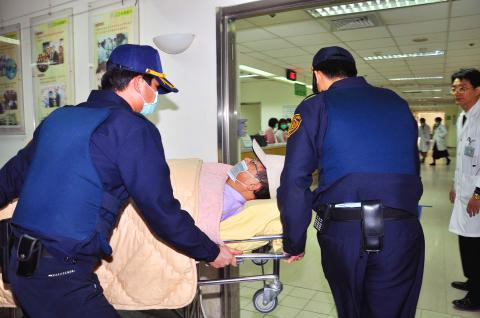
Photo: CNA
The cuffs were only taken off when they interfered with the echocardiogram, CT scan and MRI, the former president’s office said.
“It was a huge and unnecessary insult to the former president,” Jack Chen said. “Chen Shui-bian doesn’t have any special powers; he can’t even walk without wheezing ... much less plan an escape.”
Supporters were also unhappy that hospital officials arranged for a prison van carrying Chen Shui-bian to arrive at the hospital through a back entrance allegedly used for garbage disposal.
Chen Shui-bian, who is serving a 17-and-a-half-year sentence for corruption, was tested for acute coronary syndrome and congestive heart failure.
Former vice president Annette Lu (呂秀蓮) said she was “infuriated” upon learning of the treatment.
Officials denied Chen Shui-bian basic “human decency and human rights,” she said.
“Even when I was in prison after the Kaohsiung Incident [of 1979], I didn’t have such issues when I had to undergo hospital treatment,” she said.
“It almost feels like our country’s respect for human rights has regressed,” Lu said.
Family members in Greater Kaohsiung also expressed concern that Chen Shui-bian was not receiving proper medical attention.
“This is humiliating for my father and is extremely improper,” son Chen Chih-chung (陳致中) said. “He’s a former head of state. He should not be treated like this.”
Former first lady Wu Shu-jen (吳淑珍) was worried her husband’s condition was continuing to deteriorate, especially given the belatedness of the hospital visit, Jack Chen said.
Chen Shui-bian complained of headaches, shortness of breath and chest pains last month, but prison officials did not approve the visit until earlier this week.
Although allegations that the former president wore handcuffs and ankle cuffs could not be verified, as he was covered by a blanket while being wheeled into the hospital, hospital officials confirmed he was cuffed to his wheelchair for much of the visit.
Officials at Taipei Prison, where the former president began serving his sentence on Dec. 2, said that standard operating procedures for the transfer of inmates requiring medical treatment stipulates that they be cuffed, adding that those procedures were closely followed during the former president’s trip to the hospital.
About 200 police officers escorted the former president’s van and applied traffic control measures as he was taken to hospital.
Allegations that Chen Shui-bian received less than presidential treatment came two months after Chinese Nationalist Party (KMT) legislators moved to strip the former president of his monthly pension, subsidies and bodyguards.
In response to accusations that it was humiliating for the former president to enter the hospital through a side door reserved for garbage, Hsu Jin-chyr (徐錦池), vice president of the hospital, said that in accordance with regulations, patients with infectious diseases and prisoners entered and left the hospital through an “isolation channel.”
He denied the area was used for garbage.
The side door was also used to ensure the former president’s safety and to minimize crowding from the large number of people and media.
Even though the entryway is also used to cart trash out of the hospital, Hsu said the corridor was not a “trash entrance.”
Chen Shui-bian left hospital at 2:20pm through the hospital’s main entrance.
Wearing a baseball cap and a surgical mask, the former president did not respond to questions by reporters. He was immediately taken back to prison.
Citing the need for patient privacy and a request by the former president that his medical condition remain private, the hospital said it could not publicize the results of his exam.
However, Chen Shui-bian was in stable condition, with no abnormal blood pressure levels, hospital officials said.
ADDITIONAL REPORTING BY RICH CHANG

A signaling system malfunction disrupted high-speed rail (HSR) services beginning at 8am today, with trains temporarily reduced to three northbound and three southbound trains per hour as authorities conduct inspections. The malfunction occurred on a section of track in Miaoli County during pre-operation checks early this morning, forcing northbound and southbound trains to use a single track, the HSR operator said. The regular schedule has been replaced with three hourly trains offering only nonreserved seating in each direction, stopping at every station, it said, adding that business class cars would still have reserved seating. Departures from terminal stations are scheduled at the top
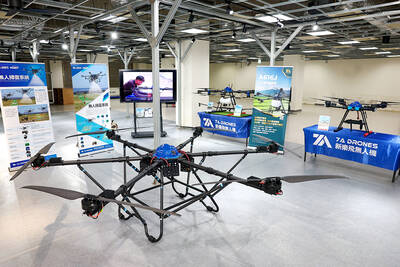
DRONE CENTRAL: Taiwan aims to become Asia’s democratic hub for drones, with most exports focused on high-quality military-grade models, an official said Taiwan’s drone industry is expected to expand significantly by 2030, producing 100,000 units per month and exporting half of them, the Ministry of Economic Affairs said yesterday. Current drone production capacity is about 15,000 units per month, but the industry can quickly scale up as demand increases, Industrial Development Administration Director-General Chiou Chyou-huey (邱求慧) told a news conference in Taipei. Taiwan’s drone output grew 2.5-fold last year to NT$12.9 billion (US$408.3 million) under a government program to develop the uncrewed vehicle sector, he said. The Executive Yuan in October last year approved plans to invest NT$44.2 billion into domestic production of uncrewed aerial

VERBOSE VESSELS: A CGA cutter and a China Coast Guard exchanged verbal barbs for more than a day in Taiwanese-controlled waters before the Chinese vessel left The Taiwanese and Chinese coast guards had a standoff near the strategically located Pratas Islands (Dongsha Islands, 東沙群島) in the north of the South China Sea, the Coast Guard Administration (CGA) said yesterday. The two sides engaged in intense radio exchanges over sovereignty claims during the 33-hour standoff. China Coast Guard vessel 3501 eventually left the restricted waters, 26.6 nautical miles (49.2km) west of the Pratas Islands, at 5pm yesterday, the CGA said. Lying approximately between southern Taiwan and Hong Kong, the Taiwan-controlled Pratas are seen by some security experts as vulnerable to Chinese attack due to their distance — more than
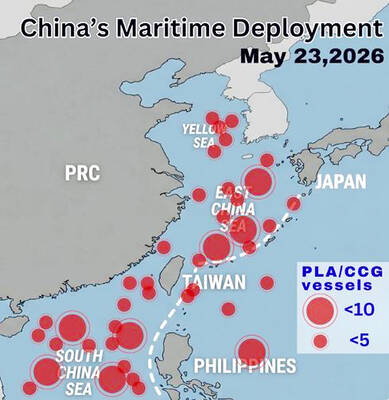
WARNING: China should stop engaging in actions that undermine regional peace and stability, as it would only build resentment among people across the Strait, the CGA said China has deployed more than 100 navy, coast guard and other vessels in waters from the Yellow Sea to the South China Sea and the western Pacific since US President Donald Trump and Chinese President Xi Jinping (習近平) met in Beijing, National Security Council Secretary-General Joseph Wu (吳釗燮) said yesterday. “In this part of the world, #China is the one & only PROBLEM wrecking the #StatusQuo & threatening regional peace & stability,” Wu wrote on X. In a separate post, he said Beijing was coercing Taiwan’s maritime domain, calling it illegal and provocative, after the Coast Guard Administration (CGA) expelled a


 RSS
RSS