


Opposition parties yesterday vowed to begin a “10-year resistance” against the government’s plan to sign an economic cooperation framework agreement (ECFA) with China, including organizing large-scale protests calling for a referendum on the controversial pact.
The Executive Yuan’s Referendum Review Committee on Thursday night voted 12-4 against an opposition-supported referendum proposal asking voters whether they agreed that the government should sign an ECFA with China. The committee said the question did not fall under what was allowed under the Referendum Act (公民投票法).
Both the Democratic Progressive Party (DPP) and the Taiwan Solidarity Union (TSU) assailed the decision and raised concerns of interference by the Chinese Nationalist Party (KMT) government.
Minutes after the decision was announced, the TSU — which initiated the referendum proposal — released a sternly worded statement saying that the committee’s decision went against the Constitution.
“The verdict is completely unacceptable,” TSU Chairperson Huang Kun-huei (黃昆輝) said. “The committee’s reasons for rejecting the proposal are unreasonable, illegal and unconstitutional.”
Although this was the second ECFA referendum proposal rejected by the committee, the TSU vowed to immediately begin preparations for another — a move the DPP said it would support.
“Thursday’s decision is proof of the government denying people their basic civil rights,” DPP spokesperson Lin Yu-chang (林右昌) said.
Last year, the DPP-initiated referendum proposal, which would have asked voters if they agreed that the government should hold a referendum before signing an ECFA, was also rejected by the committee on the grounds that it was based on a hypothetical scenario that did not exist.
A similar proposal by DPP lawmakers calling for the passage of a bill creating an ECFA referendum was blocked by the KMT-controlled legislature in April.
DPP Legislator Ker Chien-ming (柯建銘) said that based on experience, “we knew that [the TSU’s] ECFA referendum proposal would be rejected due to pressure from the Chinese government on the KMT.”
“However, this will not stop the DPP and the TSU from working hard and continuing to push for an ECFA referendum,” he said.
The DPP said it had begun plans to hold a large rally calling for an ECFA referendum later this month. Details of the planned rally could be announced by next Wednesday.
Ahead of the large-scale protest, the opposition is holding a referendum rally at Kaohsiung City’s Glory Pier today, with DPP Chairperson Tsai Ing-wen (蔡英文) and Kaohsiung Mayor Chen Chu (陳菊) giving speeches.
The DPP and the TSU say that a plebiscite is necessary to give the public a say in the controversial trade agreement.
Critics of the trade pact have also said that based on WTO rules, Taiwan and China would be forced to open up to 90 or 95 percent of their markets to cross-strait trade within 10 years, if an ECFA were signed.
Saying that the influx of cheaper Chinese goods could have a serious impact on Taiwanese jobs and vulnerable industries, Julian Kuo (郭正亮), spokesman of the DPP’s ECFA response team, said the party would begin a “10-year resistance” against the effects of an ECFA, if it were signed.
President Ma Ying-jeou (馬英九) and his administration have maintained that an ECFA with China, which aims to lower cross-strait tariffs, would benefit Taiwan’s export-based economy and aid its chances of signing FTAs with other countries. The Chinese foreign ministry said on Tuesday, however, that Beijing “firmly objects” to Taiwan signing official agreements with China’s diplomatic allies.
The Ma government has also said that benefits from the agreement would far outweigh its potential affect on Taiwan’s vulnerable industries. The president has said that he would establish a 10-year, NT$95 billion (US$2.94 billion) fund to aid industries that might be hard hit by the agreement.
Meanwhile, the Washington-based Formosan Association for Public Affairs (FAPA), the largest organization representing the Taiwanese community in the US, also condemned the committee’s decision and said it was “dismayed” at the outcome.
“This is another blow to democracy in Taiwan,” FAPA president Bob Yang (楊英育) said. “A referendum is a basic mechanism by the people of Taiwan to express their views on the very controversial ECFA proposal by the Ma government. It is unconscionable for the Ma government to block this proposal.”
US government sources refused to comment on the latest development, saying it was an internal issue and Washington did not want to interfere.
However, the administration of US President Barack Obama is basically in favor of an ECFA and closer Taiwan-China ties. Over the past few months, US administration officials speaking in private have appeared to be concerned that a referendum would prove to be a setback for the proposed trade pact.
FAPA is now in touch with the White House and with members of the US Congress, urging them to “prevail on the authorities in Taiwan to lift the blockage and respect the basic principles of democracy.”
However, the effort is unlikely to have much impact on Obama and the ruling Democrats, who are largely responsible for holding up a US free trade pact with Taiwan.
“We Taiwanese-Americans, together with the people in Taiwan, have worked hard for our democracy and we will not let the Ma government take it away,” Yang said.
Also See: Premier supports referendum decision
Also See: Activists, academics pan decision on referendum
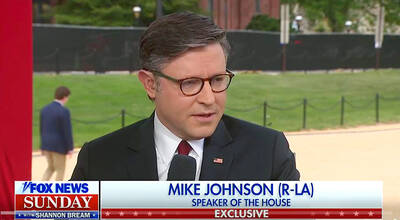
RESOLUTE BACKING: Two Republican senators are planning to introduce legislation that would impose immediate sanctions on China if it attempts to invade Taiwan US House of Representatives Speaker Mike Johnson on Sunday reaffirmed US congressional support for Taiwan, saying the US and “all freedom-loving people” have a stake in preventing China from seizing Taiwan by force. Johnson made the remarks in an interview with Fox News Sunday on US President Donald Trump’s summit with Chinese President Xi Jinping (習近平) last week. In an interview that aired on Friday on Fox News, just as Trump wrapped up a high-stakes visit to China, he said he has yet to green-light a new US$14 billion arms package to Taiwan and that it “depends on China.” “It’s a very good
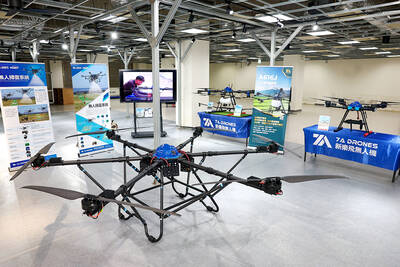
DRONE CENTRAL: Taiwan aims to become Asia’s democratic hub for drones, with most exports focused on high-quality military-grade models, an official said Taiwan’s drone industry is expected to expand significantly by 2030, producing 100,000 units per month and exporting half of them, the Ministry of Economic Affairs said yesterday. Current drone production capacity is about 15,000 units per month, but the industry can quickly scale up as demand increases, Industrial Development Administration Director-General Chiou Chyou-huey (邱求慧) told a news conference in Taipei. Taiwan’s drone output grew 2.5-fold last year to NT$12.9 billion (US$408.3 million) under a government program to develop the uncrewed vehicle sector, he said. The Executive Yuan in October last year approved plans to invest NT$44.2 billion into domestic production of uncrewed aerial
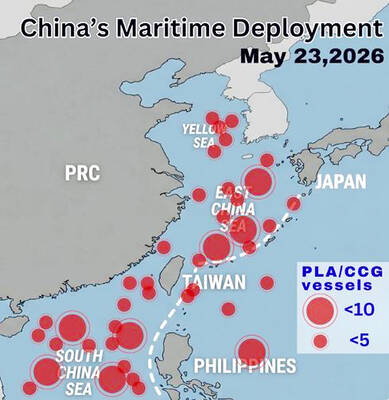
WARNING: China should stop engaging in actions that undermine regional peace and stability, as it would only build resentment among people across the Strait, the CGA said China has deployed more than 100 navy, coast guard and other vessels in waters from the Yellow Sea to the South China Sea and the western Pacific since US President Donald Trump and Chinese President Xi Jinping (習近平) met in Beijing, National Security Council Secretary-General Joseph Wu (吳釗燮) said yesterday. “In this part of the world, #China is the one & only PROBLEM wrecking the #StatusQuo & threatening regional peace & stability,” Wu wrote on X. In a separate post, he said Beijing was coercing Taiwan’s maritime domain, calling it illegal and provocative, after the Coast Guard Administration (CGA) expelled a
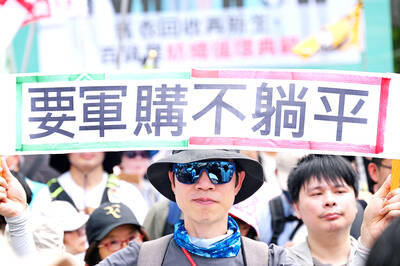
More than 8,000 people took part in a rally in Taipei yesterday to express support for more defense spending, after the opposition slashed the Cabinet’s proposed NT$1.25 trillion (US$39.6 billion) special defense budget and capped it at NT$780 billion. The demonstrators urged the Cabinet to propose another bill. Taiwan Economic Democracy Union convener Lai Chung-chiang (賴中強) said the main problem of the passed budget plan is the removal of funding for critical items, not just that the total amount is smaller. Critical budget items included purchasing or developing uncrewed vehicles, Strong Bow (強弓) missile systems, additional ammunition, artificial intelligence-powered combat systems and Taiwan-US


 RSS
RSS