


The US military is moving ahead with plans to create its first “cyber command” designed to bolster the US’ potential to wage digital warfare as well as defend against mounting cyber threats, officials said on Friday.
After US President Barack Obama announced on Friday his plans to overhaul cyber security policy, US Secretary of Defense Robert Gates was expected to soon formally propose the new cyber command that will be overseen by a four-star officer, Pentagon officials said.
The move reflected a shift in military strategy with “cyber dominance” becoming part of US war doctrine and growing alarm over the perceived threat posed by digital espionage coming from China, Russia and elsewhere.
US officials said China has built up a sophisticated cyber warfare program and that a spate of intrusions in the US and elsewhere can be traced back to Chinese sources.
Defense officials said the cyber command would focus on security efforts for US networks along with offensive capabilities to ensure “freedom of action in cyberspace” to protect US interests.
The precise details of US cyber military power remain secret, but it includes technology capable of penetrating and jamming networks, including the classified Suter airborne system, analysts say.
The technology has been reportedly added to unmanned aircraft and allows for users to take over enemy sensors to “see what enemy sensors see, and even take over as systems administrator so sensors can be manipulated into positions so that approaching aircraft can’t be seen,” Aviation Week said.
Speculation has persisted that Israel may have used the technology in a 2007 air raid against a Syrian construction site.
The new US military cyber center would be placed initially under US Strategic Command, which is already leading the military’s cyber security efforts and be located at Fort Meade, Maryland.
The officer widely expected to lead the command is Lieutenant General Keith Alexander, the director of the National Security Agency.
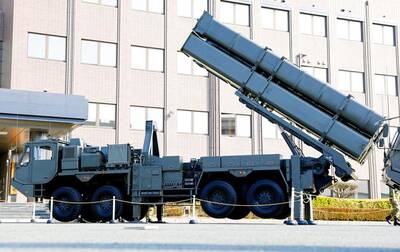
Japan has deployed long-range missiles in a southwestern region near China, the Japanese defense minister said yesterday, at a time when ties with Beijing are at their lowest in recent years. The missiles were installed in Kumamoto in the southern region of Kyushu, as Japan is attempting to shore up its military capacity as China steps up naval activity in the East China Sea. “Standoff defense capabilities enable us to counter the threat of enemy forces attempting to invade our country ... while ensuring the safety of our personnel,” Japanese Minister of Defense Shinjiro Koizumi said. “This is an extremely important initiative for

The nation’s fastest supercomputer, Nano 4 (晶創26), is scheduled to be launched in the third quarter, and would be used to train large language models in finance and national defense sectors, the National Center for High-Performance Computing (NCHC) said. The supercomputer, which would operate at about 86.05 petaflops, is being tested at a new cloud computing center in the Southern Taiwan Science Park in Tainan. The exterior of the server cabinet features chip circuitry patterns overlaid with a map of Taiwan, highlighting the nation’s central position in the semiconductor industry. The center also houses Taiwania 2, Taiwania 3, Forerunner 1 and

MORE POPULAR: Taiwan Pass sales increased by 59 percent during the first quarter compared with the same period last year, the Tourism Administration said The Tourism Administration yesterday said that it has streamlined the Taiwan Pass, with two versions available for purchase beginning today. The tourism agency has made the pass available to international tourists since 2024, allowing them to access the high-speed rail, Taiwan Railway Corp services, four MRT systems and four Taiwan Tourist Shuttles. Previously, five types of Taiwan Pass were available, but some tourists have said that the offerings were too complicated. The agency said only two types of Taiwan Pass would be available, starting from a three-day pass with the high-speed rail and a three-day pass with Taiwan Railway Corp. The former costs NT$2,800
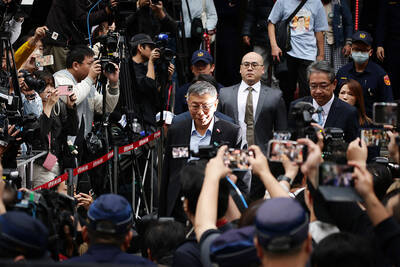
FIRST TRIAL: Ko’s lawyers sought reduced bail and other concessions, as did other defendants, but the bail judge denied their requests, citing the severity of the sentences Former Taipei mayor Ko Wen-je (柯文哲) was yesterday sentenced to 17 years in prison and had his civil rights suspended for six years over corruption, embezzlement and other charges. Taipei prosecutors in December last year asked the Taipei District Court for a combined 28-year, six-month sentence for the four cases against Ko, who founded the Taiwan People’s Party (TPP). The cases were linked to the Core Pacific City (京華城購物中心) redevelopment project and the mismanagement of political donations. Other defendants convicted on separate charges included Chinese Nationalist Party (KMT) Taipei City Councilor Angela Ying (應曉薇), who was handed a 15-year, six-month sentence; Core Pacific


 RSS
RSS