


Former president Chen Shui-bian (陳水扁) was released from detention at around 1:20am yesterday after a four-hour hearing.
“This was the toughest and loneliest 32 days of my life. But I really appreciate what the judges did back in the courtroom and what my supporters did the entire time,” he said. “Regarding those reminders from the judges, I will keep them in mind.”
Chen was referring to advice from the judges that he not use his “personal charm” with supporters to make the case more complicated.
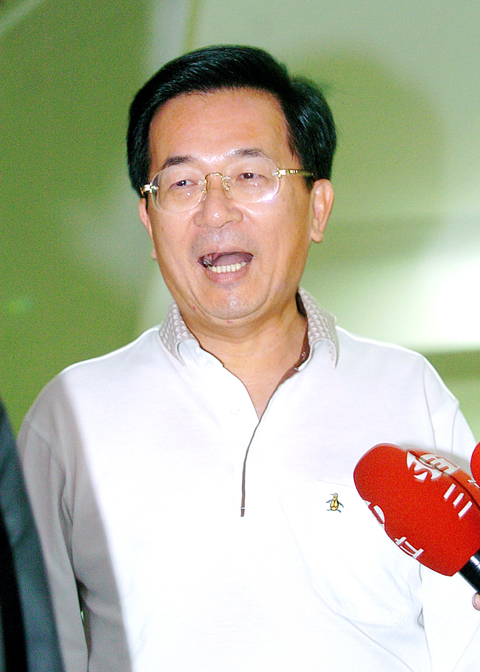
PHOTO: FANG PIN-CHAO, TAIPEI TIMES
Judges also said he shouldn’t travel around the country making public appearances like he did prior to the indictment.
When releasing Chen, the panel of three Taipei District Court judges banned him from changing his address or leaving the country.
Chen, who appeared in the court lobby after changing into a dark suit, thanked the judges and promised to honor the terms of his release.
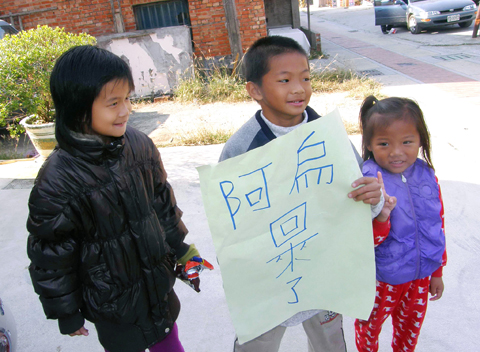
PHOTO: WU CHUN-FONG, TAIPEI TIMES
Chen shook hands briefly with some of the 20 supporters who had gathered outside the courthouse before heading home.
Presiding Judge Chou Chan-chun’s (周占春) order to free Chen said that the court was releasing him without bail because Chen had not missed a summons.
Chou also said that Chen had no chance to flee because as a former president, he is constantly protected and escorted by special agents.
The Supreme Prosecutors’ Office’s Special Investigation Panel (SIP) said that it would not appeal.
“We shall not appeal this,” SIP Spokesman Chen Yun-nan (陳雲南) said.
The spokesman said that Chou’s decision to release the former president would not have an impact on the investigation.
“We cannot do anything about it even if it could,” he said. “We will continue our efforts on this case and this is the only thing we can do.”
The former president’s lawyer, Cheng Wen-long (鄭文龍), welcomed the decision to release Chen, saying it would help increase judicial credibility.
“This is a step forward for Taiwan’s judicial system. It will also ease doubt about prosecutors forcing confessions by detaining Chen,” he said.
The former president, locked up since Nov. 12, was indicted on charges of embezzling government funds, money laundering and forgery along with 13 others, including his wife, son and daughter-in-law. As prosecutors are seeking the “severest penalty,” legal experts say that Chen, the first former president to be indicted, could face life in prison if convicted.
Chen Shui-bian, who pledged to clean up government when he was elected in 2000, left office in May after serving two four-year terms as president.
Prosecutors say the 58-year-old Chen, a lawyer by training, and his wife Wu Shu-chen (吳淑珍), embezzled about US$3 million in public funds and, along with two other people, accepted a bribe of about US$12 million on a land deal.
Their son Chen Chih-chung (陳致中) and daughter-in-law Huang Jui-ching (黃睿靚), along with 10 others, were indicted for corruption and money laundering in connection with the case.
After his release, Chen Shui-bian received a haircut at a barbershop. He smiled at reporters but made no comment.
Former first lady Wu Shu-jen’s (吳淑珍) lawyer Lee Sheng-hsiung (李勝雄) lauded the judges yesterday for making a “brave” decision to release Chen, but urged the court to release former National Security Council secretary-general Chiou I-jen (邱義仁) and former Bureau of Investigation director-general Yeh Sheng-mao (葉盛茂) as well.
Lee said he called Wu immediately after Chen was released, and that Wu said she wanted to thank God for the news.
Former vice president Annette Lu (呂秀蓮) also lauded the court’s decision yesterday as a move that tallied with law and order and respected human rights.
“The most important part of the judiciary is procedural justice ... Chen and his lawyers should face the case calmly and rationally, and society should not interfere with the trial,” she said while attending an event in Taichung City.
Meanwhile, Washington expressed hope that Taiwan’s legal system would be “transparent, fair and impartial.”
In response to a question on the indictment of the former president during a daily press briefing, State Department spokesman Sean McCormack read a short, prepared statement that said: “We are confident in Taiwan’s democracy and its legal system. And we have every expectation that the process will be transparent, fair and impartial.”
He declined to comment on allegations that the investigation was marred by political interference.

SILENCING CRITICS: In addition to blocking Taiwan, China aimed to prevent rights activists from speaking out against authoritarian states, a Cabinet department said The Ministry of Foreign Affairs (MOFA) yesterday condemned transnational repression by Beijing after RightsCon, a major digital human rights conference scheduled to be held in Zambia this week, was abruptly canceled due to Chinese pressure over Taiwanese participation. This year’s RightsCon, the world’s largest conference discussing issues “at the intersection of human rights and technology,” was scheduled to take place from tomorrow to Friday in Lusaka, and expected to draw 2,600 in-person attendees from 150 countries, along with 1,100 online participants. However, organizers were forced to cancel the event due to behind-the-scenes pressure from China, the ministry said, expressing its “strongest condemnation”
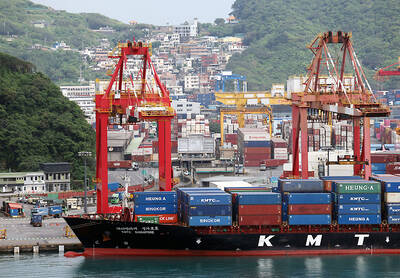
Taiwan’s economy grew far faster than expected in the first quarter, as booming demand for artificial intelligence (AI) applications drove a surge in exports, spilling over into investment and consumption, the Directorate-General of Budget, Accounting and Statistics (DGBAS) said yesterday. GDP growth was 13.69 percent year-on-year during the January-to-March period, beating the DGBAS’ February forecast by 2.23 percentage points and marking the most robust growth in nearly four decades, DGBAS senior official Chiang Hsin-yi (江心怡) told a news conference in Taipei. The result was powered by exports, which remain the backbone of Taiwan’s economy, Chiang said. Outbound shipments jumped 51.12 percent year-on-year to
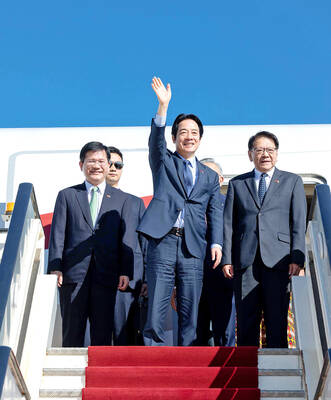
DELAYED BUT DETERMINED: The president’s visit highlights Taiwan’s right to international engagement amid regional pressure from China President Willaim Lai (賴清德) yesterday arrived in Eswatini, more than a week after his planned visit to Taiwan’s sole African ally was suspended because of revoked overflight permits. “The visit, originally scheduled for April 22, was postponed due to unforeseen external factors,” Lai wrote on social media. “After several days of careful arrangements by our diplomatic and national security teams, we successfully arrived today.” Lai said he looked forward to further deepening Taiwan-Eswatini relations through closer cooperation in the economy, agriculture, culture and education, as well as advancing the nation’s international partnerships. The president was initially scheduled to arrive in time to celebrate
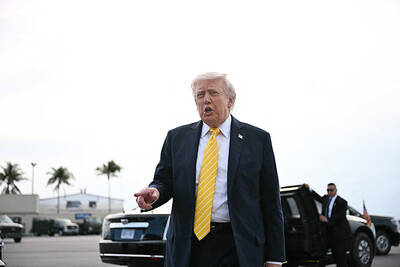
Iran’s Islamic Revolutionary Guard Corp (IRGC) yesterday said the US faced a choice between an “impossible” military operation or a “bad deal” with Tehran, after US President Donald Trump disparaged Iran’s latest peace proposal. Negotiations between the two countries have been deadlocked since a ceasefire came into effect on April 8, with only one round of direct peace talks held so far. Iran’s Tasnim and Fars news agencies reported that Tehran had submitted a 14-point proposal to mediator Pakistan, but Trump was quick to cast doubt on it. “I will soon be reviewing the plan that Iran has just sent to us, but


 RSS
RSS