


The central bank yesterday lowered key interest rates for the second time in two weeks, taking cues from its counterparts in the US, Europe and other Asian countries in a joint attempt to rein in the effects of the global credit crisis that are hurting Taiwanese exports.
In an unscheduled press conference early yesterday morning, central bank Governor Perng Fai-nan (彭淮南) said the bank’s board decided to reduce the discount rate, the rate on accommodations with collateral and the rate on accommodations without collateral by 25 basis points each to 3.5 percent, 3.875 percent and 5.75 percent respectively, effective immediately.
EXPORT DROP
“With the nation’s exports declining and the international financial turmoil escalating, the board reached a decision [to cut interest rates] to help spur domestic demand and economic growth,” Perng said. “There is no liquidity strain at home, though.”
The rate cut came one day after six central banks, including the US Federal Reserve and the European Central Bank, adopted the same measure in a concerted effort to restore confidence in the world’s financial system.
The move also follows last month’s drop in Taiwanese exports — the first decline in six-and-a-half years.
Perng said the rate cut would not fan inflationary pressures as consumer price growth had slowed for two straight months and was expected to head further down for the rest of the year.
Stocks rose on news of the rate cut but lost steam as foreign capital continued to pull out of the domestic financial market.
The TAIEX closed 78.69 points, or 1.45 percent, lower at 5,130.71. Turnover was NT$74.82 billion (US$2.3 billion), with net selling by foreign institutional investors reaching NT$2.29 billion, Taiwan Stock Exchange data showed.
Analysts painted the rate cut as a positive gesture to financial markets but voiced skepticism about its effectiveness in lifting the economy.
Cheng Cheng-mount (鄭貞茂), chief economist at Citigroup Inc Taiwan, said the rate cut fell in line with the moves taken by monetary authorities around the world even though financial markets here have ample liquidity.
‘FRIENDLY’ MOVE
“The markets will interpret the rate adjustment as friendly,” Cheng said. “But what they really lack is confidence, not more liquidity. That explains why the local bourse failed to give a favorable response.”
The national savings rate is expected to reach 30.6 percent next year, while the excess savings rate will hit NT$1.3 trillion, a ratio of 9.5 percent to GDP, meaning there are huge idle funds, government statistics showed.
Kevin Hsiao (蕭正義), head of UBS Wealth Management Research in Taiwan, agreed.
Hsiao said the equity market would remain volatile as long as the credit crunch continues to grip Wall Street and other major international bourses.
“The rate cut can definitely boost investor confidence and exports,” Hsiao said by telephone. “But the root of the problem lies with the global financial unrest over which [Taiwanese] authorities have no influence.”
Cheng and Hsiao said the central bank will further lower interest rates later this year if other central banks do so first.
See
Also See: Asian markets mixed, concerns persist
and
Also See: Interest rate cuts not sufficient: Roach


RESILIENCE: Taiwan plays a key role in semiconductors, energy, information infrastructure and advanced manufacturing, AIT Director Raymond Greene said Taiwan’s continued investment in deterrence and resilience remains vital, especially in uncrewed systems and other emerging technologies, American Institute in Taiwan (AIT) Director Raymond Greene said yesterday. Greene made the remarks at the annual National Strategic Summit on Supply Chain Resilience held by the Research Institute for Democracy, Society and Emerging Technology (DSET), a government-backed think tank. As Taiwan last year became the US’ fourth-largest trading partner and supply chain security is becoming more important, cooperation in emerging technologies continues to deepen between the two countries, he said. The US is committed to accelerating innovation, building key infrastructure, strengthening cooperation

The National Chungshan Institute of Science and Technology yesterday showcased its locally developed variants of the Vision 60 robotic patrol dog, which it plans to deploy on the nation’s outlying territories in the South China Sea. The variants were produced under the Joint Lab project — created by the institute and domestic companies — and assembled with domestically produced motors, lenses and artificial intelligence (AI) systems alongside licensed tech from the US, Missile and Rocket Systems Research Division deputy director Jen Kuo-kang (任國光) told the media event at a military base in Taipei’s Dazhi (大直) area. Taiwan has built up its strengths

RIGHT DIRECTION: Taiwan’s efforts to prevent forced labor include a proposal to ‘fully prohibit’ employers from withholding workers’ documents, an official said Taiwan is to establish a mechanism to restrict imports of goods linked to forced labor, the Executive Yuan said yesterday, after the US proposed imposing additional tariffs on Taiwanese goods over labor concerns. “The Ministry of Labor and the Ministry of Economic Affairs are to establish an interministerial review procedure,” Executive Yuan spokesperson Michelle Lee (李慧芝) said at a news briefing in Taipei. “The government is to use the Foreign Trade Act [貿易法] as the legal basis to restrict imports of goods produced with forced labor” and bring its supply chain governance more in line with international standards on human rights, resilience
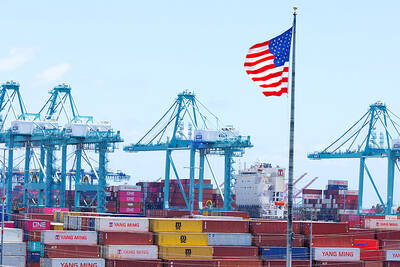
NOT IMMEDIATE: Taiwan has a chance to appeal the proposed 10 percent tariff before it starts, while other countries face a 12.5 percent tariff from the trade office Taiwan is among 60 economies determined by the US to have failed to impose or enforce a ban on the importation of goods produced with forced labor, according to a notice released on Tuesday by the Office of the US Trade Representative (USTR), which proposed imposing an additional 10 percent or more tariff on them. The USTR in a statement said that following an investigation, it had determined under Section 301 of the Trade Act of 1974 that the failure of the 60 economies to impose and effectively enforce a prohibition on the importation of goods produced with forced labor is


 RSS
RSS