


Asian markets were mixed yesterday, with investor enthusiasm over rate cuts around the world giving way to persisting fears over the severe strains in credit markets and the prospect of a global recession.
Taiwan, South Korea and Hong Kong lowered interest rates, joining a series of cuts on Wednesday in the US, Europe and China aimed at stabilizing global markets that plunged sharply this week.
But lower interest rates alone are unlikely to cure the crisis in confidence, analysts said.
“Short-term selling pressure is still strong,” said Lorraine Tan (陳麗子), director at Standard & Poor’s equity research in Singapore. “I don’t think interest rate cuts alone are going to help improve confidence all that much.”
ASIAN MIRROR
Investor reaction in Asia to the string of moves mirrored that in the US and Europe: An initial recovery in several markets faded amid deep concerns about the depth of the crisis. Adding to the pressure are financial institutions selling off shares as they try to restore their balance sheets, Tan said.
Tokyo’s benchmark Nikkei 225 index rose more than 1 percent but fell back to close down 0.5 percent to 9,157.49, a five-year low.
That followed a 9.4 percent plunge on Wednesday, its biggest one-day drop since the 1987 market crash.
HONG KONG
Hong Kong’s Hang Seng index jumped 511.51 points, or 3.3 percent, to 15,943.24, recovering some of its 8.2 percent drop the day before. South Korea’s key index rose 0.6 percent after earlier rising as much as 2.9 percent.
Mainland China’s main index fell 0.8 percent as investors continued to unload shares in banks and property firms even after its central bank lowered rates on Wednesday evening.
NOT IMMUNE
“These are obviously hard times and the global economy is suffering. The market trend is still downward since China isn’t immune to this global financial crisis,” said Peng Yunliang (彭蘊亮), a strategist at Shanghai Securities.
China’s move came as six other central banks, including the US Federal Reserve and European Central Bank, joined to lower rates to contain the spreading financial crisis. Japan’s central bank, constrained by already-low rates, said it backed the moves.
On Wall Street, the Dow Jones industrial average ended a volatile session down 2 percent — disappointing, but a milder decline than in previous days.
JITTERY SHAREHOLDERS
Wavering investors in the US were shaken by US Treasury Secretary Henry Paulson’s comment Wednesday that it would be several weeks before the government’s US$700 billion financial rescue package makes its first purchases of banks’ troubled mortgage-backed assets.
In Indonesia, trading on the Jakarta Stock Exchange was canceled yesterday after the benchmark JSX index sank 10.4 percent on Wednesday before trading was suspended by late morning.
Authorities ordered the market to stay closed, possibly through Friday, following a late night Cabinet meeting.
State-Owned Enterprise Minister Sofyan Jalil said companies could use cash reserves at their own discretion, but provided no financial details.
Indonesia has more than 100 state-owned corporations active in mining, utilities, telecommunications and commodities.


RESILIENCE: Taiwan plays a key role in semiconductors, energy, information infrastructure and advanced manufacturing, AIT Director Raymond Greene said Taiwan’s continued investment in deterrence and resilience remains vital, especially in uncrewed systems and other emerging technologies, American Institute in Taiwan (AIT) Director Raymond Greene said yesterday. Greene made the remarks at the annual National Strategic Summit on Supply Chain Resilience held by the Research Institute for Democracy, Society and Emerging Technology (DSET), a government-backed think tank. As Taiwan last year became the US’ fourth-largest trading partner and supply chain security is becoming more important, cooperation in emerging technologies continues to deepen between the two countries, he said. The US is committed to accelerating innovation, building key infrastructure, strengthening cooperation

The National Chungshan Institute of Science and Technology yesterday showcased its locally developed variants of the Vision 60 robotic patrol dog, which it plans to deploy on the nation’s outlying territories in the South China Sea. The variants were produced under the Joint Lab project — created by the institute and domestic companies — and assembled with domestically produced motors, lenses and artificial intelligence (AI) systems alongside licensed tech from the US, Missile and Rocket Systems Research Division deputy director Jen Kuo-kang (任國光) told the media event at a military base in Taipei’s Dazhi (大直) area. Taiwan has built up its strengths

RIGHT DIRECTION: Taiwan’s efforts to prevent forced labor include a proposal to ‘fully prohibit’ employers from withholding workers’ documents, an official said Taiwan is to establish a mechanism to restrict imports of goods linked to forced labor, the Executive Yuan said yesterday, after the US proposed imposing additional tariffs on Taiwanese goods over labor concerns. “The Ministry of Labor and the Ministry of Economic Affairs are to establish an interministerial review procedure,” Executive Yuan spokesperson Michelle Lee (李慧芝) said at a news briefing in Taipei. “The government is to use the Foreign Trade Act [貿易法] as the legal basis to restrict imports of goods produced with forced labor” and bring its supply chain governance more in line with international standards on human rights, resilience
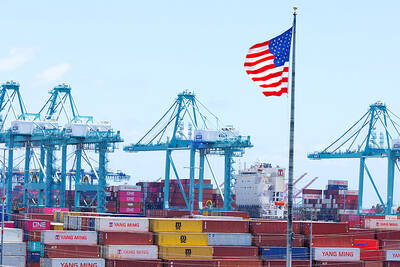
NOT IMMEDIATE: Taiwan has a chance to appeal the proposed 10 percent tariff before it starts, while other countries face a 12.5 percent tariff from the trade office Taiwan is among 60 economies determined by the US to have failed to impose or enforce a ban on the importation of goods produced with forced labor, according to a notice released on Tuesday by the Office of the US Trade Representative (USTR), which proposed imposing an additional 10 percent or more tariff on them. The USTR in a statement said that following an investigation, it had determined under Section 301 of the Trade Act of 1974 that the failure of the 60 economies to impose and effectively enforce a prohibition on the importation of goods produced with forced labor is


 RSS
RSS