


Amid demonstrations staged by people in favor of and opposing the name change, the Chiang Kai-shek (CKS) Memorial Hall was officially renamed the National Taiwan Democracy Memorial Hall (
The new plaque was unveiled by President Chen Shui-bian (
"We're gathering here ... to bid goodbye to the old age and to show that we Taiwanese are all standing firmly behind the universal values of freedom, democracy and human rights," Chen said.
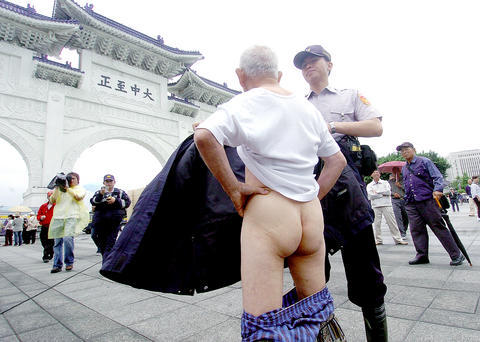
PHOTO: LO PEI-DER, TAIPEI TIMES
He also explained the significance of the date.
"Fifty-eight years ago, on this date, May 19, the Chinese Nationalist Party [KMT] regime ... officially declared martial law in Taiwan, which lasted 38 years," Chen said.
Meanwhile, in the outer regions of the hall's grounds, hundreds of supporters of and opponents to the name change held demonstrations.
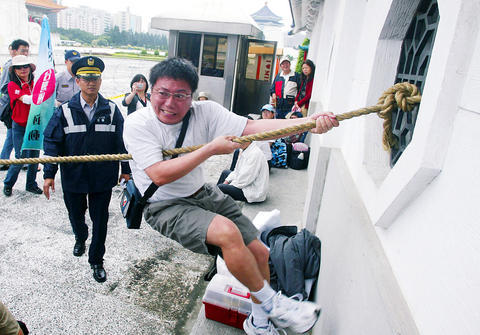
PHOTO: CNA
Scattered brawls were reported and TV footage showed a Chen supporter and several protesters hitting each other with umbrellas before police intervened.
Barbed wire barricades were erected and ETTV reported that 700 police officers had been deployed at the scene. Law enforcement authorities declined to confirm those numbers.
A group of people in favor of the name change parading on their way to welcome Chen before the ceremony were shouted at and attacked by opponents and mud was thrown at a truck leading the parade.
Police quickly put an end to the altercation.
After the ceremony, opponents of the name change attempted to damage the new name plaque. Scuffles and verbal clashes again broke out and police intervened.
Minutes after Chen's speech, survivors of the 228 Incident gathered around the hall, to cheers from Chen supporters and jeers by his detractors.
The 228 Incident refers to the uprising that began on Feb. 27, 1947, against the KMT regime. Tens of thousands of Taiwanese were subsequently killed by the KMT in a security crackdown.
After the official unveiling of the plaque, Chen, Premier Su Tseng-chang (蘇貞昌) and Minister of Education Tu Cheng-sheng (杜正勝) visited an exhibition of pictures and documents from the martial law period inside the memorial hall.
A group of former political prisoners and their families welcomed the president in the hall.
"I welcome the name change, it's a small step toward justice," said Wu Sheng-jun (
Wu was arrested in 1950 and imprisoned for 12 years for conspiracy because of complaints about the government he made while chatting with friends. "Someone just reported on me," he said.
"When the KMT arrived in Taiwan, my friends and I came all the way back from Japan just to welcome them ... I couldn't believe, then, that I was being jailed just because I had complained about the government," Wu said.
He said he disagreed with claims by pan-blue camp politicians that the name change was a move to stir up ethnic tension.
"Many Mainlanders were also victims of Chiang Kai-shek's (蔣介石) authoritarian regime, two out of five political prisoners were Mainlanders. We all suffered under Chiang," he said.
To avoid causing damage to the structure of the memorial hall, the metal plaques, which bear the carving "National Taiwan Democracy Memorial Hall" -- in Chinese and English -- were put in the garden surrounding the building.
In a bid to prevent it from being altered, in March the Taipei City Government classified the 27-year-old memorial hall and its surrounding walls as a temporary historical site.
The Cultural Heritage Protection Law (文化資產保護法) stipulates that a temporary historical site cannot be altered or damaged in any way.
The Taipei City Government said the decorations used during the unveiling ceremony were in violation of the Cultural Heritage Protection Law.
"There were many [violations], such as nails on the structure and banners covering the building. All these altered the original appearance of the historical structure," Taipei City Government director of information Yang Hsiao-tung (
Taipei's KMT Mayor Hau Lung-bin (郝龍斌), yesterday condemned the move, which he deemed "illegal."
"The government set a bad example by damaging the legal system and deceiving the public ... We demand the removal of the plaque," he told the reporters, referring to the amendment to the Organic Statute of Chiang Kai-shek Memorial Hall (中正紀念堂組織條例) and a proposed statute concerning the organization of the Taiwan Democracy Hall.
KMT caucus whip Hsu Shao-ping (徐少萍) told a press conference yesterday that the two bills have yet to be put on the legislative agenda.
Under these circumstances, changing the name of the hall and unveiling the new plaques were illegal, she said, threatening to block the two bills in the legislature.
"I will never allow them to be passed. Without them being passed, everything related to the Taiwan Democracy Memorial Hall would be invalidated," she said.
The Taiwan Solidarity Union yesterday panned the government for a different reason, accusing the Democratic Progressive Party (DPP) of "fooling the public."
The name change was "ironic" because the DPP still doesn't dare to remove Chiang's statue from the hall, said TSU Secretary-General Chien Cheng-shan (
"Changing the title of CKS Memorial Hall [to Taiwan Democracy Hall] is not enough," he said. "We need to make the Taiwan Democracy Memorial Hall a democracy hall in reality as well as in name."
"The important mission of the Taiwan Democracy Memorial Hall is to help our coming generations understand Taiwan's democratization process and commemorate all those who made a contribution to it," he said.
DPP Chairman Yu Shyi-kun, on the other hand, said he was happy to see the name change, as it represented the "fulfillment of transitional justice."
He expressed disappointment, however, at the KMT's continuing opposition to the change and its failure to use the opportunity to reflect upon its history of authoritarian governance.

A signaling system malfunction disrupted high-speed rail (HSR) services beginning at 8am today, with trains temporarily reduced to three northbound and three southbound trains per hour as authorities conduct inspections. The malfunction occurred on a section of track in Miaoli County during pre-operation checks early this morning, forcing northbound and southbound trains to use a single track, the HSR operator said. The regular schedule has been replaced with three hourly trains offering only nonreserved seating in each direction, stopping at every station, it said, adding that business class cars would still have reserved seating. Departures from terminal stations are scheduled at the top
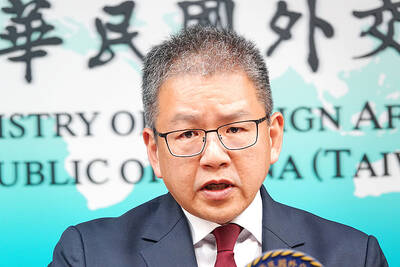
Taiwan is still in the process of assessing the possibility of recruiting workers from Eswatini, the Ministry of Foreign Affairs said yesterday, adding that its goal is to help Eswatini upgrade its vocational training centers. If there are plans to recruit workers from Eswatini, safeguarding national security, protecting public health and ensuring the employment rights of Taiwanese would be prerequisites, Department of West Asian and African Affairs Director-General Yen Chia-liang (顏嘉良) told a news conference. Key considerations would also include filling labor shortages in specific industries, and fostering bilateral professional and technical exchanges, he said. Yen was asked about the progress of labor

A US uncrewed surface vessel (USV) encountered multiple Chinese warships during an autonomous transit of the Taiwan Strait, US defense company Seasats said in a statement on Wednesday. Seasats announced that a Lightfish USV had completed the first autonomous transit of the Taiwan Strait. Over five days, the USV traversed the entire length of the Strait while constantly monitoring surface vessel traffic, the company said. The Lightfish encountered multiple Chinese warships, one of which was a Chinese People’s Liberation Army Navy (PLAN) Type 056 corvette, it said. The Chinese vessels were operating “well within Taiwan’s exclusive economic zone without transmitting their identity via the

VERBOSE VESSELS: A CGA cutter and a China Coast Guard exchanged verbal barbs for more than a day in Taiwanese-controlled waters before the Chinese vessel left The Taiwanese and Chinese coast guards had a standoff near the strategically located Pratas Islands (Dongsha Islands, 東沙群島) in the north of the South China Sea, the Coast Guard Administration (CGA) said yesterday. The two sides engaged in intense radio exchanges over sovereignty claims during the 33-hour standoff. China Coast Guard vessel 3501 eventually left the restricted waters, 26.6 nautical miles (49.2km) west of the Pratas Islands, at 5pm yesterday, the CGA said. Lying approximately between southern Taiwan and Hong Kong, the Taiwan-controlled Pratas are seen by some security experts as vulnerable to Chinese attack due to their distance — more than


 RSS
RSS