


China has stationed two to four people specializing in Taiwan affairs at its embassies in several democratic countries to monitor and harass Taiwanese, actions that the host nations would not tolerate, National Security Bureau (NSB) Director-General Tsai Ming-yen (蔡明彥) said yesterday.
Tsai made the comments at a meeting of the legislature’s Foreign Affairs and National Defense Committee, which asked him and Minister of National Defense Wellington Koo (顧立雄) to report on potential conflicts in the Taiwan Strait and military preparedness.
Democratic Progressive Party (DPP) Legislator Michelle Lin (林楚茵) expressed concern that Beijing has posted personnel from China’s Taiwan Affairs Office to its embassies abroad to monitor and harass Taiwanese businesspeople, expats and exchange students.
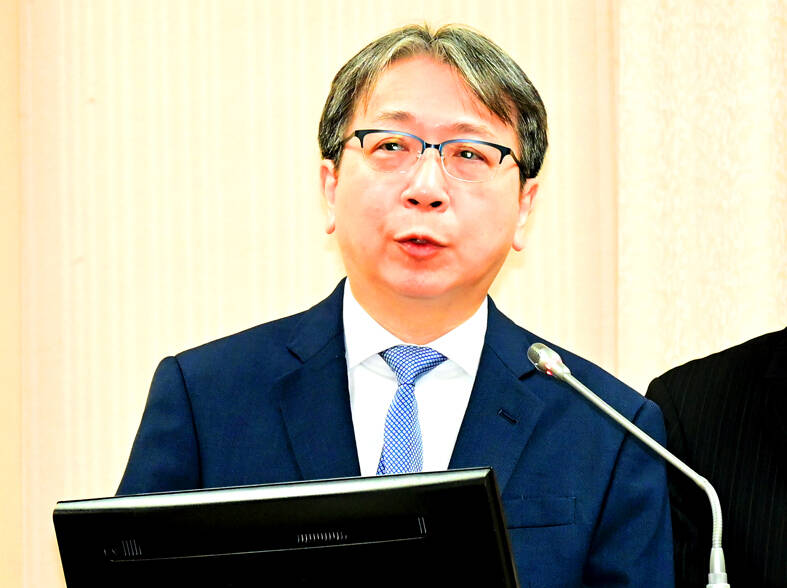
Photo: Wang Yi-sung, Taipei Times
Tsai confirmed that China sometimes sends two to four personnel with experience in Taiwan affairs to its foreign embassies, but he could not say to which countries.
The bureau is monitoring the situation and communicating with local authorities to ensure that Chinese officials do not harass Taiwanese abroad, Tsai said.
In general, Taiwanese in those nations should be safe, as many of them are democracies, where police and security agencies would not tolerate Chinese officials threatening people’s safety or breaking standards of diplomatic conduct, he said.
It would be difficult for China to enforce its jurisdiction across borders, Tsai said.
For example, it would be challenging for China to issue an Interpol “red notice” to arrest DPP Legislator Puma Shen (沈伯洋), he said.
Interpol has a legal panel that reviews notices submitted by member countries to ensure the system is not being used to target political opponents, he said.
Through its communication channels, the NSB would know if China were to use the Interpol system to target Taiwanese, and Taiwan’s partners would issue warnings, Tsai said.
Lin asked whether Southeast Asian countries such as Thailand, which have better relations with China, would be more likely to assist Beijing in exercising cross-border jurisdiction.
The Ministry of Foreign Affairs is examining the issue and discussing how to best warn people, Tsai said.
DPP Legislator Chen Chun-yu (陳俊宇) asked whether Taiwan needs to further develop intelligence sharing with like-minded nations in the first island chain.
Taiwan has held nearly 100 bilateral meetings with leaders of national security agencies from 45 countries this year, Tsai said.
The NSB uses many forms of strategic communication and intelligence sharing to stay aware of developments, including meeting with national security leaders from countries worldwide, he said.
That enables Taiwan to gain an understanding of what countries are most concerned about Indo-Pacific security, and based on that information, Taiwan and friendly nations develop a close-knit network of strategic cooperation and intelligence sharing, he said.
Lawmakers also expressed concern about whether China’s aggressive actions would shift toward nations friendly to Taiwan, after China on Monday imposed sanctions on former chief of staff of the Joint Staff of the Japan Self-Defense Forces Shigeru Iwasaki, who was appointed as a political adviser to the Cabinet in March.
China has often tried to repress or threaten people who align with Taiwan or support Taiwanese independence, Tsai said.
Based on past cases, it usually has the opposite effect and only carries symbolic meaning, as Taiwan’s partners usually do not care much about being denied entry to China, he said.
Beijing’s actions would only cause friendly nations to speak up for Taiwan and express their support, Tsai said.
The countries would not make any concessions to Chinese pressure, but would unite to criticize its provocative actions, which threaten human rights and regional stability, he said.

A signaling system malfunction disrupted high-speed rail (HSR) services beginning at 8am today, with trains temporarily reduced to three northbound and three southbound trains per hour as authorities conduct inspections. The malfunction occurred on a section of track in Miaoli County during pre-operation checks early this morning, forcing northbound and southbound trains to use a single track, the HSR operator said. The regular schedule has been replaced with three hourly trains offering only nonreserved seating in each direction, stopping at every station, it said, adding that business class cars would still have reserved seating. Departures from terminal stations are scheduled at the top

Taiwan is still in the process of assessing the possibility of recruiting workers from Eswatini, the Ministry of Foreign Affairs said yesterday, adding that its goal is to help Eswatini upgrade its vocational training centers. If there are plans to recruit workers from Eswatini, safeguarding national security, protecting public health and ensuring the employment rights of Taiwanese would be prerequisites, Department of West Asian and African Affairs Director-General Yen Chia-liang (顏嘉良) told a news conference. Key considerations would also include filling labor shortages in specific industries, and fostering bilateral professional and technical exchanges, he said. Yen was asked about the progress of labor

VERBOSE VESSELS: A CGA cutter and a China Coast Guard exchanged verbal barbs for more than a day in Taiwanese-controlled waters before the Chinese vessel left The Taiwanese and Chinese coast guards had a standoff near the strategically located Pratas Islands (Dongsha Islands, 東沙群島) in the north of the South China Sea, the Coast Guard Administration (CGA) said yesterday. The two sides engaged in intense radio exchanges over sovereignty claims during the 33-hour standoff. China Coast Guard vessel 3501 eventually left the restricted waters, 26.6 nautical miles (49.2km) west of the Pratas Islands, at 5pm yesterday, the CGA said. Lying approximately between southern Taiwan and Hong Kong, the Taiwan-controlled Pratas are seen by some security experts as vulnerable to Chinese attack due to their distance — more than

A US uncrewed surface vessel (USV) encountered multiple Chinese warships during an autonomous transit of the Taiwan Strait, US defense company Seasats said in a statement on Wednesday. Seasats announced that a Lightfish USV had completed the first autonomous transit of the Taiwan Strait. Over five days, the USV traversed the entire length of the Strait while constantly monitoring surface vessel traffic, the company said. The Lightfish encountered multiple Chinese warships, one of which was a Chinese People’s Liberation Army Navy (PLAN) Type 056 corvette, it said. The Chinese vessels were operating “well within Taiwan’s exclusive economic zone without transmitting their identity via the


 RSS
RSS