


A long-shot candidate for the Taipei mayorship has become the focus of campaigning for the nation's two largest political parties as only hours remain before voting stations open.
People First Party Chairman James Soong (宋楚瑜), running in the Taipei mayoral election as an independent, lashed out at both the Chinese Nationalist Party (KMT) and the Democratic Progressive Party (DPP) for "targeting him" in their election campaigns, saying both parties will pay the price if he wins the election.
While the KMT's strategy is to prevent Soong from peeling enough votes away from its candidate to cause a pan-blue split, the DPP is trying to use the prospect of a Soong mayorship to energize pan-green supporters.
No chance
Most polls released before the pre-election ban on publishing poll results showed Soong as having virtually no chance of winning the mayorship, with some polls showing single-digit percentages in support for the one-time presidential contender. But his candidacy has remained a prominent talking point for both major political parties.
The DPP yesterday carried a print ad in major Chinese-language newspapers which carried the warning "If James Soong wins the election, the DPP crashes," urging voters to "save" its candidate, Frank Hsieh (謝長廷).
Meanwhile, Soong sought to capitalize on the attention he was receiving.
"The KMT is worried about the election, but the DPP is more desperate about the situation. If I win the election, Hsieh will have to fulfill his promise by leaving the DPP and calling on the president to step down," Soong said yesterday while canvassing for support in Xinyi District.
Rumors
Soong condemned DPP Chairman Yu Shyi-kun for "spreading rumors" about holding a private meeting with him, while also accusing his KMT counterpart Hau Lung-bin (郝龍斌) of lacking the ability to lead Taipei City.
"The two parties are panicking about losing the election, and so now they are losing their minds," he added.
Accompanying city councilor candidates to canvass supporters in the city, Yu yesterday urged voters not to allow Soong to win the election, while once again pledging to resign from his post if the DPP lost the elections in both Taipei and Kaohsiung.
Hau, on the other hand, ignored Soong's remarks, calling on pan-blue supporters to get out and vote, rather than be "fooled" by his high support rates in most polls, which show him with as much as a 7 percentage point lead over the next closest candidate, Hsieh.
According to Hau camp spokesman Yang Hsiao-tung (羊曉東), Hau will focus the final efforts on visiting local districts, and will not issue any attacks on either Hsieh or Soong.
"It's very tight ... We predict that Hsieh could attract about 40 percent of the vote, and so it's a close game," Hau said yesterday while visiting Wenshan District.
Meanwhile, DPP lawmakers could hardly stop talking about Soong.
Conference canceled
A scheduled press conference aimed at accusing Hau of illegally purchasing land designated for conservation was canceled, and DPP legislative caucus whip Ker Chien-ming (柯建銘) called a last-minute press conference demanding Soong quit politics if the percentage of his votes obtained was "low."
Later in the day, PFP Legislator Liu Wen-hsiung (劉文雄) said that both Ker's press conference and the DPP's newspaper ads were actually designed to get pan-blue supporters to rally behind Soong to boost Hsieh's chances.
"We appreciate the DPP's kindness. However, the strategy is so tricky that swing voters won't like it. Hsieh is probably out, as he can't get elected by DPP diehards alone," Liu said.
At a separate event yesterday, Hsieh urged the public not to assume that the election was decided.
"Nobody can be 100 percent sure about the results of the election," Hsieh said. "Eight years ago, nobody was expecting my victory in the Kaohsiung mayor election. I am sorry to say that my victory also made gamblers lose lots of money."
Hsieh said that more and more rumors will be spread as election day nears.
"But, rumors are rumors because they are created by those who try to manipulate the result of the election," he said.
Additional reporting by Jimmy Chuang
also see stories:
Elections 2006: Hau promises to carry on Ma's work
Elections 2006: Hsieh eyes Olympics as catalyst for Taipei
Elections 2006: Soong promises to be a `servant for Taipei residents'
Elections 2006: Chou and Li both shooting from the lip
Elections 2006: Ko Tzu-hai stands apart in race to be mayor of Taipei
Elections 2006: DPP's Chen Chu outlines vision of a brighter future
Elections 2006: Huang fights another day
Elections 2006: Lo Chih-ming sees himself as Kaohsiung's CEO mayor
Elections 2006: Chiou rebuts campaign involvement allegations
Elections 2006: Kaohsiung a role model, Chen says
Elections 2006: Hsieh criticizes Hau over special fund abuse claim
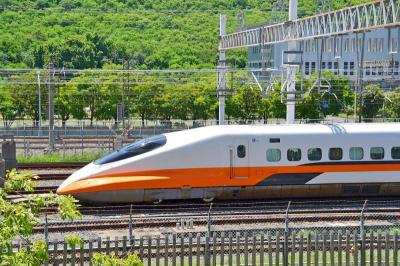
A signaling system malfunction disrupted high-speed rail (HSR) services beginning at 8am today, with trains temporarily reduced to three northbound and three southbound trains per hour as authorities conduct inspections. The malfunction occurred on a section of track in Miaoli County during pre-operation checks early this morning, forcing northbound and southbound trains to use a single track, the HSR operator said. The regular schedule has been replaced with three hourly trains offering only nonreserved seating in each direction, stopping at every station, it said, adding that business class cars would still have reserved seating. Departures from terminal stations are scheduled at the top

DRONE CENTRAL: Taiwan aims to become Asia’s democratic hub for drones, with most exports focused on high-quality military-grade models, an official said Taiwan’s drone industry is expected to expand significantly by 2030, producing 100,000 units per month and exporting half of them, the Ministry of Economic Affairs said yesterday. Current drone production capacity is about 15,000 units per month, but the industry can quickly scale up as demand increases, Industrial Development Administration Director-General Chiou Chyou-huey (邱求慧) told a news conference in Taipei. Taiwan’s drone output grew 2.5-fold last year to NT$12.9 billion (US$408.3 million) under a government program to develop the uncrewed vehicle sector, he said. The Executive Yuan in October last year approved plans to invest NT$44.2 billion into domestic production of uncrewed aerial
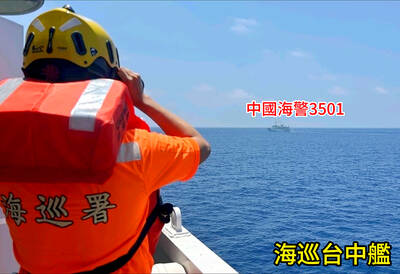
VERBOSE VESSELS: A CGA cutter and a China Coast Guard exchanged verbal barbs for more than a day in Taiwanese-controlled waters before the Chinese vessel left The Taiwanese and Chinese coast guards had a standoff near the strategically located Pratas Islands (Dongsha Islands, 東沙群島) in the north of the South China Sea, the Coast Guard Administration (CGA) said yesterday. The two sides engaged in intense radio exchanges over sovereignty claims during the 33-hour standoff. China Coast Guard vessel 3501 eventually left the restricted waters, 26.6 nautical miles (49.2km) west of the Pratas Islands, at 5pm yesterday, the CGA said. Lying approximately between southern Taiwan and Hong Kong, the Taiwan-controlled Pratas are seen by some security experts as vulnerable to Chinese attack due to their distance — more than
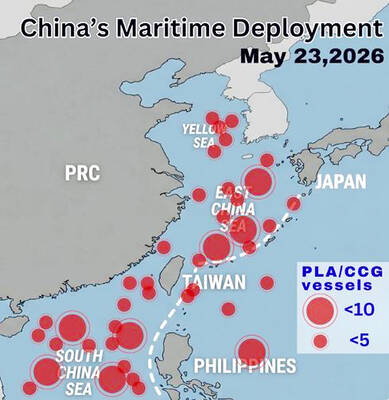
WARNING: China should stop engaging in actions that undermine regional peace and stability, as it would only build resentment among people across the Strait, the CGA said China has deployed more than 100 navy, coast guard and other vessels in waters from the Yellow Sea to the South China Sea and the western Pacific since US President Donald Trump and Chinese President Xi Jinping (習近平) met in Beijing, National Security Council Secretary-General Joseph Wu (吳釗燮) said yesterday. “In this part of the world, #China is the one & only PROBLEM wrecking the #StatusQuo & threatening regional peace & stability,” Wu wrote on X. In a separate post, he said Beijing was coercing Taiwan’s maritime domain, calling it illegal and provocative, after the Coast Guard Administration (CGA) expelled a


 RSS
RSS