


Taipei City health officials yesterday announced that some condoms sold in vending machines at gas station bathrooms operated by Chinese Petroleum Corp have not been tested or licensed, and so could be defective.
The discovery was first made on Oct. 28, and the company could face fines of up to NT$150,000 (US$4,450). Chinese Petroleum Corp has since unplugged the bathroom vending machines that sold the condoms.
The dicey condoms were marked in English with the brand names "QK" and "Eagle," and listed Suretex Ltd as the manufacturer, with an expiration date of December, 2009.
They were sold in a package with tissues for NT$10 in vending machines at 19 locations, including branches at Dingzhou Road, Guilin Road, and Guangfu N Road.
Officials from Taipei City Government's Department of Health said that the supplier had not applied for a medical appliance vending license, and thus the condoms had not undergone safety checks and testing.
Since this past June, condom manufacturers must have their products registered and need to obtain a valid patent number before they can be sold, in line with the Pharmaceutical Affairs Law (
The condoms had no Chinese instructions, which is also against the law.
Chiang Yu-mei (
Asked what danger the condoms may pose, Chiang said, "If they are faulty, then they may well have a wide range of important medical repercussions."
She said that tests will be conducted to check the safety of these condoms.
The vendors have since applied for a license, but Chiang said that pending approval, it is illegal for Chinese Petroleum Corp to sell the rubbers.

The nation’s fastest supercomputer, Nano 4 (晶創26), is scheduled to be launched in the third quarter, and would be used to train large language models in finance and national defense sectors, the National Center for High-Performance Computing (NCHC) said. The supercomputer, which would operate at about 86.05 petaflops, is being tested at a new cloud computing center in the Southern Taiwan Science Park in Tainan. The exterior of the server cabinet features chip circuitry patterns overlaid with a map of Taiwan, highlighting the nation’s central position in the semiconductor industry. The center also houses Taiwania 2, Taiwania 3, Forerunner 1 and
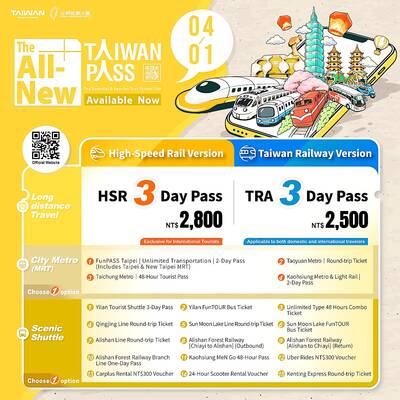
MORE POPULAR: Taiwan Pass sales increased by 59 percent during the first quarter compared with the same period last year, the Tourism Administration said The Tourism Administration yesterday said that it has streamlined the Taiwan Pass, with two versions available for purchase beginning today. The tourism agency has made the pass available to international tourists since 2024, allowing them to access the high-speed rail, Taiwan Railway Corp services, four MRT systems and four Taiwan Tourist Shuttles. Previously, five types of Taiwan Pass were available, but some tourists have said that the offerings were too complicated. The agency said only two types of Taiwan Pass would be available, starting from a three-day pass with the high-speed rail and a three-day pass with Taiwan Railway Corp. The former costs NT$2,800
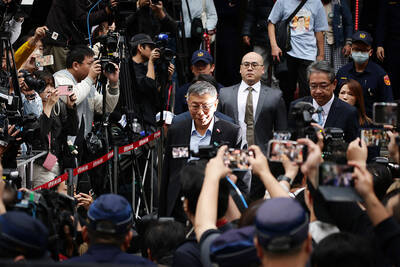
FIRST TRIAL: Ko’s lawyers sought reduced bail and other concessions, as did other defendants, but the bail judge denied their requests, citing the severity of the sentences Former Taipei mayor Ko Wen-je (柯文哲) was yesterday sentenced to 17 years in prison and had his civil rights suspended for six years over corruption, embezzlement and other charges. Taipei prosecutors in December last year asked the Taipei District Court for a combined 28-year, six-month sentence for the four cases against Ko, who founded the Taiwan People’s Party (TPP). The cases were linked to the Core Pacific City (京華城購物中心) redevelopment project and the mismanagement of political donations. Other defendants convicted on separate charges included Chinese Nationalist Party (KMT) Taipei City Councilor Angela Ying (應曉薇), who was handed a 15-year, six-month sentence; Core Pacific
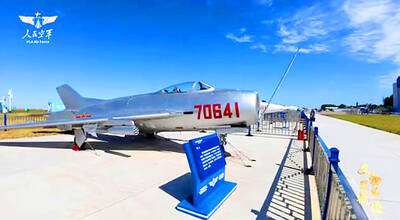
J-6 REMODEL: The converted drones are part of Beijing’s expanding mix of airpower weapons, including bombers with stand-off missiles and UAV swarms, the report said China has stationed obsolete supersonic fighters converted to attack drones at six air bases close to the Taiwan Strait, a report published this month by the Arlington, Virginia-based Mitchell Institute for Aerospace Studies said. Satellite imagery of the airfields from the institute’s “China Airpower Tracker” shows what appear to be lines of stubby, swept-winged aircraft matching the shape of J-6 fighters that first flew with the Chinese People’s Liberation Army (PLA) Air Force in the 1960s. Since their conversion to drones, the aircraft have been identified at five bases in China’s Fujian Province and one in Guangdong Province, the report said. J.


 RSS
RSS