


Georgian opposition leader Mikhail Saakashvili claimed victory in the country's presidential elections and vowed to root out corruption after an exit poll showed him with an overwhelming lead.
Saakashvili, the favorite among the six candidates on Sunday's ballot, was the driving force behind the peaceful demonstrations that brought down former President Eduard Shevardnadze in November in what became known as the "rose revolution."
After the polls closed Sunday, Georgian independent television station Rustavi-2 said its exit survey indicated that Saakashvili had won 85.8 percent of the vote. Preliminary results weren't expected until yesterday, but Saakashvili nevertheless claimed victory.
"We've got a very important mandate from our population to clean up the country, to consolidate power here, to make it official, to make it investment friendly, to make it peaceful and prosperous," he said.
Saakashvili, a 36-year-old U.S.-educated lawyer, has pledged to take a hard line against corruption and to work to restore the country's economy, which largely collapsed in the 1990s after the fall of the Soviet Union. Georgia was also ripped by two wars with separatist regions in the 1990s, ransom kidnappings became widespread and relations with its giant neighbor Russia deteriorated.
Shevardnadze had stepped down six weeks ago in the face of massive protests over parliamentary election fraud.
Lining up to vote in Tbilisi, the crumbling capital of the impoverished country, voters expressed optimism and pro-Saakashvili leanings. Some carried roses to the polling stations in commemoration of the flowers distributed to police by anti-Shevardnadze protesters in November as a sign of their peaceful intent.
"For us, it's a real holiday to use our voices to help the country," said Anastasia Kazmina, in her 60s, one of the voters who came in the freezing dawn to cast her ballot early.
The voting was closely watched by more than 500 international observers to ensure the violations and confusions of the Nov. 2 parliamentary elections didn't recur.
"It was, as far as I can tell, a normal election," said USAmbassador Richard Miles. "People voted freely."
About 1.7 million voters were registered ahead of the election, but Georgia has no central database of who lives in the country, so people who weren't on the lists were allowed to register on the day of voting. It was not clear how many people took advantage of that, but Central Elections Commission head Zurab Chiaberashvili said turnout totaled 1.7 million people.
Ultraviolet ink was placed on a finger of each voter and official polling station doors scanned people entering with black lights to ensure that no one was trying to vote more than once.
But aside from that technical innovation, the rest of the voting procedure was primitive. Voters placed their filled-in ballots in envelopes and dropped them into clear plastic boxes.
Final tabulation of the results was not expected until tomorrow.
Also see story:
Russia only wishes Georgia success in its difficult struggle

The nation’s fastest supercomputer, Nano 4 (晶創26), is scheduled to be launched in the third quarter, and would be used to train large language models in finance and national defense sectors, the National Center for High-Performance Computing (NCHC) said. The supercomputer, which would operate at about 86.05 petaflops, is being tested at a new cloud computing center in the Southern Taiwan Science Park in Tainan. The exterior of the server cabinet features chip circuitry patterns overlaid with a map of Taiwan, highlighting the nation’s central position in the semiconductor industry. The center also houses Taiwania 2, Taiwania 3, Forerunner 1 and
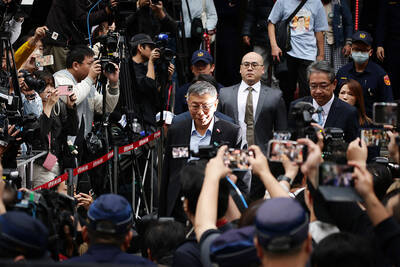
FIRST TRIAL: Ko’s lawyers sought reduced bail and other concessions, as did other defendants, but the bail judge denied their requests, citing the severity of the sentences Former Taipei mayor Ko Wen-je (柯文哲) was yesterday sentenced to 17 years in prison and had his civil rights suspended for six years over corruption, embezzlement and other charges. Taipei prosecutors in December last year asked the Taipei District Court for a combined 28-year, six-month sentence for the four cases against Ko, who founded the Taiwan People’s Party (TPP). The cases were linked to the Core Pacific City (京華城購物中心) redevelopment project and the mismanagement of political donations. Other defendants convicted on separate charges included Chinese Nationalist Party (KMT) Taipei City Councilor Angela Ying (應曉薇), who was handed a 15-year, six-month sentence; Core Pacific
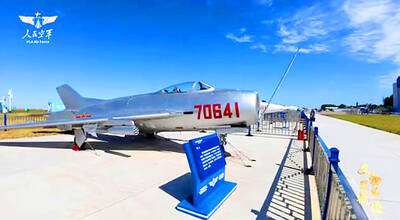
J-6 REMODEL: The converted drones are part of Beijing’s expanding mix of airpower weapons, including bombers with stand-off missiles and UAV swarms, the report said China has stationed obsolete supersonic fighters converted to attack drones at six air bases close to the Taiwan Strait, a report published this month by the Arlington, Virginia-based Mitchell Institute for Aerospace Studies said. Satellite imagery of the airfields from the institute’s “China Airpower Tracker” shows what appear to be lines of stubby, swept-winged aircraft matching the shape of J-6 fighters that first flew with the Chinese People’s Liberation Army (PLA) Air Force in the 1960s. Since their conversion to drones, the aircraft have been identified at five bases in China’s Fujian Province and one in Guangdong Province, the report said. J.

China used fake LinkedIn profiles to harvest sensitive data from NATO and EU institutions by soliciting information from staff, a European security source said on Friday. The operation, allegedly orchestrated by the Chinese Ministry of State Security, targeted dozens of employees at the military alliance or EU organizations through fictitious accounts, the source said, confirming reports in French and Belgian media. Posing as recruiters on the online professional networking platform, Chinese spies would initially request paid reports before later soliciting non-public or even classified information. One particularly active fake profile used the name “Kevin Zhang,” claiming to be the head


 RSS
RSS