


Two British men who spent more than a year retracing the rugged route of the 1930s "Long March" by Mao Zedong's (毛澤東) communist guerrillas said yesterday it turned out to be about one-third shorter than reported by Communist Party propaganda.
Ed Jocelyn and Andy McEwan said their findings showed the trek -- a major event in the formative years of the party that took power in 1949 -- to be some 6,000km.
History books often say the Long March covered 10,000km. Some say it was as long as 13,000km.
"Some will get upset at what they see as an attack on a central myth of the revolution. The Long March is the founding myth of the party," McEwan said by mobile telephone from near Yanan, where Mao's forces settled in western China following the march.
Jocelyn, 35, and McEwan, 37, said they had worked in Beijing as editors for English-language publications by the city government. Their background is not in geography or history.
Between 1934 and 1935, fleeing the forces of Chinese Nationalist Party leader Chiang Kai-shek (蔣介石), Mao and his Red Army followers walked through some of China's poorest, most remote areas, from Jiangxi Province in the southeast to Shanxi in the north.
Jocelyn and McEwan completed their journey on Monday. They based their estimate of its length on timed walks, maps and distance markers along the way.
McEwan said the men were "astonished" by the relative freedom the enjoyed during the trek. Many of the areas they passed through were closed to outsiders after the 1949 revolution.
However, he said the pair were detained four times by suspicious local authorities, and once held overnight and bused out of the area the next day. Hardships also included sickness, dog bites and harsh weather.
But McEwan said people along the way were welcoming and excited about the project, often correcting their route and pointing out trails taken by the communists.
Jocelyn said the pair hope to exhibit photographs and other documentation collected during their trip, in part to remind younger generations of Chinese of their history.
"It was still a remarkable achievement in endurance and courage. The fact that it's shorter than originally believed doesn't diminish that in any way," Jocelyn said.
The pair also said they met a woman during their 384-day walk who they claimed might have been a long-lost daughter of Mao, the communist founder who died in 1976.
The woman, 68-year-old Xiong Huazhi, was born at about the same time and place as a daughter reportedly born to Mao and his third wife, He Zizhen, McEwan said.
Mao's child was left with a family in Sichuan Province as the Red Army fled attacks by Chiang. Xiong's family and neighbors told Jocelyn and McEwan that she was Mao's daughter, although no genetic link or other hard evidence has been provided.

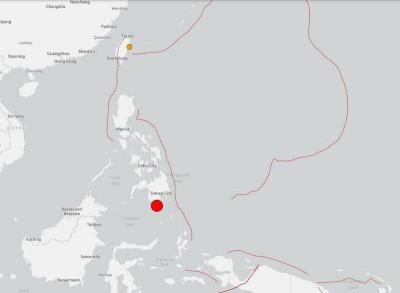
A magnitude 7.8 earthquake struck off the southern coast of Mindanao in the Philippines at 7:38am today, prompting the US Tsunami Warning System to issue an alert for neighboring countries, including Taiwan. The system issued a purple alert indicating a "tsunami threat." The potential threat zone includes Taiwan, the Philippines, Papua New Guinea, Yap and Palau. A spokesperson for Indonesia disaster mitigation agency said there were no reports of damage so far. Arlene Hollero, disaster chief of Maasim town in the Philippines' Sarangani Province, said their evacuation was underway in coastal villages and there were no reported casualties so far. DZBB radio, broadcasting from the

RESILIENCE: Taiwan plays a key role in semiconductors, energy, information infrastructure and advanced manufacturing, AIT Director Raymond Greene said Taiwan’s continued investment in deterrence and resilience remains vital, especially in uncrewed systems and other emerging technologies, American Institute in Taiwan (AIT) Director Raymond Greene said yesterday. Greene made the remarks at the annual National Strategic Summit on Supply Chain Resilience held by the Research Institute for Democracy, Society and Emerging Technology (DSET), a government-backed think tank. As Taiwan last year became the US’ fourth-largest trading partner and supply chain security is becoming more important, cooperation in emerging technologies continues to deepen between the two countries, he said. The US is committed to accelerating innovation, building key infrastructure, strengthening cooperation

The National Chungshan Institute of Science and Technology yesterday showcased its locally developed variants of the Vision 60 robotic patrol dog, which it plans to deploy on the nation’s outlying territories in the South China Sea. The variants were produced under the Joint Lab project — created by the institute and domestic companies — and assembled with domestically produced motors, lenses and artificial intelligence (AI) systems alongside licensed tech from the US, Missile and Rocket Systems Research Division deputy director Jen Kuo-kang (任國光) told the media event at a military base in Taipei’s Dazhi (大直) area. Taiwan has built up its strengths

RIGHT DIRECTION: Taiwan’s efforts to prevent forced labor include a proposal to ‘fully prohibit’ employers from withholding workers’ documents, an official said Taiwan is to establish a mechanism to restrict imports of goods linked to forced labor, the Executive Yuan said yesterday, after the US proposed imposing additional tariffs on Taiwanese goods over labor concerns. “The Ministry of Labor and the Ministry of Economic Affairs are to establish an interministerial review procedure,” Executive Yuan spokesperson Michelle Lee (李慧芝) said at a news briefing in Taipei. “The government is to use the Foreign Trade Act [貿易法] as the legal basis to restrict imports of goods produced with forced labor” and bring its supply chain governance more in line with international standards on human rights, resilience


 RSS
RSS