


In yet another policy U-turn, the Executive Yuan announced yesterday that it will halt a plan to study the circulation and financial resources of the print media and will "adjust" the controversial items of an evaluation report on the news coverage of the mainstream Chinese-language newspapers.
"Although the study plans are well-intended and referential in nature, we'd rather drop them if they cause controversy and misunderstanding," Cabinet Spokesman Lin Chia-lung (林佳龍) quoted Premier Yu Shyi-kun as saying yesterday morning.
Lin made the remark after receiving a mobile telephone call from Yu during the press conference held after the weekly closed-door Cabinet affairs meeting.
The controversy started Monday when the Government Information Office (GIO) announced that it had awarded NT$950,000 to the Foundation for the Advancement of Media Excellence (
The foundation would look into the six dailies' news coverage from page one to page four from the perspective of justice, objectivity, appropriateness and accuracy. Results of the evaluation would be released every two months.
Although the GIO claimed that the practice has been going on since the KMT administrations, the media have berated the government for violating their freedom of speech.
The GIO had also planned to finance another private organization to study the basic structural elements of the print media. Study items would include the circulation volume, circulation area, manpower and financial resources of the nation's newspapers and magazines and the impact of the nation's accession to the WTO has had on the print media.
Yu said yesterday, however, that the tender for this NT$3 million project had been cancelled.
Stressing the government's commitment to free speech and a free press, Yu said that the Cabinet's stance on the matter was clear.
"We totally respect the development space of the media and we'll do whatever it takes to safeguard liberty, democracy, freedom of speech and freedom of the press," Yu said.
Yu, however, called on the media to practice self-discipline to ensure that the public interest is safeguarded.
"While the electronic media is regulated by the Broadcasting and Television Law (廣電法), the print media is not bound by any existing legislation," Yu said. "We're more than happy to let private organizations take the initiative to review the performance of the media if they're interested in or capable of doing it."
According to GIO Director-General Arthur Iap (葉國興), several private organizations have approached the Foundation for the Prevention of Public Damage by the Media to provide funding to carry out the project.
"If we've gained anything from this incident, it's the public awareness of the financial plight of private organizations," he said. "We're more than happy to let go of the project."
Iap said that there was nothing new in the government entrusting private organizations to review the performance of the print media.
"During the KMT administrations, a non-profit private organization, the National Press Council of the Republic of China (新聞評議委員會), was the appointed organization to carry out such work," Iap said. "We didn't expect the plan, the first of its kind to award the contractor via open bidding, to cause so much controversy."
Iap also dismissed media reports that the GIO is planning to revive the Publishing Law (
"We're just studying how to regulate new forms of publications such as electronic books, music CDs, cassette tapes and so on," he said. "Even if there is a public consensus that a law should be enacted to manage such publications, the legislation would only be a basic law and not specify any punishment."
Iap brushed aside media speculation that President Chen Shui-bian (陳水扁) played a role in the government's policy U-turn.
"The president has never tried to sway the decision-making of the Cabinet in this matter," he said. "Our stance is in line with that of the Presidential Office and we're in close contact with each other."
Also See Story:
Media watchdog vows to press ahead
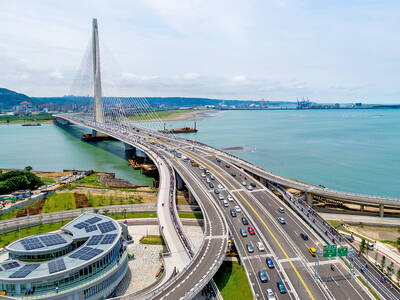
The Ministry of Transportation and Communications yesterday inaugurated the Danjiang Bridge across the Tamsui River in New Taipei City, saying that the structure would be an architectural icon and traffic artery for Taiwan. Feted as a major engineering achievement, the Danjiang Bridge is 920m long, 211m tall at the top of its pylon, and is the longest single-pylon asymmetric cable-stayed bridge in the world, the government’s Web site for the structure said. It was designed by late Iraqi-British architect Zaha Hadid. The structure, with a maximum deck of 70m, accommodates road and light rail traffic, and affords a 200m navigation channel for boats,
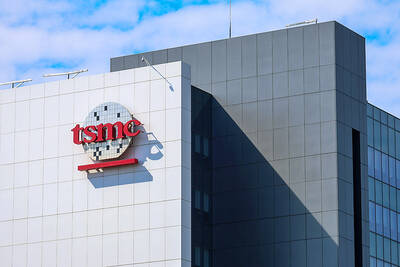
Taiwan Semiconductor Manufacturing Co (TSMC, 台積電), the world’s largest foundry service provider, yesterday said that global semiconductor revenue is projected to hit US$1.5 trillion in 2030, after the figure exceeds US$1 trillion this year, as artificial intelligence (AI) demand boosts consumption of token and compute power. “We are still at the beginning of the AI revolution, but we already see a significant impact across the whole semiconductor ecosystem,” TSMC deputy cochief operating officer Kevin Zhang (張曉強) said at the company’s annual technology symposium in Hsinchu City. “It is fair to say that in the past decade, smartphones and other mobile devices were
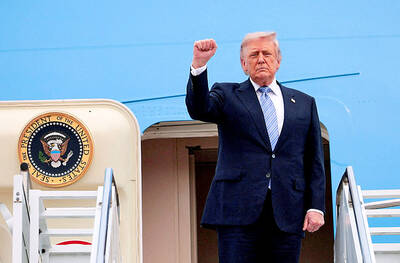
US-CHINA SUMMIT: MOFA welcomed US reassurance of no change in its Taiwan policy; Trump said he did not comment when Xi talked of opposing independence US President Donald Trump yesterday said he has not made a decision on whether to move forward with a major arms package for Taiwan after hearing concerns about it from Chinese President Xi Jinping (習近平). Trump’s comments on Taiwan came as he flew back to Washington after wrapping up critical talks in which both leaders said important progress was made in stabilizing US-China relations even as deep differences persist between the world’s two biggest powers on Iran and Taiwan. “I will make a determination,” Trump said, adding: “I’ll be making decisions. But, you know, I think the last thing we need right
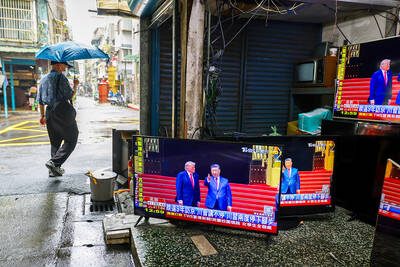
TAIWAN ISSUE: US treasury secretary Scott Bessent said on the first day of meetings that ‘it wouldn’t be a US-China summit without the Taiwan issue coming up’ There were no surprises on the first day of the summit between US President Donald Trump and Chinese President Xi Jinping (習近平), the Mainland Affairs Council (MAC) said yesterday, as the government reiterated that cross-strait stability is crucial to the Asia-Pacific region, as well as the world. As the two presidents met for a highly anticipated summit yesterday, Chinese state media reported that Xi warned Trump that missteps regarding Taiwan could push their two countries into “conflict.” Trump arrived in China with accolades for his host, calling Xi a “great leader” and “friend,” and extending an invitation to visit the White House


 RSS
RSS