


Driven from power by a devastating economic crisis and deadly riots, outgoing President Fernando De la Rua returned to his offices for a last time yesterday to await the handover to a caretaker government.
Looking somber in a dark suit, De la Rua arrived at the Casa Rosada, or Government House, and lashed out at the opposition Peronists for failing to join him in a government of "national unity."
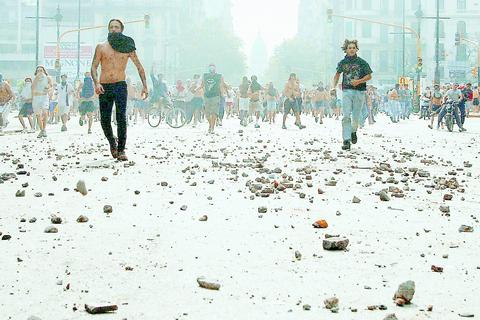
PHOTO: AFP
"The Peronists made a mistake," said De la Rua, saying their refusal to join him in a reorganized government as he had requested Thursday had hastened events that triggered his downfall.
Technically, De la Rua remained president until his resignation could be formally approved by Congress later yesterday. He said he wanted to cancel a state of siege he imposed Wednesday. "I would like that to be my last act in government," he said.
Facing riots and unrest that have since claimed 22 lives, De la Rua took up the emergency powers to forbid public gatherings and grant security forces greater powers of arrest.
De la Rua resigned late Thursday and flew from the government palace in a helicopter, driven out by deepening economic troubles, riots in the capital and looting of homes and supermarkets across Argentina.
It was Argentina's worst unrest in a decade, but the protests had largely subsided late Thursday in the capital though looting continued nationwide.
Police fired rubber bullets and tear gas at thousands of anti-government protesters in the runup to his fall. Rioters looted houses and stores in other cities, and more than 200 people were injured nationwide.
"I'm delighted he's finally gone. Thank God!" said Maria Andrejuk, who was among those celebrating after tensions eased across much of Buenos Aires. But as night fell Thursday, some looting persisted.
Now Argentina's faltering economy awaits the hands of a caretaker government led by the party founded by strongman Juan Peron in the 1940s. The Peronists, who hold a majority in both the Lower House and Senate, will take their turn at trying to tame a crisis that has left the country perilously close to defaulting on its US$132 billion debt burden.
Senate Leader Ramon Puerta was in line to take over yesterday as interim president until a special legislative assembly decides whether to call new elections within months.
Puerta said yesterday he wished only to hold the presidency temporarily -- for 48 hours -- while Congress decides whether to call new elections.
"I've never held a post for which I have not been elected," Puerta told reporters.
"But I will fulfill my duties to the republic in these very difficult moments."
That means Congress must now either select one of Argentina's powerful provincial governors or a member of Congress to take over or call snap elections, analysts say.
They include charismatic for-mer Peronist President Carlos Menem, the most important Argentine politician of the last half century. His privatization drive opened Argentina up to foreign investment, but his legacy was smeared by corruption accusations that he is still battling.
Peronist provincial governors Carlos Ruckauf and Jose Manuel de la Sota, a favorite of foreign investors, are both seen as potential contenders, as is Peronist Senator Eduardo Duhalde -- who also served as vice president under Menem.
Many Peronist leaders said they favored calling new elections in no less than 60 days.
Whoever takes the helm inherits a ship sinking under the weight of its public debt and facing the prospect of insolvency or devaluation. The new leader will also have to wrestle with rampant rioting and looting that has left 24 dead so far and continues to reign.
Trade unions meanwhile have called a general strike until the effective state of emergency -- due to remain in place for 30 days -- is lifted.
De la Rua was departing as one of the most unpopular leaders in Argentina's history having imposed round after round of punishing spending cuts.
In working-class neighborhoods in Buenos Aires province, hordes of teenagers ransacked grocery stores as outnumbered police stood by helplessly on Thursday. Helmeted officers fired tear gas to disperse dozens of looters in a central Buenos Aires neighborhood.
The capital's streets looked like a battleground. Fires smoldered and smoke curled over the Plaza de Mayo outside the ornate pink government palace as thousands gathered to vent anger over the economy and call for De la Rua's ouster.
The US and Britain have urged Argentina to employ democratic means to resolve its crisis, while Brazil's President Fernando Henrique Cardoso said he regretted De la Rua's resignation.
But while words of support poured in from around the globe there were no signs the likes of the US or the International Monetary Fund would pony up more cash.
A recession in its fourth year, 18.3 percent unemployment, relentless pay cuts and tax hikes to service the public debt, plus draconian limits on cash withdrawals to stop a run on banks have effectively strangled the economy.
Every day 2,000 people drop below the poverty line in a country that was one of the wealthiest nations in the early 20th century and is now paying the price of decades of endemic corruption and economic mismanagement.

A signaling system malfunction disrupted high-speed rail (HSR) services beginning at 8am today, with trains temporarily reduced to three northbound and three southbound trains per hour as authorities conduct inspections. The malfunction occurred on a section of track in Miaoli County during pre-operation checks early this morning, forcing northbound and southbound trains to use a single track, the HSR operator said. The regular schedule has been replaced with three hourly trains offering only nonreserved seating in each direction, stopping at every station, it said, adding that business class cars would still have reserved seating. Departures from terminal stations are scheduled at the top

DRONE CENTRAL: Taiwan aims to become Asia’s democratic hub for drones, with most exports focused on high-quality military-grade models, an official said Taiwan’s drone industry is expected to expand significantly by 2030, producing 100,000 units per month and exporting half of them, the Ministry of Economic Affairs said yesterday. Current drone production capacity is about 15,000 units per month, but the industry can quickly scale up as demand increases, Industrial Development Administration Director-General Chiou Chyou-huey (邱求慧) told a news conference in Taipei. Taiwan’s drone output grew 2.5-fold last year to NT$12.9 billion (US$408.3 million) under a government program to develop the uncrewed vehicle sector, he said. The Executive Yuan in October last year approved plans to invest NT$44.2 billion into domestic production of uncrewed aerial

VERBOSE VESSELS: A CGA cutter and a China Coast Guard exchanged verbal barbs for more than a day in Taiwanese-controlled waters before the Chinese vessel left The Taiwanese and Chinese coast guards had a standoff near the strategically located Pratas Islands (Dongsha Islands, 東沙群島) in the north of the South China Sea, the Coast Guard Administration (CGA) said yesterday. The two sides engaged in intense radio exchanges over sovereignty claims during the 33-hour standoff. China Coast Guard vessel 3501 eventually left the restricted waters, 26.6 nautical miles (49.2km) west of the Pratas Islands, at 5pm yesterday, the CGA said. Lying approximately between southern Taiwan and Hong Kong, the Taiwan-controlled Pratas are seen by some security experts as vulnerable to Chinese attack due to their distance — more than
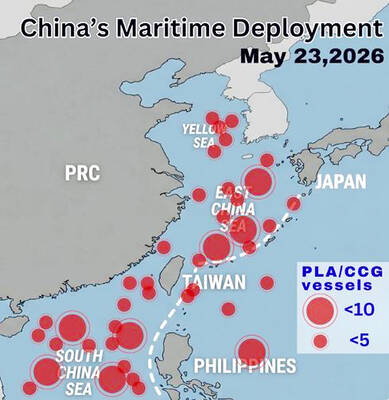
WARNING: China should stop engaging in actions that undermine regional peace and stability, as it would only build resentment among people across the Strait, the CGA said China has deployed more than 100 navy, coast guard and other vessels in waters from the Yellow Sea to the South China Sea and the western Pacific since US President Donald Trump and Chinese President Xi Jinping (習近平) met in Beijing, National Security Council Secretary-General Joseph Wu (吳釗燮) said yesterday. “In this part of the world, #China is the one & only PROBLEM wrecking the #StatusQuo & threatening regional peace & stability,” Wu wrote on X. In a separate post, he said Beijing was coercing Taiwan’s maritime domain, calling it illegal and provocative, after the Coast Guard Administration (CGA) expelled a


 RSS
RSS