


Under heavy pressure from environmentalists and residents in southern Taiwan, a committee under the Cabinet-level Environmental Protection Administration (EPA) decided yesterday to postpone sending a plan for the controversial Pinnan Industrial Complex (濱南?u業區) for a final EPA review next month.
At an Environmental Impact Assessment (EIA) review meeting for the project yesterday, the project's developers, the Tuntex Group (
In addition, the developers said several controversial environmental issues, including the project's possible impact on the ecological system, the loss of lagoons and soil liquefaction, had been studied comprehensively and no problems had been found.
Environmentalists differed, however, saying the area's coastal ecology would be destroyed once the Chiku lagoon (?C股溼|a) is transformed into an industrial park.
By then, they said, all the endangered black-faced spoonbills, which now reportedly number less than 600 globally, would be gravely endangered for lack of wintering sites.
Environmental activists said at the meeting that the Pinnan project should be cancelled immediately because the Chiku lagoon has been classified by Bird Life International, an organization that has worked in cooperation with the Council of Agriculture (COA
EPA officials decided yesterday to allow experts to investigate the proposed field at the southern site again, to study the possible impact on the ecology of the Chiku lagoon near the Tsengwen River Estuary (
Environmentalists have been working to persuade the EPA to prohibit the use of the lagoon for industrial development since 1993, when the Tuntex Group and Yieh-loong Co first proposed building the industrial complex, which is to include a petrochemical plant and a steel-making facility.
Legislators opposed to the project said at the meeting yesterday that the report provided by the developers was "tricky" to evaluate.
"We see obvious faults in the EIA process. It's very hard to convince us that the report is true, because the environmental engineering consultant was hired by the developers," said Su Huan-chih (
"I would lose faith in the government if the Pinnan project -- reflecting the contradictory policies of this country -- is approved," Su said.
Su said that in any case, high water-demand industries should not be encouraged in their development, since Taiwan is plagued by a chronic lack of water resources.
Other officials, including the county commissioner, claimed they had a different perspective.
"Development does hurt the environment. But as a commissioner, I cannot look at this matter only from the angle of environmental protection," Chen Tang-shan (
Chou Wu-liu (
The politicians' remarks did not go down well among local fishermen from Chiku, who expressed their anger by banging on several tables at the meeting.
"The only thing I care about is the oyster fields where I have spent my entire lifetime. Am I wrong to fight for my right to live?" one long-time oyster farmer said.
"I don't understand why we fishermen have become third-class citizens in our own country. The government always takes coastal land to build industrial parks," he said.
Environmentalists said yesterday that they would highlight several ecology-related issues, such as carbon dioxide emissions from the proposed site, to organizations in the international community in a bid to pressure the government to reconsider its industrial development policy.
"In the Pinnan project, we see that people's right to live has been ignored by the government and industry. We can never restore the ecology once they start to build the complex," said Huang Min-ching (

The nation’s fastest supercomputer, Nano 4 (晶創26), is scheduled to be launched in the third quarter, and would be used to train large language models in finance and national defense sectors, the National Center for High-Performance Computing (NCHC) said. The supercomputer, which would operate at about 86.05 petaflops, is being tested at a new cloud computing center in the Southern Taiwan Science Park in Tainan. The exterior of the server cabinet features chip circuitry patterns overlaid with a map of Taiwan, highlighting the nation’s central position in the semiconductor industry. The center also houses Taiwania 2, Taiwania 3, Forerunner 1 and

MORE POPULAR: Taiwan Pass sales increased by 59 percent during the first quarter compared with the same period last year, the Tourism Administration said The Tourism Administration yesterday said that it has streamlined the Taiwan Pass, with two versions available for purchase beginning today. The tourism agency has made the pass available to international tourists since 2024, allowing them to access the high-speed rail, Taiwan Railway Corp services, four MRT systems and four Taiwan Tourist Shuttles. Previously, five types of Taiwan Pass were available, but some tourists have said that the offerings were too complicated. The agency said only two types of Taiwan Pass would be available, starting from a three-day pass with the high-speed rail and a three-day pass with Taiwan Railway Corp. The former costs NT$2,800

FIRST TRIAL: Ko’s lawyers sought reduced bail and other concessions, as did other defendants, but the bail judge denied their requests, citing the severity of the sentences Former Taipei mayor Ko Wen-je (柯文哲) was yesterday sentenced to 17 years in prison and had his civil rights suspended for six years over corruption, embezzlement and other charges. Taipei prosecutors in December last year asked the Taipei District Court for a combined 28-year, six-month sentence for the four cases against Ko, who founded the Taiwan People’s Party (TPP). The cases were linked to the Core Pacific City (京華城購物中心) redevelopment project and the mismanagement of political donations. Other defendants convicted on separate charges included Chinese Nationalist Party (KMT) Taipei City Councilor Angela Ying (應曉薇), who was handed a 15-year, six-month sentence; Core Pacific
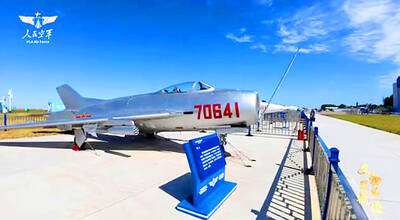
J-6 REMODEL: The converted drones are part of Beijing’s expanding mix of airpower weapons, including bombers with stand-off missiles and UAV swarms, the report said China has stationed obsolete supersonic fighters converted to attack drones at six air bases close to the Taiwan Strait, a report published this month by the Arlington, Virginia-based Mitchell Institute for Aerospace Studies said. Satellite imagery of the airfields from the institute’s “China Airpower Tracker” shows what appear to be lines of stubby, swept-winged aircraft matching the shape of J-6 fighters that first flew with the Chinese People’s Liberation Army (PLA) Air Force in the 1960s. Since their conversion to drones, the aircraft have been identified at five bases in China’s Fujian Province and one in Guangdong Province, the report said. J.


 RSS
RSS