


A spate of executions on Wednesday, in which notorious criminal Chen Chin-hsing (陳進興) and seven others were shot dead, has prompted heated debate here on the death penalty.
According to Amnesty International, which has long campaigned for the abolition of the death penalty, the 105 countries which have ended capital punishment by legislation or abstention from practice, now surpass in number the 90 that still use it.
Among those 90 countries, just a few account for most of the world's executions: China, the Congo, the US and Iran. Taiwan, where more than one hundred death row inmates have been executed in the last five years, is perceived as no less harsh in its implementation of capital punishment.

PHOTO: CHUNG KUO-WEI, LIBERTY TIMES
"There is no question Taiwan ranks on the list of countries which account for the majority of the world's executions. But is it something we should be proud of?" asked Peter Ng (黃文雄) of the Taiwan Association for Human Rights.
"The reality is Taiwan will be seen as barbaric as long as it retains this inhuman punishment," he said.
The death penalty is used in Taiwan for a range of offenses and is mandatory for 65 different offenses. Human rights activists believe the number of executions has increased in recent years following a public outcry over several kidnap and murder cases between 1996 and 1997. Former Taoyuan County Commissioner Liu Pang-you (劉邦友) and seven others were assassinated at his home in November 1996; the DPP women's affairs department chief Peng Wan-ru (彭婉如) was killed in December, 1996; and Pai Hsiao-yen (白曉燕), the daughter of a TV celebrity, was kidnapped and murdered in April 1997.
Thirty-two people were executed in 1998, 38 in 1997, and 22 in 1996. The executions Wednesday marked a record for Taiwan's justice system, with eight people executed in a single day.
Lee Ching-chuan (
"Combating crime is like treating illnesses. The more serious the illness, the stronger the prescription to be used. The death penalty, which we see as the most severe punishment, is well used to treat those people for whom no prescription works," Lee said.
Few politicians, meanwhile, dare defy the public's preference for social order, and perception of what contributes to that, over considerations of human rights The Ministry of Justice conducted a study on the merits of capital punishment and assessed public support for it in 1994. The study showed at that time more than 70 percent of respondents supported the death penalty.
Public outrage over crimes such as those committed by Chen Chin-hsing has discouraged politicians from supporting the abolition of the death penalty. In cases such as Chen's, it would be even more difficult for politicians to address the issue of human rights.
"Elections are everything, which is true politically, economically and socially. Politicians could speak of human rights when they think voters want them to. But talk of humanism disappears when the general public demands social order over protection of human rights," said Lin Shan-tien (林山田), a criminal law professor at National Taiwan University.
The trend internationally has been to abolish the death penalty and institute rehabilitation programs. Abolition of the death penalty has been called for in three international treaties, optional protocols to the European and American conventions on human rights, and to the International Covenant on Civil and Political Rights. In April this year, the annual meeting of the United Nation Commission on Human Rights in Geneva passed a resolution calling for restriction or eventual abolition of the death penalty.
In Taiwan, campaigning for abolition of the death penalty did not catch public attention until June 1996, when a campaign was staged by local residents and international human rights organizations to save three death row inmates, known as the Hsichih Trio, Liu Bin-lang (
Charged in a 1991 double murder, the three men received mandatory death sentences and have been awaiting execution. It is alleged that the confessions used as the convicting evidence in their cases were extracted by torture, casting doubt over the legal process in their convictions.
The Hsichih Trio case has become central to the island's anti-capital punishment campaign because of compelling evidence that the island's criminal justice system is deeply flawed.
Because of this evidence, Minister of Justice Yeh Chin-feng (葉金鳳) has yet to sign an execution order for the three men. But she did sign the execution orders for the eight inmates last week, despite their having been convicted under the disputed Act for the Control and Punishment of Banditry (
Peter Ng believes that Wednesday's executions marked a dark chapter in the history of Taiwan's justice, and warned that capital punishment was fundamentally flawed regardless of the controversies surrounding the law.
"How can we be convinced a miscarriage of justice didn't occur in one of the eight cases? Capital punishment is dangerous because it's impossible to rectify mistakes once an execution is carried out," said Ng. "How the hell could these people be executed when the Banditry Law is still in question?"

SILENCING CRITICS: In addition to blocking Taiwan, China aimed to prevent rights activists from speaking out against authoritarian states, a Cabinet department said The Ministry of Foreign Affairs (MOFA) yesterday condemned transnational repression by Beijing after RightsCon, a major digital human rights conference scheduled to be held in Zambia this week, was abruptly canceled due to Chinese pressure over Taiwanese participation. This year’s RightsCon, the world’s largest conference discussing issues “at the intersection of human rights and technology,” was scheduled to take place from tomorrow to Friday in Lusaka, and expected to draw 2,600 in-person attendees from 150 countries, along with 1,100 online participants. However, organizers were forced to cancel the event due to behind-the-scenes pressure from China, the ministry said, expressing its “strongest condemnation”

Taiwan’s economy grew far faster than expected in the first quarter, as booming demand for artificial intelligence (AI) applications drove a surge in exports, spilling over into investment and consumption, the Directorate-General of Budget, Accounting and Statistics (DGBAS) said yesterday. GDP growth was 13.69 percent year-on-year during the January-to-March period, beating the DGBAS’ February forecast by 2.23 percentage points and marking the most robust growth in nearly four decades, DGBAS senior official Chiang Hsin-yi (江心怡) told a news conference in Taipei. The result was powered by exports, which remain the backbone of Taiwan’s economy, Chiang said. Outbound shipments jumped 51.12 percent year-on-year to
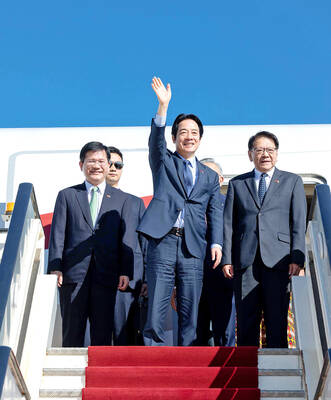
DELAYED BUT DETERMINED: The president’s visit highlights Taiwan’s right to international engagement amid regional pressure from China President Willaim Lai (賴清德) yesterday arrived in Eswatini, more than a week after his planned visit to Taiwan’s sole African ally was suspended because of revoked overflight permits. “The visit, originally scheduled for April 22, was postponed due to unforeseen external factors,” Lai wrote on social media. “After several days of careful arrangements by our diplomatic and national security teams, we successfully arrived today.” Lai said he looked forward to further deepening Taiwan-Eswatini relations through closer cooperation in the economy, agriculture, culture and education, as well as advancing the nation’s international partnerships. The president was initially scheduled to arrive in time to celebrate

Iran’s Islamic Revolutionary Guard Corp (IRGC) yesterday said the US faced a choice between an “impossible” military operation or a “bad deal” with Tehran, after US President Donald Trump disparaged Iran’s latest peace proposal. Negotiations between the two countries have been deadlocked since a ceasefire came into effect on April 8, with only one round of direct peace talks held so far. Iran’s Tasnim and Fars news agencies reported that Tehran had submitted a 14-point proposal to mediator Pakistan, but Trump was quick to cast doubt on it. “I will soon be reviewing the plan that Iran has just sent to us, but


 RSS
RSS