

Tattoo artist Remy painstakingly injects tiny dots of pigment into Koki Hatanaka’s bald scalp to mimic hair follicles, performing a grey-zone cosmetic procedure increasingly in the crosshairs of Japanese health authorities.
Japan bucks a global trend by viewing permanent make-up as the domain of medical professionals, and has ramped up threats of criminal prosecution against anyone else who practices it — like the 44-year-old Okinawan.
Industry insiders insist that their craft, from make-believe hair to filled-in eyebrows and lip tints, is an artistic pursuit more befitting tattooists and hairstylists.
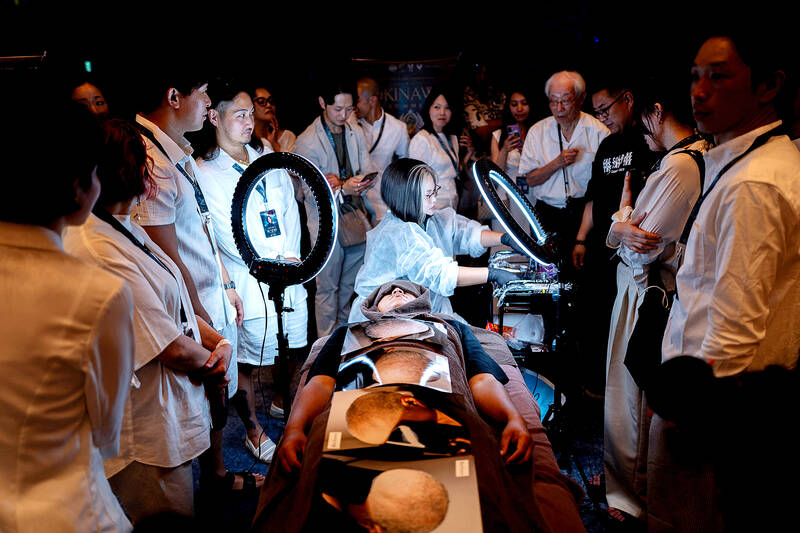
Photo: AFP
But in a country where body art has long symbolized yakuza gangsters, these cosmetic tattooists’ safety and sanitary protocols are not enough to dispel skepticism.
“It’s a complete mystery to me why they keep saying this constitutes a medical practice,” Remy — his professional name — said as he used a fine needle to ink 28-year-old Hatanaka.
The procedure known as scalp micropigmentation (SMP) is “hardly invasive” and “so painless that clients sometimes even fall asleep,” while requiring sophisticated aesthetic talent, Remy argues.
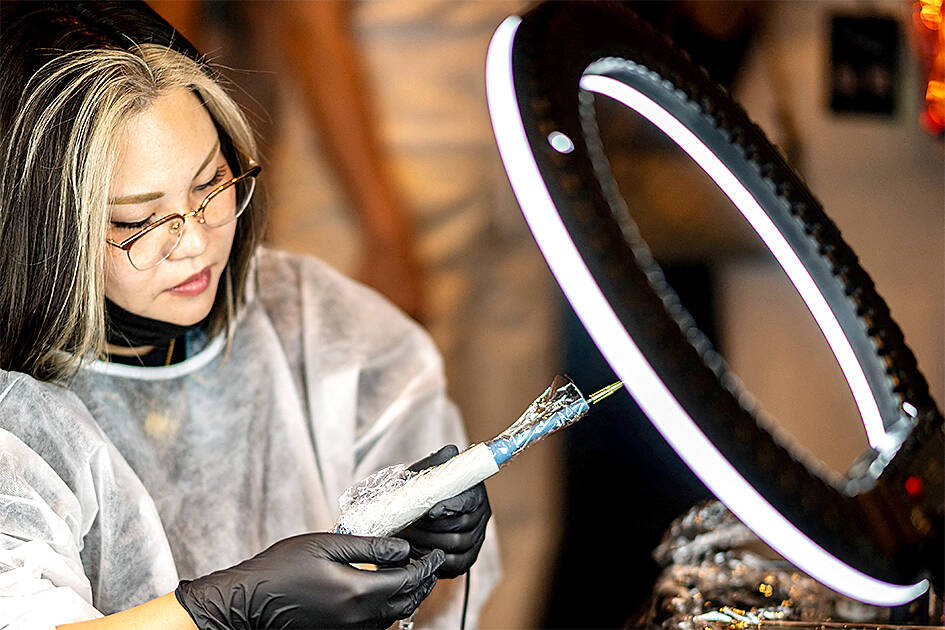
Photo: AFP
And it is an important job: a sudden onslaught of alopecia — the medical term for hair loss — once plunged Hatanaka into despair.
“I didn’t even want to go outside,” said the marine sports instructor, whose style now passes for a buzz cut.
“If I hadn’t done this, I wouldn’t have become brave enough to strike up conversations with strangers,” he said.
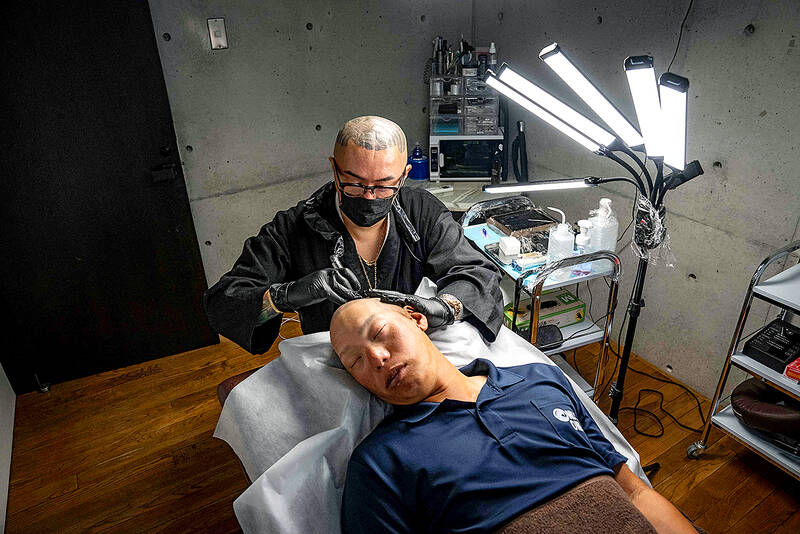
Photo: AFP
“I’m more confident in myself now.”
RISKY NEEDLES
A landmark Supreme Court ruling in 2020 declared traditional decorative tattooing a non-medical act, welcome news for an industry long run by artists with no clinical training.
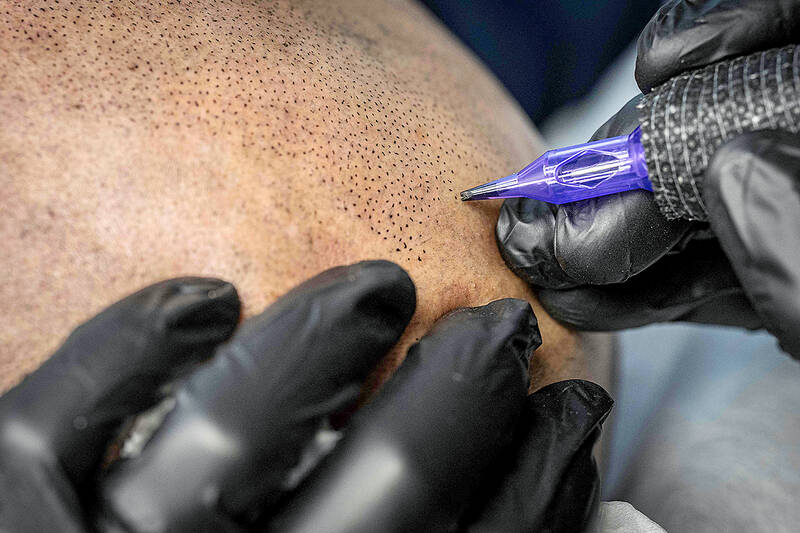
Photo: AFP
But the same did not apply to SMP, which has “an established history of doctors’ involvement,” said a health ministry official.
The use of needles makes it a “risky enough practice that it can hurt human bodies if done without medical expertise,” she said.
The ministry has repeatedly warned, most recently in December, that criminal complaints can be filed against unlicensed practitioners, “essentially signaling arrest,” said healthcare law expert Akihiro Saotome.
That notice likely had a “significant chilling effect” on these businesses, he said.
In reality though, a slew of medically unlicensed cosmetic tattooists continue to operate openly, having even rallied together at a flamboyant convention hosted by Remy’s SMP brand, Scalp Ink, in Okinawa last month.
Dozens of beauty specialists, including from South Korea, Vietnam and Sweden, deftly inked the scalps, eyebrows and lips of their models, surrounded by towering banners depicting each participant as oceanic royalty in coral crowns.
They argued that, if anything, permanent make-up is even less medical in nature than tattooing for artistic purposes, because it does not penetrate the skin as deeply.
Otherwise, they said, both follow the same hygiene safeguards, use needles to insert pigment into human skin and are practically indistinguishable.
“I’m doing nothing I should be ashamed of,” said Tatsuki Miyahira, an Okinawa tattooist who also performs SMP. He has no medical license.
If raided, he said, he would “give them a full tour” of his workplace and explain every safety precaution. He added that if Japan officially declared SMP art, “I think I can hold my head even higher.”
WORRIED CUSTOMERS
Experts say Japan and South Korea were long among the few countries that penalized permanent make-up by non-medical personnel — until last year when Seoul passed a landmark law decriminalizing it.
“Why is it only Japan that still can’t do this?” asked hairstylist Michiko Shinmasu, 50, who doubles as an eyebrow tattooist.
The lack of legal endorsement “makes my clients (for eyebrow work) feel as though they’re doing something wrong. They’re like, ‘this is grey-zone, right?’” she said.
Some think Japan’s complicated relationships with tattoos — historically etched on criminals and then favored by mobsters to assert their rebellion — fuel official distrust of the practice.
Even today tattoos are often banned in public places like hot springs, and Japanese are far less inked than their Western counterparts, although this is changing.
“Nowadays lots of people get their bodies inked just for fashion” in Japan, said SMP business operator Yasuaki Sameshima, 41.
“But tattoos of a different kind existed before. I think their negative image is spilling over and shaping the way SMP is perceived today.”
Despite repudiating medical control on his profession, SMP guru Remy agrees it risks infections if done poorly, warning against a completely unregulated approach.
In fact, he campaigns for the systematic accreditation and training of all tattoo artists — cosmetic or not — in an industry he says remains an ungoverned “grey zone.”
“Every country has some kind of license specifically for doing tattoos, but Japan hasn’t created that,” Remy said.
He founded the Japan Tattoo Hygiene Association, with the ultimate goal of making its program mainstream and even mandatory for the opening of tattoo parlors.
“I believe that’s the best way to protect clients and to ensure that tattoos are done under proper hygiene management.”
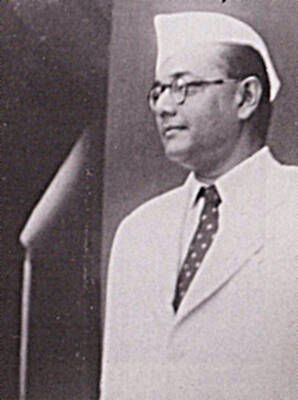
Aug. 17 to Aug. 23 Subhas Chandra Bose was meant to be in Taiwan for no more than two hours. After refueling at today’s Songshan Airport in Taipei, the Mitsubishi Ki-21 bomber carrying the Indian independence leader took off for Japan — and crashed almost immediately. It was Aug. 18, 1945, three days after Japan announced its surrender to the Allies. Bose, who advocated armed struggle to free India from British rule, had worked closely with Imperial Japan. He was attempting to reach the Soviet Union via Manchuria in the hope of gaining support

This week a flood of news on the great divide in Taiwan. Not the Blue-Green one, but the other divide, between the haves and the have-nots. The government announced that real wages (wage growth after inflation) grew 1.16 percent in the first six months of this year, marking the strongest real wage growth in six years for the same period, according to the Directorate General of Budget, Accounting and Statistics (DGBAS). Good news! The statistics also mapped the demographic strain on the workforce: average monthly overtime hours was 17.8 hours per employee in the first half of the year. That was the

These few weeks will decide who ends up on the ballot, and who does not, in this year’s elections. Registration closes on Sep. 4, but until then, politicians may drop in or drop out of the race. Both the pan-green Democratic Progressive Party and the its supporters (DPP) and the pan-blue Chinese Nationalist Party (KMT) have nominated 19 candidates for 22 of the top-level mayor and county commissioner posts. The KMT is also promoting a “great opposition alliance” in the remaining three, backing two independents and one candidate from the KMT-aligned Taiwan People’s Party (TPP). For more context and a
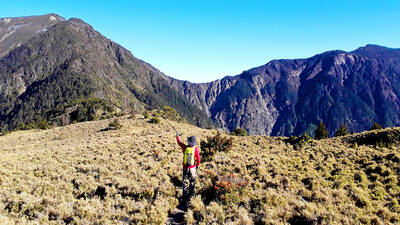
Starting dramatically on a historic trail built by the Japanese above a hot springs town and ending unceremoniously on a muddy, leech-infested forest road after what could be your worst night’s sleep ever in the mountains, the Mabolasi Traverse (馬博拉斯橫斷) is full of challenge and reward. For fit hikers who can survive the former and still enjoy the latter, “Mabo” is the route for you. UP, DOWN AND UP AGAIN The first challenge of the trip: three days of uphill walking with a heavy backpack. From the hot springs town of Dongpu (東埔) in Nantou County, the route follows the Japanese-built Batongguan


 RSS
RSS