

The Chinese Nationalist Party (KMT) and other opposition politicians are “taking Taiwan’s democracy hostage” for selfish gain, The Economist said in a column published online on Tuesday.
“Taiwan’s freedoms should be a strength, raising the costs to China of a takeover. Shamefully, they are being betrayed from within,” the British news magazine said.
While a lot of countries have toxic politicians, Taiwan’s stand out as particularly irresponsible, and “the blame is not evenly distributed,” it said.
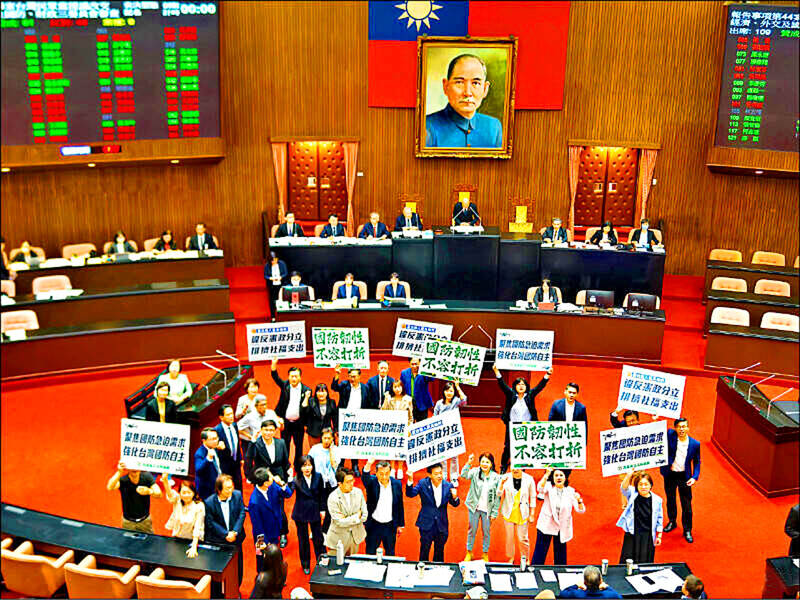
Photo: Chen Yun, Taipei Times
Although President William Lai (賴清德) is stubborn and, unlike his predecessor, does not consult KMT moderates, the opposition has triggered a “rolling constitutional crisis,” holding up government budgets and funding for US arms purchases, blocking judicial appointments, leaving the remaining Constitutional Court justices unsure whether they have a quorum to resolve government gridlock, the magazine said.
Taiwan has an acute need to bolster its self-defense capabilities, particularly as Washington has become an “unreliable friend” under US President Donald Trump, The Economist said.
However, “in a dramatic act of self-harm, the opposition has held up plans to kick-start a domestic drone industry with orders for 210,000 air and sea drones,” it said, adding that Taiwan could also export drones to Western countries desperate for non-Chinese equipment.
Citing interviews with senior KMT officials, the magazine said the party claims to support drone making, but one confided that KMT legislators fear drone funding would be funneled to companies that donate to the Democratic Progressive Party (DPP).
Yet, the magazine said the same KMT insider said that KMT-friendly firms often have investments in China and would “not dare” make drones, it said.
“DPP insiders” say that some in the KMT have effectively become “surrogates” for China, the magazine said, adding that “there is no doubt that Taiwan is the target of Chinese influence operations.”
Young Taiwanese are becoming disillusioned with politics while being bombarded with China-backed “social media mocking Taiwan’s democracy as chaotic,” it said.
Even if China were to take Taiwan, its rule would likely be bloody, The Economist said.
“Chinese officials have talked of the need for re-education campaigns in post-conquest Taiwan,” it said. “On an island of 23 [million] people, where surveys consistently show that a large majority of the public favor some form of self-rule, millions might have to enroll.”
“Imagine a coercive Chinese takeover, brokered by pro-appeasement Taiwanese elites,” it said. “Whose troops would clear the streets, and with what lethal force?”
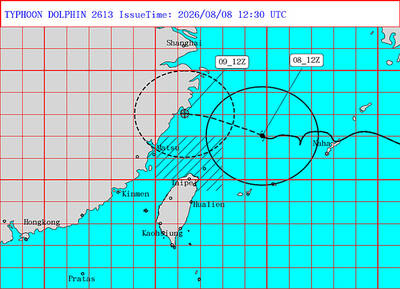
Typhoon Dolphin was expected to make its closest approach to Taiwan yesterday afternoon through today before continuing west toward China, the Central Weather Administration (CWA) said yesterday, forecasting that mountainous areas of Hsinchu and Miaoli could receive the heaviest rainfall, with precipitation expected to reach 350mm to 500mm. The rain could fall within a single day, raising the risk of torrential downpours, the agency warned. The likelihood of a land warning for Taiwan proper has been ruled out, while the chance of a land warning for outlying Lienchiang County has fallen from the previous day’s estimate, it added. If Dolphin’s track and
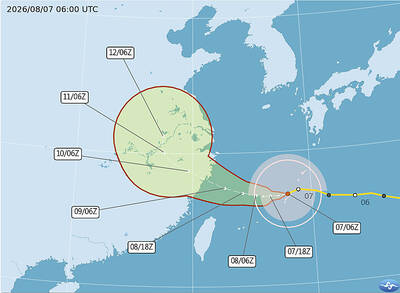
The Central Weather Administration (CWA) issued a sea warning for Typhoon Dolphin at 2:30pm yesterday, as the storm steadily moved toward the waters north of Taiwan, with heavy or extremely heavy rain expected over the weekend in the central mountains and the north. As of 5pm yesterday, Dolphin was about 680km east-northeast of Taipei and moving west at 10kph, with maximum sustained winds of 144kph and a storm radius of 280km, CWA data showed. While the typhoon has slowed slightly, it remains within forecast expectations and would not be longer than previously predicted, CWA forecaster Chu Mei-lin (朱美霖) told a news conference. The
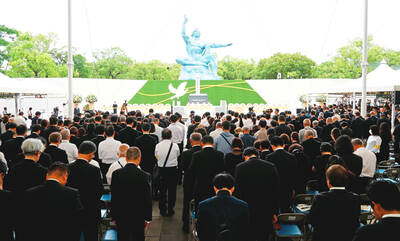
‘IRONIC’: The Nagasaki memorial calls for the abolition of nuclear weapons and peace, but it sided with China, which has been threatening peace in the Strait, an official said Taipei yesterday protested the seating arrangement at the Nagasaki atomic bombing memorial ceremony, saying that the Nagasaki City Government’s decision to place its representative outside the diplomatic delegation area slighted Taiwan’s national status and played into Beijing’s efforts to suppress the nation. Representative to Japan Lee Yi-yang (李逸洋) said he declined to attend the event, because the seat placement deliberately diminished Taiwan’s status and dignity, with Chen Ming-chun (陳銘俊), head of the Fukuoka Branch of the Taipei Economic and Cultural Office in Osaka, attending in his place. Taiwan is known worldwide for its commitment to peace and democracy, Lee said, adding that
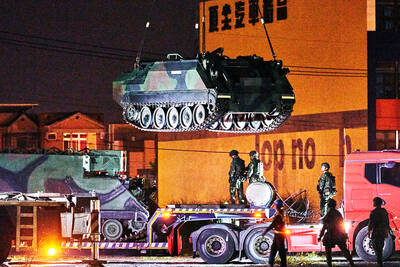
CHINESE THREAT: The military also simulated repelling an attack on Penghu and transporting military vehicles from Hualien to Yilan to reinforce defenses in the north The government yesterday slowed mobile Internet coverage for a large swathe of the central part of Taiwan proper for the first time during annual war games, simulating communication disruption in the event of a Chinese attack or natural disaster. Taiwan, which has long lived with the threat of a Chinese invasion, holds air raid drills along with its war games every year, clearing people from the streets for 30 minutes. During the Internet “throttling” drill, centered on Taichung, only basic mobile phone services worked, although other functions, including ATMs, traffic signals, landlines and fixed-line Internet services, were not affected. Air raid sirens rang


 RSS
RSS