

The Legislative Yuan is slated to hold cross-caucus negotiations on 14 versions of a draft uncrewed vehicle act on Thursday, amid rumors that Beijing is pressuring some Taiwanese politicians to block passage of a special bill proposed by the Ministry of National Defense to procure military drones and uncrewed vessels.
A source in Beijing said the Chinese Communist Party has been using its United Front Work Department and Taiwan Affairs Office to pressure Taiwanese politicians who are friendly toward Beijing, pushing them to block the Executive Yuan’s proposed special act to fund military uncrewed vehicles.
The proposed legislation would allocate up to NT$210 billion (US$6.55 billion) from August next year through December 2031 to procure coastal surveillance and reconnaissance drones, coastal attack drones and small uncrewed surface vessels designed for attack missions.
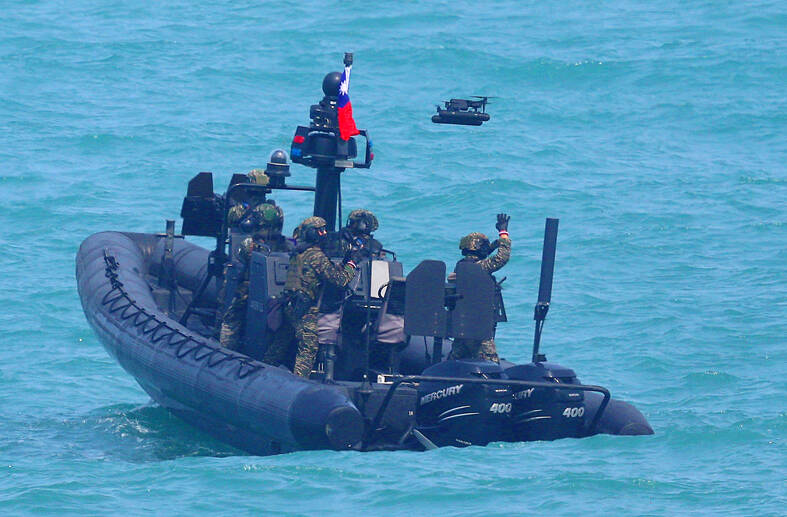
Photo: CNA
The source said staff units of the Chinese People’s Liberation Army (PLA) have conducted several wargame simulations of Taiwan’s plans to build up its drone forces in coordination with the US.
Beijing reportedly believes the deployment could significantly undermine the PLA’s strategic advantage in the Taiwan Strait and weaken its strategic deterrence against Japan and the Philippines. The PLA has recommended to the Chinese Central Military Commission that Taiwan’s drone buildup be blocked.
Beijing could accept a version of the legislation focused on “demilitarization,” but wants the budget to be subject to annual, item-by-item review and approval, the source said.
They said blocking the Executive Yuan’s special budget could also pressure the administration of President William Lai (賴清德) to find alternative ways to complete its planned military buildup, giving the Chinese military more time to develop countermeasures.
The Legislative Yuan’s Economics, Foreign Affairs and National Defense, and Finance committees on July 27 jointly reviewed the 14 versions of the legislation. After nearly six hours of discussion, lawmakers failed to reach agreement on the bill, including its responsible authority, spending cap and implementation period. The bills passed the committee stage, but must undergo cross-party negotiations before being considered by the full legislature.
The Legislative Yuan on Friday approved NT$63.4 billion in uncrewed vehicle spending, including a six-year NT$44.2 billion industrial development program proposed by the Ministry of Economic Affairs and NT$19.2 billion in drone procurement budgets proposed by government agencies.
Executive Yuan Secretary-General Xavier Chang (張惇涵) on Saturday said the opposition should support the administration’s special act if it supports the armed forces.
He said opposition lawmakers previously blocked drone-related spending, adding that the upcoming negotiations would show whether they truly support the country’s drone development and national defense.
Chinese Nationalist Party (KMT) caucus deputy secretary-general Hsu Yu-chen (許宇甄) yesterday said the opposition had supported the NT$63.4 billion in related spending.
Hsu said the KMT’s proposed legislation would invest NT$240 billion over six years in the uncrewed vehicle industry, more than the NT$210 billion proposed by the Executive Yuan.
The KMT favors funding the program through annual budgets rather than a special budget, Hsu said, adding that this would allow the legislature to review procurement results, industrial policy and progress toward domestic production each year.
She said the KMT supports drone development and greater defense autonomy, but wants greater scrutiny of how the money is spent, what equipment is purchased, who produces it, how much is manufactured domestically and whether the equipment meets the military’s operational needs.
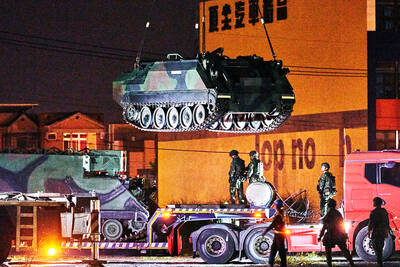
CHINESE THREAT: The military also simulated repelling an attack on Penghu and transporting military vehicles from Hualien to Yilan to reinforce defenses in the north The government yesterday slowed mobile Internet coverage for a large swathe of the central part of Taiwan proper for the first time during annual war games, simulating communication disruption in the event of a Chinese attack or natural disaster. Taiwan, which has long lived with the threat of a Chinese invasion, holds air raid drills along with its war games every year, clearing people from the streets for 30 minutes. During the Internet “throttling” drill, centered on Taichung, only basic mobile phone services worked, although other functions, including ATMs, traffic signals, landlines and fixed-line Internet services, were not affected. Air raid sirens rang
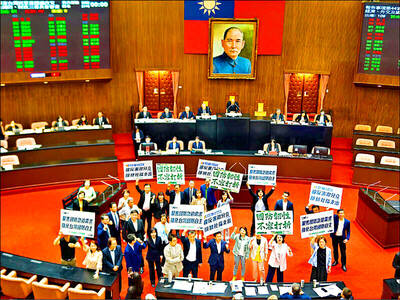
The Chinese Nationalist Party (KMT) and other opposition politicians are “taking Taiwan’s democracy hostage” for selfish gain, The Economist said in a column published online on Tuesday. “Taiwan’s freedoms should be a strength, raising the costs to China of a takeover. Shamefully, they are being betrayed from within,” the British news magazine said. While a lot of countries have toxic politicians, Taiwan’s stand out as particularly irresponsible, and “the blame is not evenly distributed,” it said. Although President William Lai (賴清德) is stubborn and, unlike his predecessor, does not consult KMT moderates, the opposition has triggered a “rolling constitutional crisis,”

CHINESE INFLUENCE? The TPP denied any knowledge that the Chinese immigrant had been reporting to Beijing or that she had participated in the party’s decisionmaking The New Taipei District Court yesterday sentenced Chinese immigrant Xu Chunying (徐春鶯) to seven years in prison for fraud, helping Chinese nationals illegally enter Taiwan and acting at Beijing’s direction to influence Taiwanese politics. The New Taipei District Prosecutors’ Office said it found that Xu and Cross-Strait Marriage Harmony Promotion Association chairman Chung Chin-ming (鍾錦明) had maintained long-term contact with Yang Wentao (楊文濤), director of the Cross-Strait Marriage and Family Service Center, and Sun Xian (孫憲), vice director of the Shanghai China Council for the Promotion of Peaceful National Reunification. Prosecutors accused Xu and Chung of accepting instructions to campaign for certain
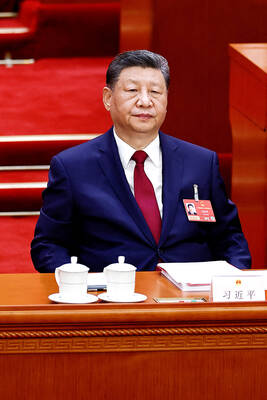
The Chinese Communist Party (CCP) has reportedly set four priorities for its Taiwan policy at its Beidaihe (北戴河) summer meeting, including opposing “Taiwanese independence” and supporting “patriotic forces” in Taiwan’s November nine-in-one local elections, an official said yesterday. The two-week Beidaihe meeting started on Monday last week, with this year’s theme being “Striving Forward in the 15th Five-Year Plan.” Aside from discussing the agenda of the CCP Central Committee’s fifth plenary session in late October and the 21st CCP National Congress, former and current Chinese officials would focus on strategies toward the US and Taiwan, as well as domestic personnel affairs. A


 RSS
RSS