


Audiences in Leicester, Cardiff, London and Sheffield will this month gather to watch a series of black-and-white Taiwanese-language films made more than 70 years ago. On the surface, these screenings commemorate the seventieth anniversary of taiyupian (台語片) — Taiwanese-language cinema. Yet the significance of these events extends far beyond nostalgia or film history. They represent a remarkable chapter in Taiwan’s ongoing effort to recover, preserve and reinterpret a cultural heritage that was once thought to have largely disappeared.
The centerpiece of the program is the Ho Chi-ming (何基明) directed Xue Pinggui and Wang Baochuan (薛平貴與王寶釧), a film produced in 1955 and released to enormous success in 1956. Historians generally regard it as the work that launched Taiwan’s Taiwanese-language film boom, which would eventually produce well over a thousand films over the following two decades. Yet for many years the film itself was believed lost.
Like much of Taiwan’s early cinema, it seemed destined to survive only in newspaper advertisements, production records and fading memories. The rediscovery of the film by the Tainan National University of the Arts (TNNUA, 南藝大) in Miaoli in 2013 therefore transformed our understanding of Taiwan’s cinematic past. It demonstrated that what appeared absent from history could sometimes return unexpectedly and compel us to rethink what we thought we knew.
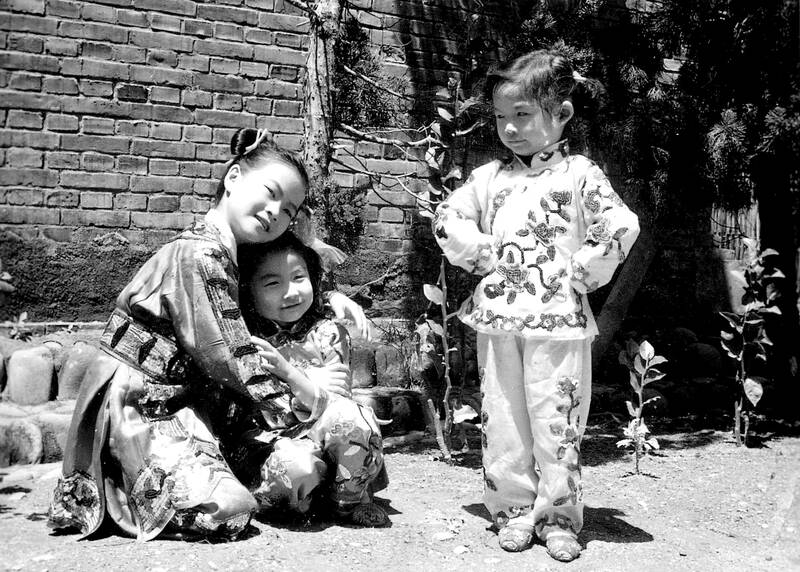
Photo courtesy of the Taiwan Film and Audiovisual Institute
MULTILINGUAL CINEMA
The rediscovered version proved even more surprising because it was dubbed in Hakka rather than Hoklo (more commonly known as Taiwanese). This discovery challenges conventional assumptions about the relationship between language and cinema in post-war Taiwan. The term “Taiwanese-language film” often suggests a distinctly Minnan-speaking cultural sphere. Yet the Hakka version of Xue Pinggui and Wang Baochuan reveals a far more fluid media environment in which films travelled across linguistic communities through dubbing, adaptation and musical transformation. Rather than existing within separate cultural worlds, Taiwanese and Hakka audiences participated in overlapping networks of popular entertainment.
This multilingual dimension carries particular resonance today. Contemporary discussions of Taiwan often emphasize its democratic achievements, technological innovation and geopolitical importance. Less visible internationally is Taiwan’s long history as a multilingual society in which cultural exchange across communities has shaped everyday life. The rediscovered film reminds us that linguistic diversity is not a recent policy aspiration but a historical reality deeply embedded in Taiwan’s cultural development.
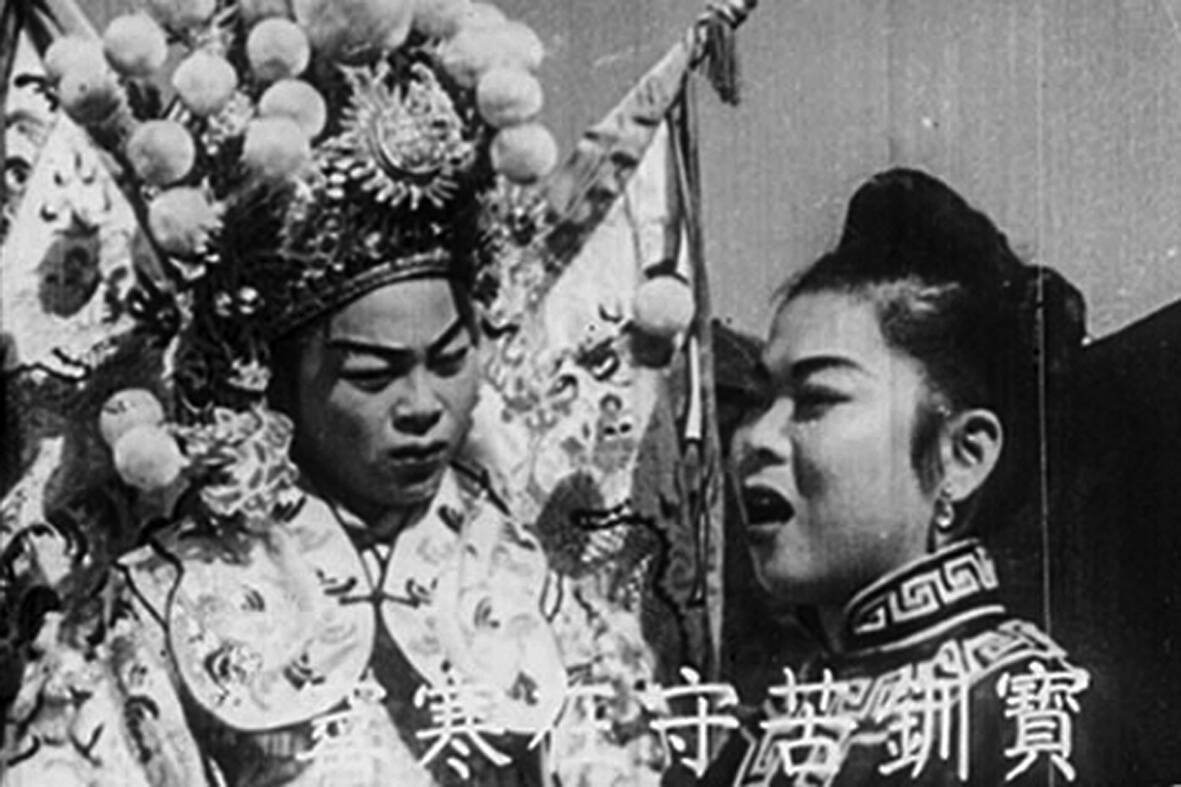
Photo courtesy of the Taiwan Film and Audiovisual Institute
TAIWAN’S FILM HERITAGE
The British screenings also highlight another important story: the growing international recognition of Taiwan’s film heritage. For decades, research on Taiwanese-language cinema was constrained by the simple fact that so few films survived. Although approximately 1,200 to 1,500 taiyupian were produced between the 1950s and 1970s, only a fraction remains today. The scarcity of surviving prints meant that scholars frequently had to reconstruct film history through secondary evidence. In recent years, however, restoration projects undertaken by institutions such as the Taiwan Film and Audiovisual Institute (TFAI, 國家電影及視聽文化中心) and the Graduate Institute of Documentary and Film Archiving at Tainan National University of the Arts have begun to change this situation dramatically.
The current screenings are the latest stage of a longer international effort. Since 2017, the “Taiwan’s Lost Commercial Cinema” project has introduced restored Taiwanese-language films to audiences across Britain and Europe. What began as a relatively small initiative has gradually generated growing scholarly and public interest. Researchers who once had little access to these films can now engage directly with the surviving works, while audiences encounter an alternative history of Taiwan that differs markedly from the political narratives that often dominate international news coverage.
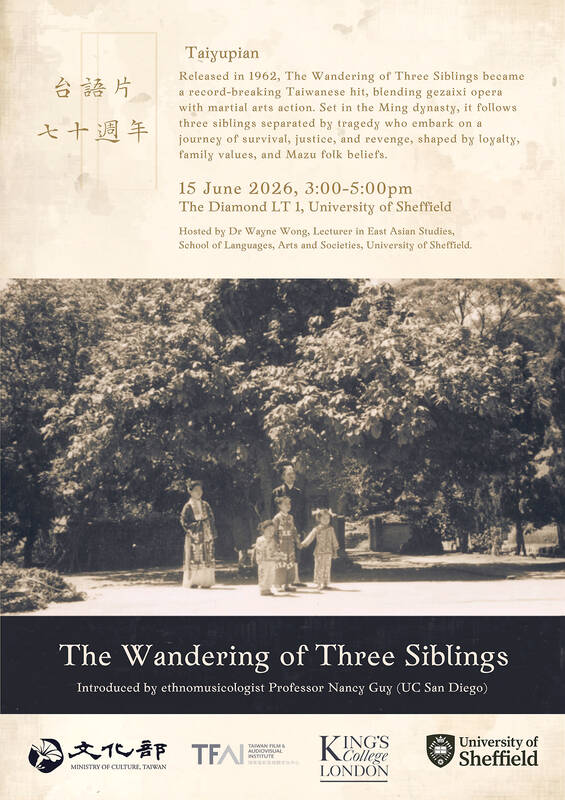
Poster courtesy of Ming-yeh T. Rawnsley
The films themselves reveal why this rediscovery matters. Consider The Wandering of Three Siblings (流浪三兄妹), directed by Shao Lo-hui (邵羅輝) one of the other films featured in this year’s program. Released in 1962, it combines Taiwanese opera traditions, martial arts action, folk religion and melodrama. Its story of children separated from their family, enduring hardship before ultimately achieving justice, resonated strongly with audiences during a period of rapid social change. The film demonstrates how Taiwanese-language cinema developed distinctive narrative and emotional forms rooted in local cultural traditions while simultaneously experimenting with new genres and cinematic techniques.
Such films remind us that Taiwan’s cultural history cannot be understood solely through politics or economics. Popular cinema offers insight into how ordinary people imagined family, love, loyalty, mobility and justice. It captures aspirations, anxieties, and social values that official historical records often overlook. In this sense, film restoration is not simply an act of preservation; it is also a process of recovering voices, experiences and cultural memories that might otherwise remain inaccessible.
The timing of the British program is therefore significant. As Taiwan becomes increasingly visible on the international stage, there is growing interest in understanding the society beyond the headlines. Cinema provides one pathway into that understanding. Through film, audiences can encounter Taiwan not merely as a geopolitical issue but as a place with a rich cultural history, shaped by multiple languages, performance traditions, and generations of creative experimentation.
Seventy years after the birth of Taiwanese-language cinema, these screenings demonstrate that the story of taiyupian is far from over. What once seemed a lost chapter of Taiwan’s past is finding new audiences across the world. In doing so, it reminds us that cultural memory is never fixed. It survives through acts of preservation, rediscovery, and reinterpretation. The films being shown in Britain this month are not simply historical artifacts. They are evidence that Taiwan’s cultural heritage continues to speak across generations, languages and national borders.
Ming-yeh T. Rawnsley is a research associate at SOAS University of London’s Centre for Taiwan Studies.

Taiwan’s English education system is being pulled apart by three opposing forces. Bilingual Nation 2030 pulls students toward English and global communication. Artificial Intelligence (AI) readiness pulls them toward digital judgment, verification and AI-mediated work. But Taiwan’s old exam culture pulls them back toward memorization, grammar drills, timed reading and correct answers. If the education system keeps using old exams to define success, it risks producing graduates who are neither genuinely bilingual nor genuinely AI-ready, but trained for tasks machines can already perform. The first force is Bilingual Nation 2030. Launched in 2018, the policy aimed to “help Taiwan’s workforce connect

“Taiwan’s Opposition Leader Comes to US With a Message Straight Out of Beijing” read a May 31 headline in the Wall Street Journal. Top US administration officials and members of Congress almost certainly read the WSJ, and if there was a bullet point takeaway that people in Washington should absorb ahead of Chinese Nationalist Party (KMT) Chair Cheng Li-wun’s (鄭麗文) arrival in DC on June 9, that headline is it. The last few columns have discussed this very topic, and the timing is not coincidental. While those top officials likely do not read the Taipei Times, judging by the number

With weighty, anxiety-inducing geopolitical topics dominating the headlines, checking in on the wild and weird state of local politics can take some of the edge off. This November’s elections will determine who will be in charge of fixing potholes in your neighborhood, not the potholes in Taiwan’s complicated geopolitical space. Recently, after an online interview with a Taipei-based journalist, I commented that Taipei journalists never go further than the MRT can take them. He laughed and agreed. Naturally, the Taipei mayoral race is eating up much of the press attention. TAIPEI CITY Democratic Progressive Party (DPP) candidate Puma Shen (沈伯洋) has
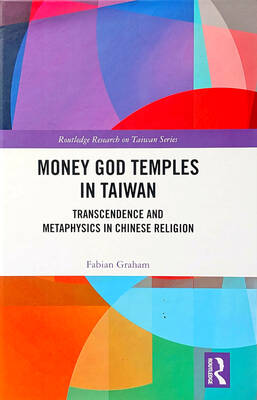
As someone who normally steers clear of books with “transcendence” or “metaphysics” in their subtitles, this reviewer — a casual observer of local belief systems since the 1990s — found Fabian Graham’s Money God Temples in Taiwan a challenging read. Those who’ve only dipped their toes into temple culture will likely need to parse several sections with special care if they’re to keep up with the author, a British ethnographic researcher whose previous books have investigated religious practices among ethnic Chinese in Southeast Asia. This scholarly volume examines a facet of Taiwan’s religious landscape that didn’t exist a century ago, and


 RSS
RSS