


June 8 to June 14
It was once said that flowers bloomed throughout the four seasons in Yunxiaocuo (雲霄厝). Not real ones, but “incense flowers,” referring to a radiating circular formation of freshly cut incense sticks set out to dry.
Up until the 1970s, almost every woman in the settlement in Chiayi City manually split bamboo into 0.3 cm-thick incense sticks using razor sharp knives, and arranged them into incense flowers to supplement family income. It was demanding work, requiring years of practice to achieve precision, and injuries were common.
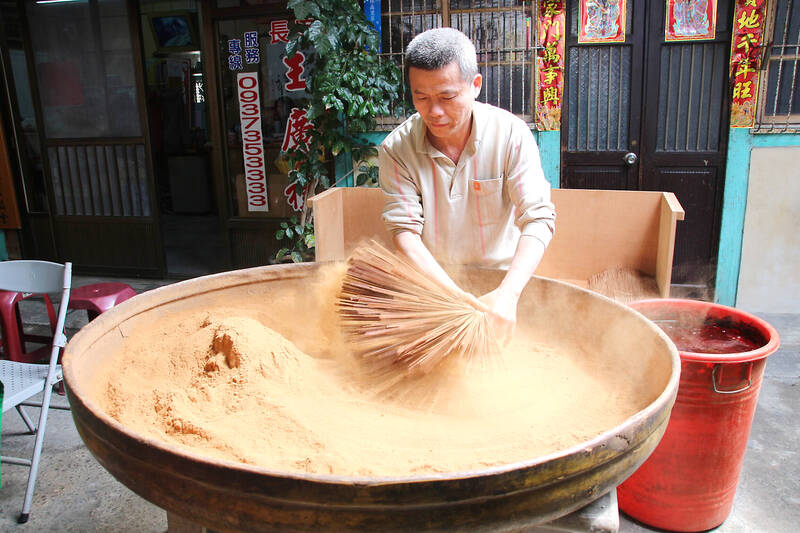
Photo courtesy of Chiayi City Cultural Affairs Bureau
Now in her 70s, Chiu Chin-yun (邱錦雲) is one of the few residents still adept at the craft. The eldest of seven children from a poor family, she began learning from her grandmother and mother at the age of seven. Chiu says each bamboo segment can be split into over 1,000 incense sticks, and each incense flower is made up of 5,000 to 6,000 sticks. She used to make up to 30 flowers a day, which earned her about 7kg of rice. The flowers take about two to three days to dry.
She has been demonstrating this fading craft since the late 1990s, most recently on Sunday last week at the Chiayi Municipal Museum. Her longtime collaborator, Tsai Tseng-chen (蔡增成), deftly works the bundles through a large bowl of incense powder using a series of hand motions.
Despite searching, Chiu has yet to find someone to pass the craft on to. Besides the risk of injury, square hand-split sticks are less efficient at taking up incense powder than the round, machine-made ones, leaving little economic incentive for younger people to learn.
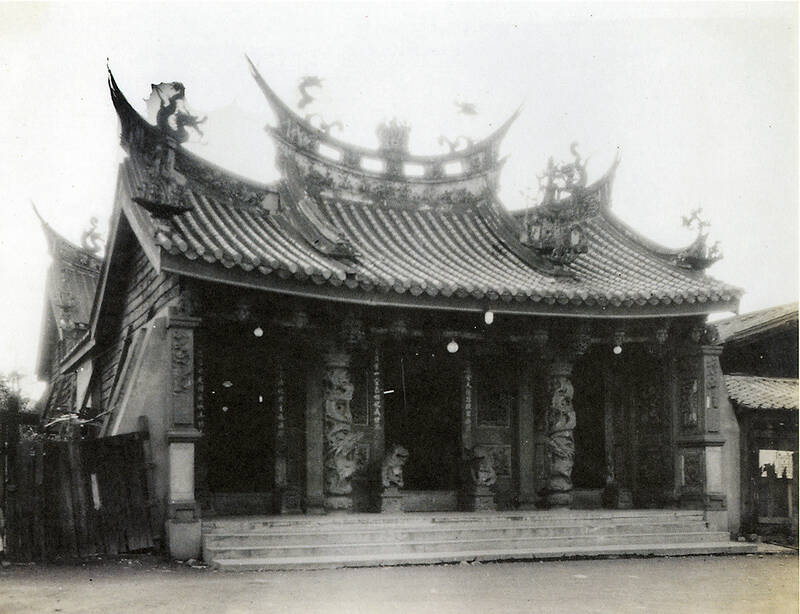
Photo courtesy of Taiwan Culture Memory Bank
“You’re bleeding all the time during the first three years of training,” an interviewee tells Tsai Hung-pin (蔡鴻濱) in “Analysis of cultural restoration strategies of Yunxiaocuo” (嘉義雲霄厝文化再造). “People talk about passing the craft on now, but in the past it was learned out of necessity, simply to make a living.”
INCENSE PRODUCTION AND ROOTS
The practice of burning incense was brought to Taiwan by Han settlers during Dutch rule. In 1660, Albrecht Herport observed them lighting fine incense daily before statues of their deities. A late 19th-century report noted numerous incense shops in Tainan, which used wood imported from China.
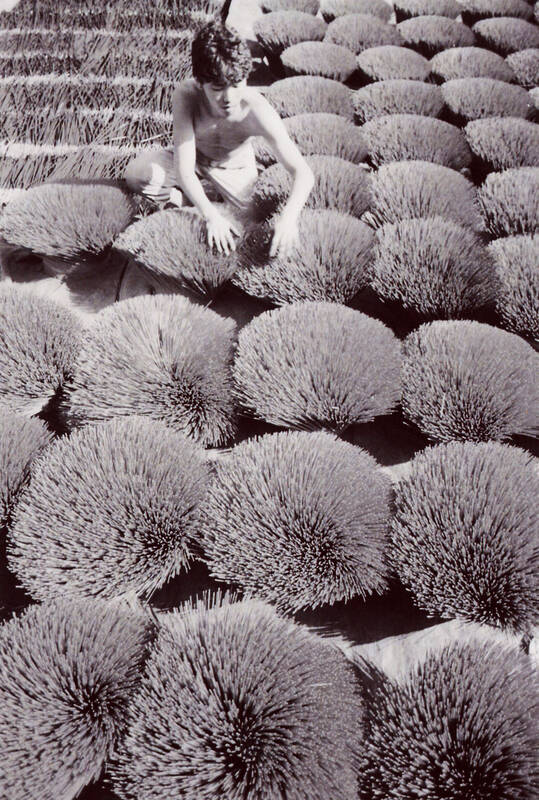
Photo courtesy of Changhua County Cultural Affairs Bureau
After Taiwan became a colony of Japan in 1895, the Japanese observed that incense was produced mainly for local consumption, identifying it as a potential industry for export. A 1910 article in the Taiwan Daily News recorded about 200 incense makers across the colony, the majority of them being in Tainan with 40 to 50 shops. Chiayi had 14.
Yunxiaocuo was originally settled by immigrants from Yunxiao County, Fujian Province. During the Qing Dynasty, it served as a vital thoroughfare for people traveling through the walled city’s north and east gates; travelers from Minsyong (民雄), Meishan (梅山) and Jhuci (竹崎) townships all had to pass through, making it a bustling commercial district.
Today, a 450m stone-paved path running from Lane 197, Anhe Street (安和街) through Heping Street (和平街) to Lane 165, Gonghe Street (共和街) is called the Yunxiao Old Trail, according the Chiayi City Government Web site.
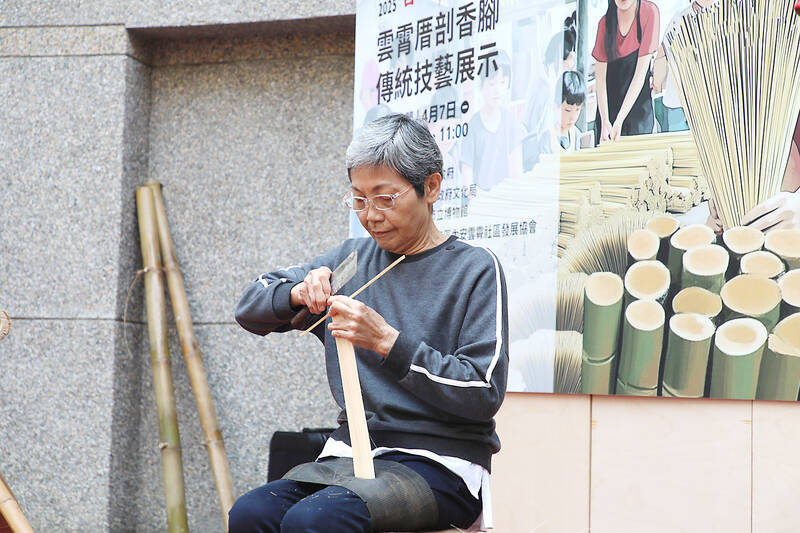
Photo courtesy of Chiayi City Cultural Affairs Bureau
Due to the settlement’s proximity to the popular Jihuashan Dizang Temple (九華山地藏庵), growing numbers of women began taking up incense splitting, with many families like Chiu’s working across three generations. At one point, it was the largest center of incense stick production in southern Taiwan.
RELIGION AND COMMUNITY
Tsai writes that the settlement’s ties to local religion ran deep.
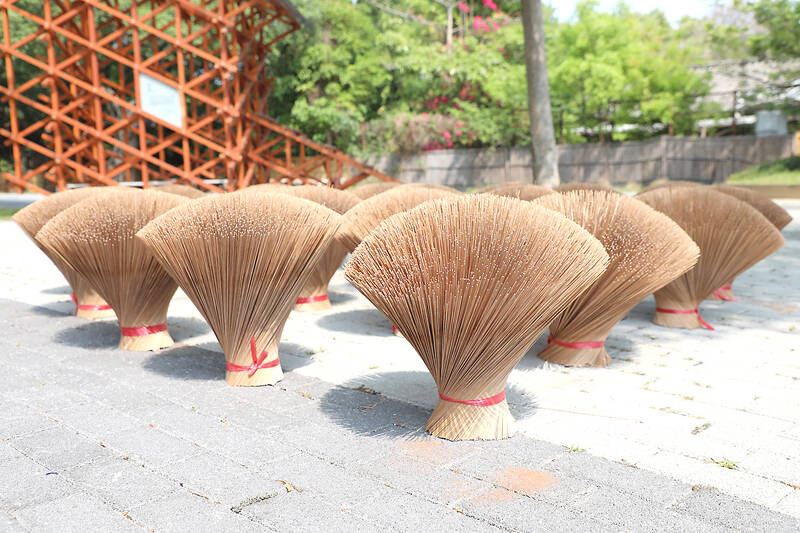
Photo courtesy of Chiayi City Cultural Affairs Bureau
After the local Matsu temple collapsed in an earthquake in 1906, the statue of the principal deity was moved to the Chiayi City God Temple. Elders recall that during Lantern Festival, locals would go “invite” Matsu back home, passing through the main street and stopping under an old banyan tree where residents offered prayers. The procession then continued to Dizang Temple, remaining there throughout the afternoon before returning along the same route.
Residents would often offer capons they had raised to the goddess. One year, Dizang Temple held a competition for the largest bird, with the top three entrants receiving medals and being escorted back to their homes with a musical troupe.
The community also formed its own religious ensemble in 1946, participating in Dizang Temple’s events as well as weddings, funerals and other ceremonies.
Incense making, which declined significantly during World War II, picked up again under Chinese Nationalist Party (KMT) rule. However, by the early 1970s, producers began switching to machine-made sticks.
The Dajiale (大家樂) gambling craze of the 1980s led to an explosion in demand, as many turned to praying for the gods to reveal winning numbers. Some believed that the more incense offered, the more accurate the results; others looked for clues in smoke or burning patterns. This surge further accelerated the shift toward mechanization.
REVIVING THE CRAFT
Born in 1960, Wang Kuang-li (王廣禮) recalls that when his grandfather became disabled after falling from a longan tree, his grandmother turned to incense splitting to raise their 12 children. Stricken with polio and the youngest grandson, he said he had fond memories of his grandmother pushing him in a cart along with the dried incense sticks and hand them to the incense shop.
He later became the local borough warden, and as the director of the Yunxiaocuo Community Development Association, he sought to revive the craft. Starting in 1997, he brought the remaining masters out of retirement and began putting on demonstrations in the community. The activity gained popularity, and in 2021 they began collaborating with the Chiayi Municipal Museum.
Chiu performs the entire process: sawing the bamboo, removing the nodes, soaking them, peeling the green layer, cutting them into slices and thin strips, then tying them into bundles and forming incense flowers.
“[The masters] once assumed that they would never have to practice incense splitting in their lifetime again … but 30 years later, it has become a source of pride,” Wang says.
Taiwan in Time, a column about Taiwan’s history that is published every Sunday, spotlights important or interesting events around the nation that either have anniversaries this week or are tied to current events.

Taiwan’s English education system is being pulled apart by three opposing forces. Bilingual Nation 2030 pulls students toward English and global communication. Artificial Intelligence (AI) readiness pulls them toward digital judgment, verification and AI-mediated work. But Taiwan’s old exam culture pulls them back toward memorization, grammar drills, timed reading and correct answers. If the education system keeps using old exams to define success, it risks producing graduates who are neither genuinely bilingual nor genuinely AI-ready, but trained for tasks machines can already perform. The first force is Bilingual Nation 2030. Launched in 2018, the policy aimed to “help Taiwan’s workforce connect
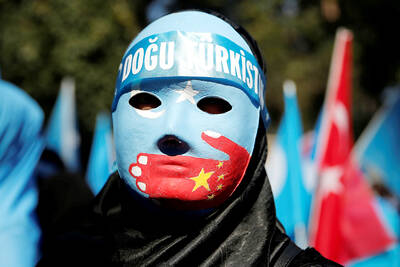
It seems every few days one bumps into one of those “real man” comments in which Taiwan is urged to “face reality” or similar, and “make a deal,” with the speaker implying that soon it will be too late. “Deal” advocates always present themselves as having a superior grip on reality, and the manly ability to make the “hard choice.” Their testosterone-laden language often echoes that of Taiwan sellout advocates. Note that such commentary always specifies a process (“make a deal, work with, make progress”), never the end state of what occupation by a violent authoritarian colonialist state will entail. In

“Taiwan’s Opposition Leader Comes to US With a Message Straight Out of Beijing” read a May 31 headline in the Wall Street Journal. Top US administration officials and members of Congress almost certainly read the WSJ, and if there was a bullet point takeaway that people in Washington should absorb ahead of Chinese Nationalist Party (KMT) Chair Cheng Li-wun’s (鄭麗文) arrival in DC on June 9, that headline is it. The last few columns have discussed this very topic, and the timing is not coincidental. While those top officials likely do not read the Taipei Times, judging by the number
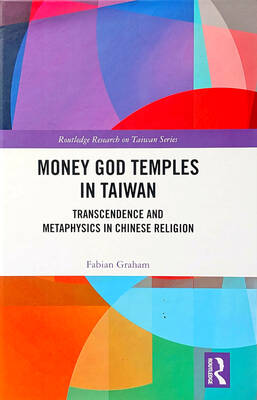
As someone who normally steers clear of books with “transcendence” or “metaphysics” in their subtitles, this reviewer — a casual observer of local belief systems since the 1990s — found Fabian Graham’s Money God Temples in Taiwan a challenging read. Those who’ve only dipped their toes into temple culture will likely need to parse several sections with special care if they’re to keep up with the author, a British ethnographic researcher whose previous books have investigated religious practices among ethnic Chinese in Southeast Asia. This scholarly volume examines a facet of Taiwan’s religious landscape that didn’t exist a century ago, and


 RSS
RSS