


Billie Eilish is levitating. Or so it seems. When the pop star first emerges on screen in the mouthful Billie Eilish — Hit Me Hard and Soft: The Tour (Live in 3D), she is suspended above a cube built of LED screens, surrounded by a sold-out crowd of over 23,000 fans in the center of the UK’s largest arena — Manchester’s Co-op Live. She launches into the midtempo Chihiro, a house experiment from her latest album, and the 3D magic begins. In the contemporary pop music landscape, Eilish is a rulebreaker — and so is this work.
The new concert film, co-directed by Eilish and three-time Academy Award winner James Cameron, was his idea. Cameron e-mailed Eilish’s mother, Maggie Baird — a friend of his wife via their shared interest in plant-based diets and environmentalism — and suggested they shoot Eilish’s Hit Me Hard and Soft tour in 3D.
It is new territory for Cameron, in some ways, and old hat in others. His production company has done a number of concert films, including one with Eilish’s musical hero Justin Bieber, but Cameron hasn’t sat in the director’s chair of a project like this one. A 3D concert film also brings up a number of technical challenges — a passion of Cameron’s, as anyone who has seen the blockbuster Avatar franchise could attest to — and as a fellow outlier of industry, the pairing succeeds.
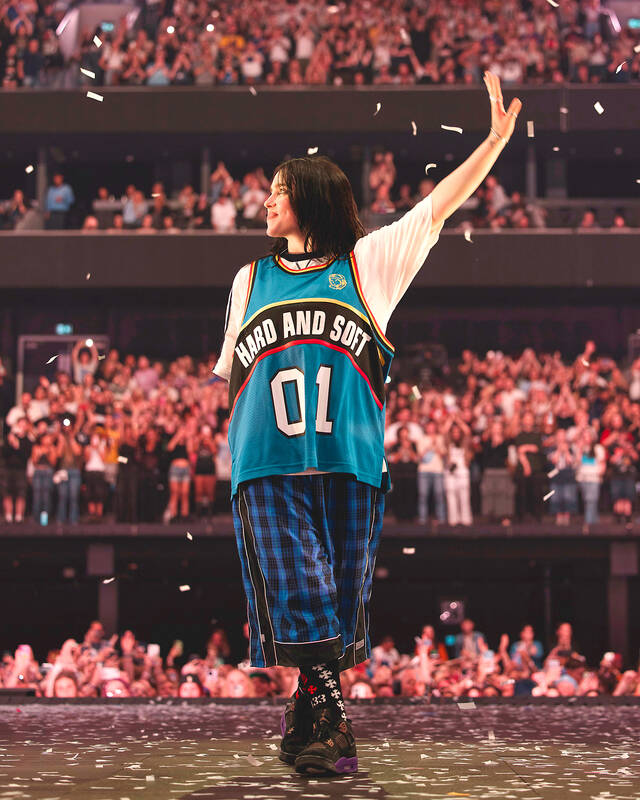
Photo: AP
Eilish, too, is no stranger to film: She’s the subject of the 2021 documentary, Billie Eilish: The World’s a Little Blurry, and a concert film released that same year, Happier Than Ever: A Love Letter to Los Angeles. This, however, is her first time co-directing a feature. And where The World’s a Little Blurry served as a composite of her come-up and various successes, Hit Me Hard and Soft is dedicated to the concert film format while pushing its boundaries.
While no movie can serve as the perfect replica of a transformative live music experience, Billie Eilish — Hit Me Hard and Soft: The Tour (Live in 3D) works an immersive magic. Every seat is the best seat in the house in these shots; common issues with concert films find solutions. Audience members are celebrated like additional characters. When the camera is on them, their voices are heard loud — sniffling, screams, cheers, off-key sing-alongs get their shine, sometimes above Eilish in the mix, mimicking the experience of swaying in the crowd.
In 3D, her minimalist set is given a visceral tangibility. Fans see Eilish jump through trap doors, hook into safety harnesses, chug water, dance off screen, become teary eyed and embrace her band mates. At nearly two-hours of runtime, it passes like zephyr, a thrill ride so fun it feels too short.
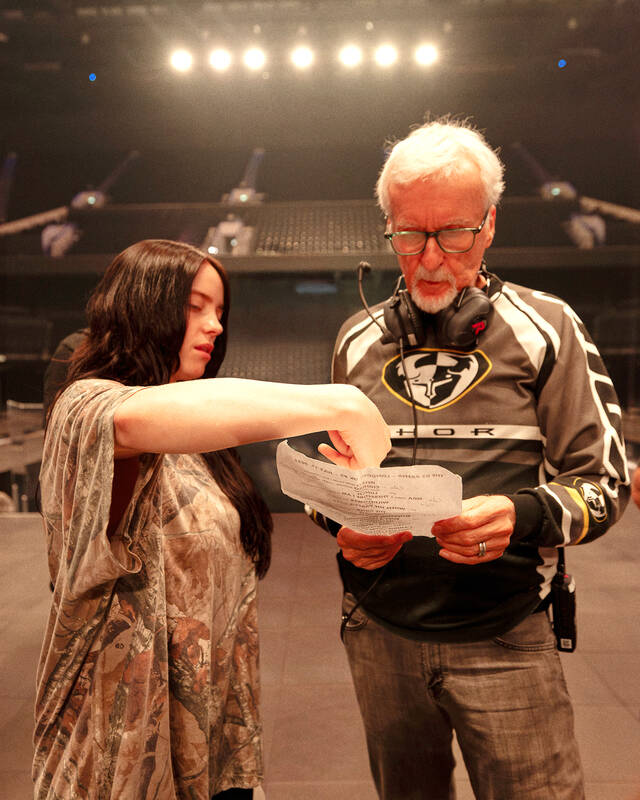
Photo: AP
There is also new insight for the Eilish fan: Cameras escort the pop star backstage and underneath it. In the beginning of the film, viewers experience the tour’s opening scene — and then they get to see it again, from Eilish’s perspective. In other moments, Cameron is on screen with Eilish as she co-directs, giving the film the intimacy of a behind-the-scenes DVD extra detailing how the movie was made … in the middle of it. It’s a compelling watch and demonstrates a deep understanding of a dedicated pop music audience, where accessibility is the most valuable cultural currency.
“You’re like a tuning fork,” Cameron says to Eilish in one scene. “And they’re hitting the same beats.”
There is little narrativizing, what often ruins a fine film, turning it into a vanity project. Eilish is shown backstage strengthening her ankle after suffering a sprain, mostly to highlight the physicality of her performance. In another, she plays with puppies, a brief reminder of her animal rights activism. They’re welcomed breaks, but not totally memorable. The strength of the film is Eilish on stage — not in its interview interludes.
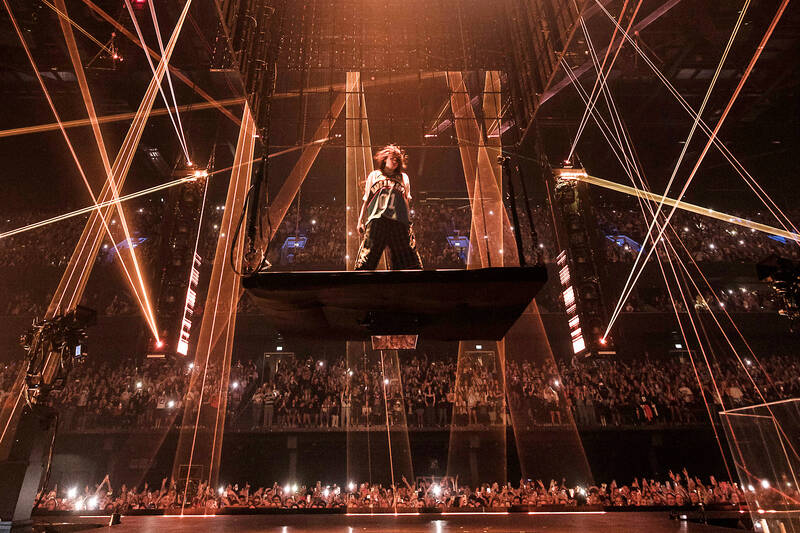
Photo: AP
For years, Eilish has chosen to perform solo on stage. In this movie, fans will learn it is because she has long wanted to mimic a hip-hop performance, where a rapper can command a stage with just a microphone, the strength of their songs and charisma.
“I just wanted the freedom of being a guy running around,” she tells Cameron.
The performance that follows is Bury a Friend from her first record, a song with production that pulls inspiration from hip-hop — a masterful exhibition of influence creating innovation.
The only place where the structure falters is in a candid conversation about desirability and femininity followed by the Oscar-winning Barbie theme What Was I Made For? Other songs in Eilish’s discography would’ve driven the point home with more subtlety.
But the moment comes and goes. What is left are big songs and bigger emotions. When a fan in the front row is heard wailing, “Billie! Billie! Billie,” with tears in her eyes and a handmade sign asking for a hug, the viewer has no choice but to hope she gets that embrace, that Eilish makes individual eye contact with her, that a connection can be realized in some brief, healing moment.
“I understand that need and that desperation,” Eilish says in one scene, describing herself as a superfan like the ones before her. “I want to be the artist I would want to be a fan of.”
Concert films are engineered for loyal listeners: To relive the night, or experience it for the first time, or to revel in the joy of being a face in the crowd. That goes for Eilish as well.
“To get to see these close up, beautiful, 3D shots of these fans who I would never have gotten to see have that emotional reaction,” from the stage in the middle of her performance, Eilish said last month, “I feel really grateful for that gift.”
Spoken like a true fan.

May 11 to May 17 Traversing the southern slopes of the Yushan Range in 1931, Japanese naturalist Tadao Kano knew he was approaching the last swath of Taiwan still beyond colonial control. The “vast, unknown territory,” protected by the “fierce” Bunun headman Dahu Ali, was “filled with an utterly endless jungle that choked the mountains and valleys,” Kano wrote. He noted how the group had “refused to submit to the measures of our authorities and entrenched themselves deep in these mountains … living a free existence spent chasing deer in the morning and seeking serow in the evening,” even describing them as

As a different column was being written, the big news dropped that Chinese Nationalist Party (KMT) caucus whip Fu Kun-chi (傅?萁) announced that negotiations within his caucus, with legislative speaker Han Kuo-yu (韓國瑜) of the KMT, party Chair Cheng Li-wun (鄭麗文), Taichung Mayor Lu Shiow-yen (盧秀燕) and Taiwan People’s Party (TPP) Chair Huang Kuo-chang (黃國昌) had produced a compromise special military budget proposal. On Thursday morning, prior to meeting with Cheng over a lunch of beef noodles, Lu reiterated her support for a budget of NT$800 or NT$900 billion — but refused to comment after the meeting. Right after Fu’s

Yesterday, the Democratic Progressive Party (DPP) nominated legislator Puma Shen (沈伯洋) as their Taipei mayoral candidate, the Chinese Nationalist Party (KMT) put their stamp of approval on Wei Ping-cheng (魏平政) as their candidate for Changhua County commissioner and former legislator Tsai Pi-ru (蔡壁如) of the Taiwan People’s Party (TPP) has begun the process to also run in Changhua, though she has not yet been formally nominated. All three news items are bizarre. The DPP has struggled with settling on a Taipei nominee. The only candidate who declared interest was Enoch Wu (吳怡農), but the party seemed determined to nominate anyone

What government project has expropriated the most land in Taiwan? According to local media reports, it is the Taoyuan Aerotropolis, eating 2,500 hectares of land in its first phase, with more to come. Forty thousand people are expected to be displaced by the project. Naturally that enormous land grab is generating powerful pushback. Last week Chen Chien-ho (陳健和), a local resident of Jhuwei Borough (竹圍) in Taoyuan City’s Dayuan District (大園) filed a petition for constitutional review of the project after losing his case at the Taipei Administrative Court. The Administrative Court found in favor of nine other local landowners, but


 RSS
RSS