


Fears that artificial intelligence could help people design bioweapons or hack into national infrastructure are mutual concerns for Xi Jinping (習近平) and Donald Trump, despite their countries’ fierce rivalry over the technology, analysts say.
As the leaders prepare for a rare summit in Beijing this week, policy experts have stressed the importance of US-Chinese discussions on steps to contain the risks, such as a hotline for de-escalation when an AI crisis hits.
But with China set on narrowing the US’ lead in the strategic sector, the stakes will be high.
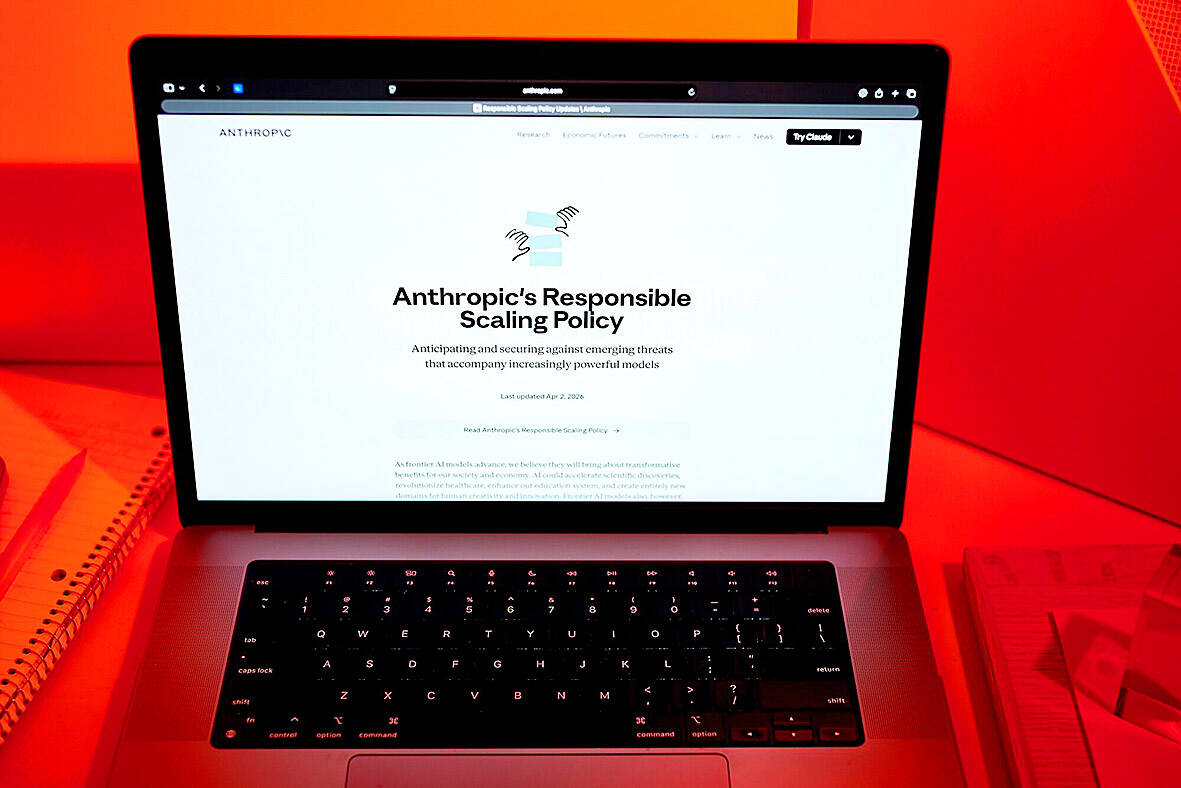
Photo: Bloomberg
“There is a kind of shared concern about where this AI arms race might be going,” and if it could create an “out of control” scenario, said Michael Jinghan Zeng, a professor at City University of Hong Kong.
“Despite critical disagreements on a wide range of issues, there is also this kind of understanding from both sides” on the need for AI guardrails, he said.
The White House recently accused Chinese entities of “industrial-scale” efforts to steal US technology, while Beijing blocked the acquisition of a Chinese-founded AI agent tool by tech giant Meta.
In 2024, Xi agreed with Trump’s predecessor Joe Biden that humans must remain in control of the decision to fire nuclear weapons.
Although little more has followed, Xi and Trump could “commit to some rhetorical signal” in Beijing as a basis for further cooperation, Zeng said.
‘CATASTROPHIC RISKS’
The AI cybersecurity threat has been highlighted by Mythos, a powerful new model that US startup Anthropic withheld from public release to stop it from being exploited by hackers.
And “if a non-state actor uses an AI model to develop a biological weapon, that could pose catastrophic risks to both the United States and China,” Chris McGuire of the Council on Foreign Relations wrote in a recent article.
“Over the long term, addressing these risks will require cooperation,” McGuire said, cautioning that China’s “willingness to make and abide by robust international commitments on AI safety is low.”
Washington says the latest AI model from Chinese startup DeepSeek — considered the country’s most advanced — is about eight months behind the top offerings from US companies.
To stop Chinese tech firms catching up too quickly, the US bars them from purchasing the most cutting-edge chips made by California-based Nvidia.
China has boosted its domestic AI chip industry in response, and could be hoping to use its control over rare earths as leverage at the summit on Thursday and Friday.
‘INTERTWINED’
Top US executives, including Tesla’s Elon Musk and Apple’s Tim Cook, will accompany Trump — with Nvidia boss Jensen Huang (黃仁勳) a last-minute addition to the trip.
Chen Liang, founder of Strategic Times Consulting, said he did not expect any “dramatic breakthroughs.”
Trump’s visit will merit attention if he and Xi manage to “shelve the most sensitive issues” while establishing “rule-based tracks” on points of cooperation, Chen said.
But competition is likely to remain stiff “in high-tech sectors like AI chips that directly involve the core interests of both sides.”
Beijing has refuted accusations made by the White House of large-scale Chinese AI “distillation” of US rivals — a practice often used by companies to create cheaper, smaller versions of their own models.
Meanwhile, China’s top economic planning body has blocked Meta’s US$2-billion bid for China-founded, Singapore-based AI agent startup Manus.
The move, which followed a regulatory review, has been seen as a sign of China’s growing oversight of its AI sector.
Yet “the talent, capital and supply chains underpinning the field are deeply intertwined across the United States and China,” said Grace Shao, a China AI analyst and author of the AI Proem newsletter.
“Any delusion of full decoupling isn’t realistic on any near-term horizon”, she said.
“Leadership in the technology... will define the next decade of productivity and growth, so it’s in everyone’s interest that the two superpowers find common ground on sensible guardrails for AI.”
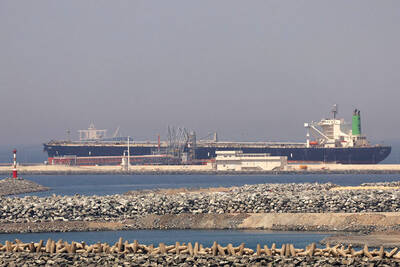
The breakwater stretches out to sea from the sprawling Kaohsiung port in southern Taiwan. Normally, it’s crowded with massive tankers ferrying liquefied natural gas from Qatar to be stored in the bulbous white tanks that dot the shoreline. These are not normal times, though, and not a single shipment from Qatar has docked at the Yongan terminal since early March after the Strait of Hormuz was shuttered. The suspension has provided a realistic preview of a potential Chinese blockade, a move that would throttle an economy anchored by the world’s most advanced and power-hungry semiconductor industry. It is a stark reminder of
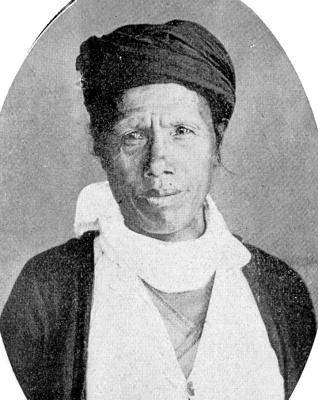
May 11 to May 17 Traversing the southern slopes of the Yushan Range in 1931, Japanese naturalist Tadao Kano knew he was approaching the last swath of Taiwan still beyond colonial control. The “vast, unknown territory,” protected by the “fierce” Bunun headman Dahu Ali, was “filled with an utterly endless jungle that choked the mountains and valleys,” Kano wrote. He noted how the group had “refused to submit to the measures of our authorities and entrenched themselves deep in these mountains … living a free existence spent chasing deer in the morning and seeking serow in the evening,” even describing them as
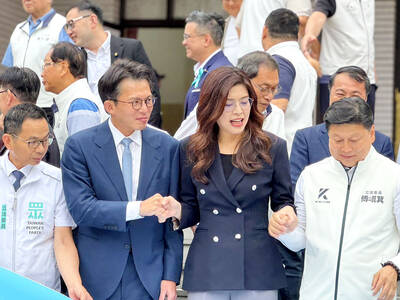
As a different column was being written, the big news dropped that Chinese Nationalist Party (KMT) caucus whip Fu Kun-chi (傅?萁) announced that negotiations within his caucus, with legislative speaker Han Kuo-yu (韓國瑜) of the KMT, party Chair Cheng Li-wun (鄭麗文), Taichung Mayor Lu Shiow-yen (盧秀燕) and Taiwan People’s Party (TPP) Chair Huang Kuo-chang (黃國昌) had produced a compromise special military budget proposal. On Thursday morning, prior to meeting with Cheng over a lunch of beef noodles, Lu reiterated her support for a budget of NT$800 or NT$900 billion — but refused to comment after the meeting. Right after Fu’s
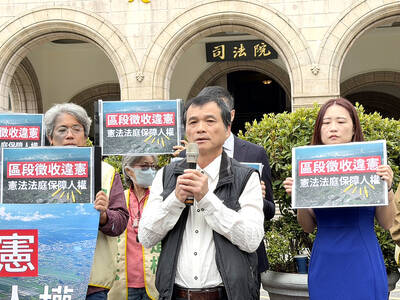
What government project has expropriated the most land in Taiwan? According to local media reports, it is the Taoyuan Aerotropolis, eating 2,500 hectares of land in its first phase, with more to come. Forty thousand people are expected to be displaced by the project. Naturally that enormous land grab is generating powerful pushback. Last week Chen Chien-ho (陳健和), a local resident of Jhuwei Borough (竹圍) in Taoyuan City’s Dayuan District (大園) filed a petition for constitutional review of the project after losing his case at the Taipei Administrative Court. The Administrative Court found in favor of nine other local landowners, but


 RSS
RSS