


The battered wooden trunk had been in the family for a century — shifted from attic to barn to garage as it was handed down through the generations. No one knew a cinematic treasure was inside.
That was until retired high school teacher Bill McFarland’s curiosity got the better of him. For the past 20 years, McFarland, 76, had been the keeper of the trunk, which originally belonged to his late great-grandfather who showed silent movies to audiences in rural Pennsylvania at the turn of the 20th century.
“It was just this trunk of films that seemed too good to throw away. But I had no idea what they were or how to show them,” McFarland said.
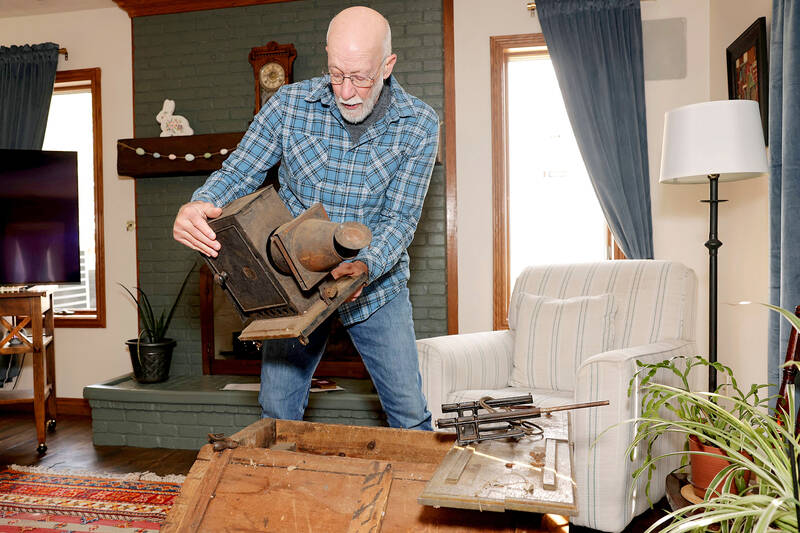
Photo: AFP
He offered them to museums and even tried to sell them through an antique store, whose owner soon told him to take them away after learning vintage nitrate film reels were highly combustible and could explode.
Then last summer, McFarland drove from his home in the northern state of Michigan to the US Library of Congress’ National Audio-Visual Conservation Center in Culpeper in the southern state of Virginia.
He was in for a surprise — a pleasant one.
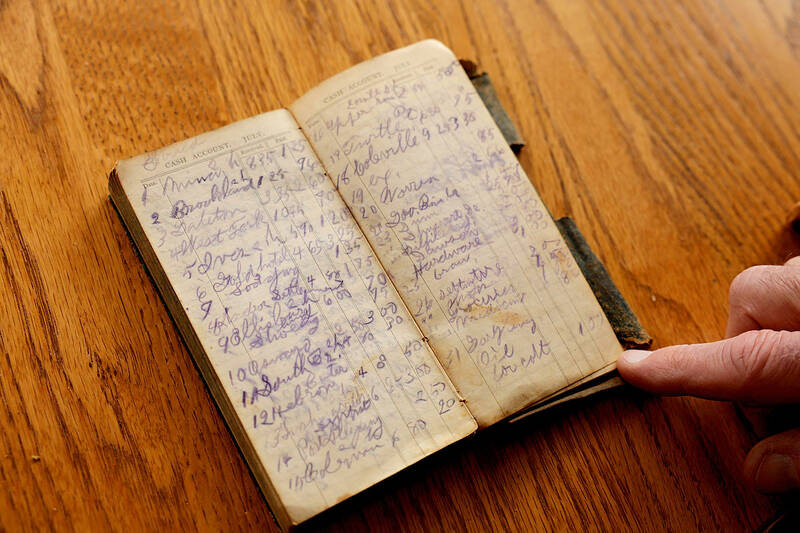
Photo: AFP
PIONEERING SHORT FILM
Spliced in the middle of one of the 10 reels was a lost short film by Georges Melies, a French cinema pioneer — the first to experiment with fictional narratives and special effects at the very dawn of moving pictures.
The 45-second film, Gugusse and the Automaton, was made in 1897 — just two years after the Lumiere Brothers staged the world’s first public screening of a movie in Paris.
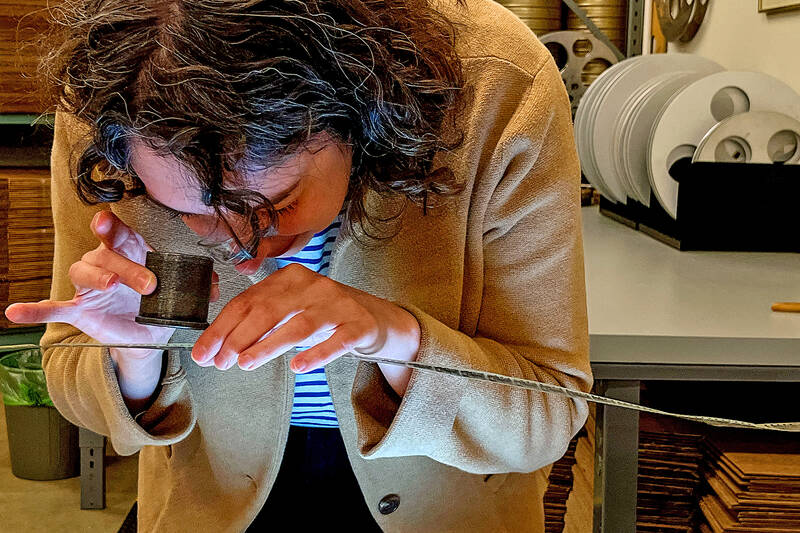
Photo: AFP
Melies, a theatrical showman and magician, attended that screening and was inspired to make films of his own. He is most famous for A Trip to the Moon (1902) with its iconic scene of a rocket landing in the eye of the man in the Moon.
By a decade later, his filmmaking had fallen out of vogue as the center of the movie world shifted from Europe to America.
Melies ended up as a toy seller in Paris’ Gare Montparnasse train station — a story that was dramatized in Martin Scorsese’s 2011 film, Hugo. But his legacy endured.
“He was one of the first filmmakers,” said George Willeman, leader of the congressional library’s nitrate film vault, who said the recovered reel was likely a third-generation copy of the Melies original. “And one of the first to experience film piracy.”
MIRACULOUS SURVIVAL
In retrospect, piracy was a salvation for film historians as it means that Melies’ work lives on.
Reputedly, he destroyed hundreds of his own negatives, and the celluloid was melted down — and some of it used as raw material to make soldiers’ boots during World War I.
While Gugusse and the Automaton was known to be in Melies’ back catalog, no one had seen it until McFarland delivered it to the library in his Toyota sedan last September.
It features a magician — played by Melies — cranking up an automaton that grows in size and then beats the magician on the head with a stick. The magician retaliates by bashing the automaton with a sledgehammer until it disappears, shrinking through a surprisingly slick series of jump cuts.
“These single frame cuts are really precise for a movie this old, and the gags are timeless,” said Jason Evans Groth, curator of the library’s moving image section, who recounted McFarland popping the trunk of his car with the film reels inside when he arrived in Culpeper.
The film’s discovery has taken McFarland on another journey — learning about the life of his great-grandfather William DeLyle Frisbee.
‘TICKING TIME BOMB’
Born in 1860 in the rural northwest of Pennsylvania, Frisbee was a stocky, mustached man with many strings to his bow. He grew potatoes, kept bees, made maple syrup and taught school three months each year. In his downtime he would travel by horse and buggy across Pennsylvania and neighboring states with what he called his “exhibition”: a new-fangled Edison phonograph, a magic lantern slide projector and later on, movies.
Well-thumbed pocket diaries describe Frisbee’s travels. “Gave the exhibition at Garland, US$5 receipts, rough crowd,” reads one entry, referring to a community in northwestern Pennsylvania.
“I can only imagine Saturday night, they might have been liquored up a little bit,” observed McFarland. “I wonder if there were disappointed customers, or if they were just rowdy? Maybe they were excited at seeing these pictures.”
A century on, and the archivists at the Library of Congress were excited too.
An alarmed McFarland watched specialists whisk the precious reels to a refrigerated vault, already home to tens of thousands of films from the golden age of Hollywood — and specially designed to prevent a nitrate-fueled fire.
“It finally really registered that I had been...carrying a ticking time bomb,” McFarland said.
Library film preservation specialists spent a week restoring the film reel frame-by-frame and digitizing it. The reel was shrunken through age and frayed, but otherwise in remarkable condition for something stashed in sun-heated attics for years.
It’s now a piece of cinema history, viewable on the library’s Web site.

If one asks Taiwanese why house prices are so high or why the nation is so built up or why certain policies cannot be carried out, one common answer is that “Taiwan is too small.” This is actually true, though not in the way people think. The National Property Administration (NPA), responsible for tracking and managing the government’s real estate assets, maintains statistics on how much land the government owns. As of the end of last year, land for official use constituted 293,655 hectares, for public use 1,732,513 hectares, for non-public use 216,972 hectares and for state enterprises 34 hectares, yielding

The small platform at Duoliang Train Station in Taitung County’s Taimali Township (太麻里) served villagers from 1992 to 2006, but was eventually shut down due to lack of use. Just 10 years later, the abandoned train station had become widely known as the most beautiful station in Taiwan, and visitors were so frequent that the village had to start restricting traffic. Nowadays, Duoliang Village (多良) is known as a bit of a tourist trap, with a mandatory, albeit modest, admission fee of NT$10 giving access to a crowded lane of vendors with a mediocre view of the ocean and the trains

Traditionally, indigenous people in Taiwan’s mountains practice swidden cultivation, or “slash and burn” agriculture, a practice common in human history. According to a 2016 research article in the International Journal of Environmental Sustainability, among the Atayal people, this began with a search for suitable forested slopeland. The trees are burnt for fertilizer and the land cleared of stones. The stones and wood are then piled up to make fences, while both dead and standing trees are retained on the plot. The fences are used to grow climbing crops like squash and beans. The plot itself supports farming for three years.

For many people, Bilingual Nation 2030 begins and ends in the classroom. Since the policy was launched in 2018, the debate has centered on students, teachers and the pressure placed on schools. Yet the policy was never solely about English education. The government’s official plan also calls for bilingualization in Taiwan’s government services, laws and regulations, and living environment. The goal is to make Taiwan more inclusive and accessible to international enterprises and talent and better prepared for global economic and trade conditions. After eight years, that grand vision is due for a pulse check. RULES THAT CAN BE READ For Harper Chen (陳虹宇), an adviser


 RSS
RSS