


When we last left our new bride, Grace, at the end of 2019’s Ready or Not, she was smoking a well-earned cigarette, having survived a night of slaughter. She sat on a stone step as a mansion went up in flames behind her, her wedding dress ripped and caked with blood, dirt and grime (but mostly blood.)
“In-laws,” she’d explained drily, when asked by police what had happened. It was the biggest laugh of the movie — and also well-earned, especially by us, after all that gore.
Now, seven years later, we have Ready or Not 2: Here I Come, which takes off from that same moment. But the mood does not remain light. Uttering that last line, Grace (Samara Weaving) then collapses into unconsciousness and is carted away by ambulance. And her troubles, of course, are just beginning.
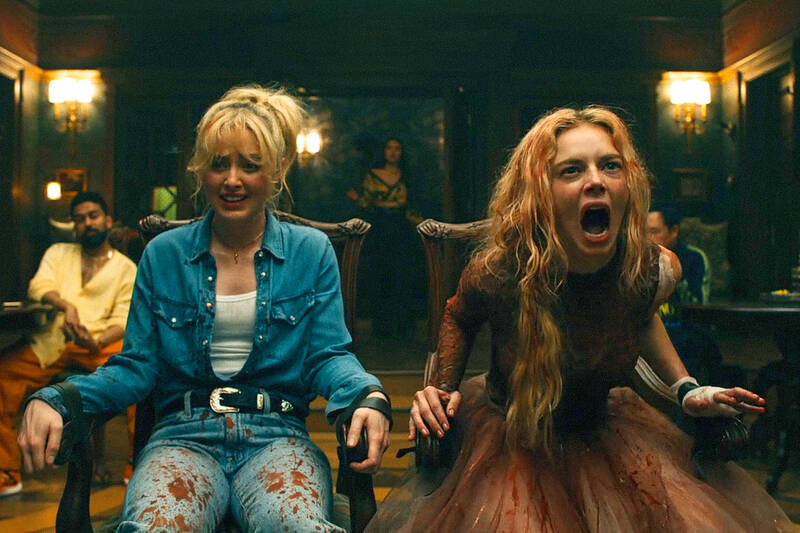
Photo: AP
It’s hard to pinpoint why this next level of Grace’s very bad wedding night, again directed by Matt Bettinelli-Olpin and Tyler Gillett, feels darker and heavier — and hence, less enjoyable — than the original, which managed to maintain a bouncy feel, even with bodies combusting at an absurd rate. But if we have to blame someone, we’re gonna go with the doctor from The Pitt.
Yep, that would be Shawn Hatosy, and we’re sorry, dear handsome Dr. Jack Abbott, but we never thought you could be such a downer. There’s a particularly odious scene where Hatosy’s character, Titus, seems to echo the murderous Shakespearean protagonist that he is, come to think of it, probably named after — Titus Andronicus. His twin sister, Ursula, is played by Sarah Michelle Gellar, and together they’re quite the depressing duo.
But back to the plot: Grace had triumphantly stayed alive ‘til dawn in the first movie, thus winning the dastardly game she’d been forced to play moments after marrying Alex, her rich boyfriend. Required by family ritual to draw a game card from a deck, she’d unluckily drawn hide-and-seek, which meant she had to hide while the extended family hunted her down with weapons both antique and modern. Only gritty Grace survived.
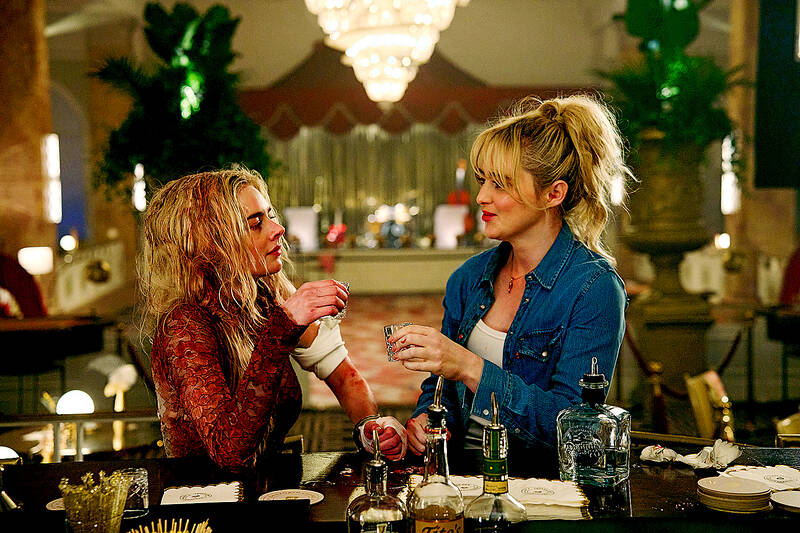
Photo: AP
The supporting cast of the first movie, including Andie MacDowell and Adam Brody, is not back (duh). In their place is a new group, including Hatosy, Gellar, Elijah Wood as the attorney who runs the grim proceedings, and Kathryn Newton as Grace’s sister, Faith.
Or should we say estranged sister. Faith shows up at Grace’s hospital bed, having not seen her in years, because she was listed as Grace’s emergency contact. There’s a detective in the room, too. Grace is now, annoyingly, suspected of arson and murder.
But soon none of that matters. Because, it turns out, Grace is being hunted yet again — not by her in-laws, the Le Domas family, which is gone, but by four other families jockeying for the High Seat on the council that rules the world.
And so Grace is captured, and everyone converges on a Newport, Rhode Island, estate with a gorgeous golf course, for another night of hunting. Is Grace up to the challenge of this new level of play?
Of course she is, and so is Weaving, who proves yet again that she’s better than the material: expressive in both fear and feistiness, a good screamer and able to step back for an occasional moment of humor. Lookalike Newton proves an appealing companion, and of course Faith and Grace stop bickering and start bonding — did you expect anything else? “I tried to invite you to the wedding,” Grace says helpfully at one point. Reminder: the wedding ended in a bloodbath.
Speaking of a bloodbath, deep into the movie’s production notes comes an icky statistic: Some 250 gallons of stage blood were used for the film. Maybe all that blood was needed, but the extra 15 minutes of run time, compared to the original, feel unnecessary. You start to wonder when dawn will come.
And while most of the deaths have a cartoonish element, there’s nothing cartoonish when Titus is involved.
No, there is little to redeem this truly mendacious character. So fair warning: If you’re still in the middle of the current season of “The Pitt,” where Hatosy’s Abbott is busy being heroic and also taking off his shirt, it might be better to wait a bit before you watch him here, doing the very opposite of saving lives.

The race for New Taipei City mayor is being keenly watched, and now with the nomination of former deputy mayor of Taipei Hammer Lee (李四川) as the Chinese Nationalist Party’s (KMT) candidate, the battle lines are drawn. All polling data on the tight race mentioned in this column is from the March 12 Formosa poll. On Christmas Day 2010, Taipei County merged into one mega-metropolis of four million people, making it the nation’s largest city. The same day, the winner of the mayoral race, Eric Chu (朱立倫) of the Chinese Nationalist Party (KMT), took office and insisted on the current

Last week the government announced that by year’s end Taiwan will have the highest density of anti-ship missiles in the world. Its inventory could exceed 1,400, or enough for the opening two hours of an invasion from the People’s Republic of China (PRC). Snark aside, it sounds impressive. But an important piece is missing. Lost in all the “dialogues” and “debates” and “discussions” whose sole purpose is simply to dawdle and delay is what the Chinese Nationalist Party (KMT) alternative special defense budget proposal means for the defense of Taiwan. It is a betrayal of both Taiwan and the US. IT’S

March 16 to March 22 Hidden for decades behind junk-filled metal shacks, trees and overgrowth, a small domed structure bearing a Buddhist swastika resurfaced last June in a Taichung alley. It was soon identified as a remnant of the 122-year-old Gokokuzan Taichuu-ji (Taichung Temple, 護國山台中寺), which was thought to have been demolished in the 1980s. In addition, a stone stele dedicated to monk Hoshu Ono, who served as abbot from 1914 to 1930, was discovered in the detritus. The temple was established in 1903 as the local center for the Soto school

Paul Thomas Anderson’s “One Battle After Another” was crowned best picture at the 98th Academy Awards, handing Hollywood’s top honor to a comic, multi-generational American saga of political resistance. The ceremony Sunday, which also saw Michael B. Jordan win best actor and “Sinners” cinematographer Autumn Durald Arkapaw make Oscar history as the first female director of photography to win the award, was a long-in-coming coronation for Anderson, a San Fernando Valley native who made his first short at age 18 and has been one of America’s most lionized filmmakers for decades. Before Sunday, Anderson had never won an Oscar. But “One Battle


 RSS
RSS