


China’s announcement its top general was under investigation stunned defense watchers, hollowing out the country’s top military body and confirming President Xi Jinping’s (習近平) far-reaching power.
Zhang Youxia (張又俠), a vice chairman of the powerful Central Military Commission (CMC), is targeted in a probe for serious violations of the law — a common euphemism for corruption. Investigations almost always end in removal.
Until recently, Zhang’s abrupt sidelining was largely unexpected, due to his long military tenure and perceived closeness with Xi.
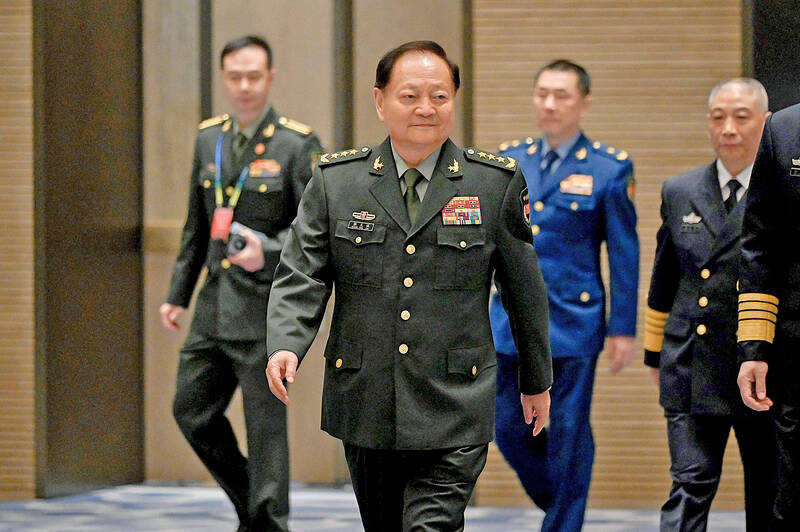
Photo: AFP
The sturdy, square-faced general was frequently pictured standing beside the president during officer promotion ceremonies as recently as December.
He had survived several previous rounds of anti-graft sweeps through the CMC since its seven-person roster was set during the last Party Congress in 2022.
Another CMC official, Liu Zhenli (劉振立), is also under investigation, leaving untouched just two known members on the commission: Xi and discipline czar Zhang Shengmin (張升民).
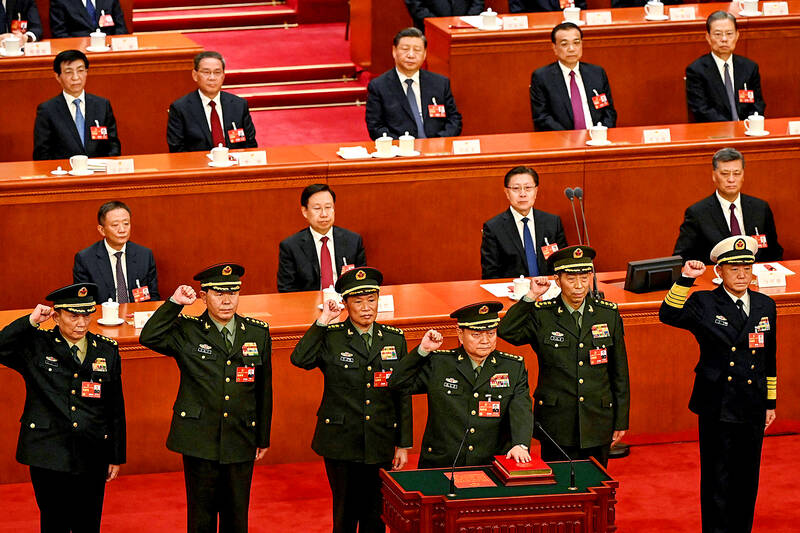
Photo: AFP
MILITARY FAMILY
Born in 1950 to a military family less than a year after Communist leader Mao Zedong (毛澤東) declared the founding of the People’s Republic of China (PRC), Zhang’s proximity to power dates back to his youth. His father Zhang Zongxun (張宗遜) is considered a “founding general” of the PRC. He served alongside Xi’s father when the two were Communist fighters in the country’s northwest.
The younger Zhang and Xi, now 75 and 72, are both “princelings” — a term describing the children of revolutionary leaders who have benefitted from their family connections.
CAREER
Zhang joined the army at the age of 18 and moved up the ranks in a regiment headquartered in southwestern Yunnan province, which borders Myanmar, Laos and Vietnam.
He fought in border conflicts including the weekslong 1979 Sino-Vietnamese War, giving him rare combat experience.
The war, which involved around 200,000 Chinese soldiers, was the last major armed conflict fought by PLA troops, although clashes with Vietnam continued for around a decade.
Zhang later moved north and was eventually named commander of the Shenyang Military Region. He was made general in 2011, and later put in charge of arms and equipment procurement and development.
He was tapped to the CMC in 2012 when Xi became its head after ascending to the top of the Communist Party.
Battle-learned Zhang “had an aura of competence around him,” said former US defense official Drew Thompson during a Chinese delegation’s visit to the US in 2012.
Officers “stood up faster and straighter when he entered a room” and Zhang “wasn’t afraid to talk to foreigners,” Thompson wrote in a Substack post about his encounter.
In 2017, Zhang was promoted to one of the CMC’s vice chairman positions, also joining the Communist Party’s elite body, the Politburo.
He assumed the CMC’s senior vice chair role in 2022.
LINKS TO XI
Some analysts have described Zhang as a childhood friend of Xi, although others have questioned that claim.
Knowledge of their relationship is “limited,” according to Asia Society’s Neil Thomas, who studies elite Chinese politics.
The two men may have shared childhood circles in Beijing thanks to their fathers, who were both from northern Shaanxi province, but did not work together until later in their careers. Still, the president oversaw Zhang’s rise, Thomas wrote, making it “clear that Xi used to see him as a trusted colleague.”
DOWNFALL
Rumors of an investigation swirled days before it was announced, after Zhang and Liu appeared to miss an official meeting chaired by Xi and attended by second-ranked CMC vice chairman Zhang Shengmin.
But analysts have suggested trouble began far earlier, pointing to the purge of former defense minister Li Shangfu (李尚福) — who like Zhang oversaw military equipment.
The defense ministry did not say specifically why the probe into Zhang and Liu had been opened.
However, the PLA Daily — the Chinese military’s mouthpiece — said they were “corrupt elements” in a front-page editorial published Monday.
The “resolute investigation and punishment” of Zhang and Liu “removes roadblocks” and “squeezes out the water diluting combat effectiveness,” it said.
An earlier editorial, published a day after Beijing announced the probes, said their actions “seriously undermined and violated the system of responsibility of the CMC chairman,” Xi.

Dissident artist Ai Weiwei’s (艾未未) famous return to the People’s Republic of China (PRC) has been overshadowed by the astonishing news of the latest arrests of senior military figures for “corruption,” but it is an interesting piece of news in its own right, though more for what Ai does not understand than for what he does. Ai simply lacks the reflective understanding that the loneliness and isolation he imagines are “European” are simply the joys of life as an expat. That goes both ways: “I love Taiwan!” say many still wet-behind-the-ears expats here, not realizing what they love is being an
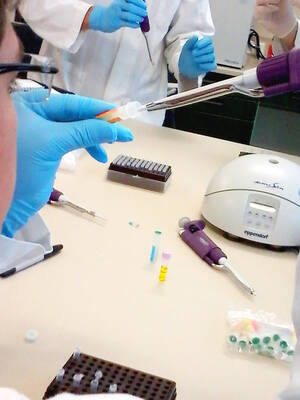
Google unveiled an artificial intelligence tool Wednesday that its scientists said would help unravel the mysteries of the human genome — and could one day lead to new treatments for diseases. The deep learning model AlphaGenome was hailed by outside researchers as a “breakthrough” that would let scientists study and even simulate the roots of difficult-to-treat genetic diseases. While the first complete map of the human genome in 2003 “gave us the book of life, reading it remained a challenge,” Pushmeet Kohli, vice president of research at Google DeepMind, told journalists. “We have the text,” he said, which is a sequence of
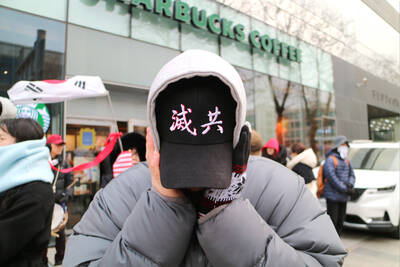
On a harsh winter afternoon last month, 2,000 protesters marched and chanted slogans such as “CCP out” and “Korea for Koreans” in Seoul’s popular Gangnam District. Participants — mostly students — wore caps printed with the Chinese characters for “exterminate communism” (滅共) and held banners reading “Heaven will destroy the Chinese Communist Party” (天滅中共). During the march, Park Jun-young, the leader of the protest organizer “Free University,” a conservative youth movement, who was on a hunger strike, collapsed after delivering a speech in sub-zero temperatures and was later hospitalized. Several protesters shaved their heads at the end of the demonstration. A
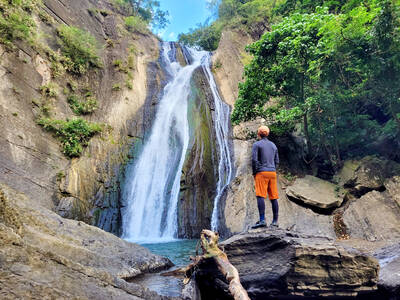
Every now and then, even hardcore hikers like to sleep in, leave the heavy gear at home and just enjoy a relaxed half-day stroll in the mountains: no cold, no steep uphills, no pressure to walk a certain distance in a day. In the winter, the mild climate and lower elevations of the forests in Taiwan’s far south offer a number of easy escapes like this. A prime example is the river above Mudan Reservoir (牡丹水庫): with shallow water, gentle current, abundant wildlife and a complete lack of tourists, this walk is accessible to nearly everyone but still feels quite remote.


 RSS
RSS