


With the publication of Honghong Tinn’s (鄭芳芳) Island Tinkerers last year, it seemed like the canonical work on the development of Taiwan’s electronics industry had arrived.
It was hard to imagine much had been left uncovered by this book (reviewed in the Taipei Times, Feb. 27, 2025, and listed as a notable 2025 book about Taiwan in the Taipei Times, Jan. 2, 2026).
Yet, this short monograph — magnanimously recommended to me by Tinn for taking “a different approach” — reimagines the story of Taiwan’s engineers through a lens that is both novel and instructive.
The idea that Taiwan’s development was premised on competing visions and aspirations is not unprecedented — Ian Rowen’s One China, Many Taiwans (reviewed in the Taipei Times, April 20, 2023), which examines the tourist industry’s “performance” of territory embraces such a notion, as does James Lin’s In the Global Vanguard, an analysis of Taiwan’s agrarian evolution.
Indeed, Lin’s book (reviewed in the Taipei Times, Aug. 14, 2025) is an excellent companion piece to Engineers and the Two Taiwans. Both highlight institutionalized inequality in career opportunities between “local” Taiwanese, or “islanders,” and “mainlanders,” or those who arrived from China after World War II.
“The makeup of overseas development missions tended to conform to a colonial hierarchy on the island itself, with “mainlander” waishengren (外省人) in positions of power and “Taiwanese” benshengren (本省人) comprising most of the junior technicians,” writes Lin.
Likewise, this book reveals that would-be benshengren engineers were initially restricted to education at technical colleges where they earned diplomas and associate degrees, leading to lower-skilled positions as technicians.
Their waishengren counterparts, who graduated from degree programs at top institutions, two of which — National Chiao Tung University and National Tsing Hua University — had been re-established in Taiwan, landed managerial positions in large government-owned and private industrial enterprises.
Military figures with engineering backgrounds such as Yang Chi-tseng (楊繼曾) and Chiang Shao (Kiang Piao, 江杓) — both of whom served as minister of economic affairs in the mid-1950s — led a national and “political” and “ethical” reconstruction that was, in part, based on Chiang Kai-shek’s (蔣介石) exhortation to “fulfil the principle of complete loyalty to the state and filial piety toward the nation.”
WILLING AND ABLE
That these “ethical knowers” of reconstruction were drawn from US-educated mainland elites, who had become officials in Republican China’s National Resources Commission, rather than islanders “degraded” by Japanese education was a given.
To show that they were capable “and more than prepared to serve an arriving government of scholar officials and to help train new talents,” islander scientists and industrialists formed the 3,000-strong Formosa Association for the Advancement of Science.
Recalling in a memoir this initiative to show Taiwan’s new Chinese National Party (KMT) rulers that local talent was willing and able to “serve the nation with industry,” engineer Chu Jiang-hui (朱江淮), wanted to “debunk” the “rumor” that Taiwanese had served only in dogsbody roles under the Japanese. These appeals fell on deaf ears.
“Unfortunately, local ‘scientists’ could not be accepted as knowers of national reconstruction,” write the book’s authors. “Having been colonized for 50 years, they could not have completed the educational formation necessary to claim the status of committed technical leaders.”
The association was soon dissolved and its members entreated to re-organize “under government supervision,” which entailed rank-and-file membership in “Chinese” bodies, with no opportunities to influence decision-making.
LIMITED PARTICIPATION
In fact, as the authors note, the KMT government’s assumptions were not unfounded, as Chu’s own circumstances make clear.
At the age of 22, in the mid-1920s, Chu had become the first Taiwanese to earn a bachelor’s degree in electrical engineering from a Japanese university. Yet his prospects remained limited to a sales position at the state-run Taiwan Electric Company.
While berating local Taiwanese talent as underqualified and morally lacking, the KMT administration ironically perpetuated the divide with its own two-tier system.
Ever pragmatic and resourceful, the Taiwanese circumvented these roadblocks, working from the margins to make themselves an indispensable part of the ecosystem that developed. It was precisely because discrimination was not a new phenomenon that they were adept at “climbing up from the underside.”
In contrast to the behemoth zaibatsu of Japan and chaebol of South Korea, which stressed vertical integration, Taiwan’s success was dependent on an environment where small and mediums enterprises (SMEs) could thrive.
These SMEs proliferated in spite of or perhaps because of scant government support, though this political point is not dwelt upon by the authors.
CARVING NICHES
Personified by technocrats such as Li Kwoh-ting (李國鼎) and Sun Yun-suan (孫運璿), both ministers of economic affairs, with the latter also later serving as premier, the KMT has long been credited with guiding Taiwan’s development as a tech powerhouse.
However, as this book shows, disillusioned by a lack of opportunities, under successive colonizing powers, Taiwanese entrepreneurs turned to private enterprise, carving their own niches, and helping to shape the direction of the nascent electronics industry.
This replicated similar, albeit more limited advances made by private ventures established by Taiwanese during Japanese rule. Examples were the Guang-Zhi Business (光智商會), the Xie-Zhi Business (協志商會) and the Tang-Eng Iron Works (唐榮鐵工廠), all of which contracted to the government on public works projects, eventually playing increasingly prominent roles, as part of Japan’s southward expansion.
UNAVOIDABLY POLITICAL
As for the “abnormal club” of the book’s title, the name came from a group of Chiao Tung students in the 1960s. The group stood out because it comprised both islanders and mainlanders, none of whom studied in the US.
By extension, the two-track system of satellites that clustered around the state-backed stars became an “abnormal club” writ large. Within this “club,” different views of what it meant to be working in the national interest emerged, particularly as trade with China flourished. The supposedly apolitical nature of engineering could not prevent this.
Some, like Chi Gou-chung (紀國鐘), whose career was “compromised” by his support of the Democratic Progressive Party in the early 1990s, or the hundreds of engineering scholars who signed a petition against the 2013 Cross-Strait Trade in Services Agreement, were unabashedly political.
For those that weren’t, the authors argue, “the different identities, commitments and forms of knowledge” that engineers brought to the “material provisioning” of Taiwan, made partisan politics unavoidable.
Most of all, the “attachment to … specific lands,” that informed career decisions, influencing the work engineers undertook, helped cement Taiwan’s status as “a thing unto itself.”

By global standards, the traffic congestion that afflicts Taiwan’s urban areas isn’t horrific. But nor is it something the country can be proud of. According to TomTom, a Dutch developer of location and navigation technologies, last year Taiwan was the sixth most congested country in Asia. Of the 492 towns and cities included in its rankings last year, Taipei was the 74th most congested. Taoyuan ranked 105th, while Hsinchu County (121st), Taichung (142nd), Tainan (173rd), New Taipei City (227th), Kaohsiung (241st) and Keelung (302nd) also featured on the list. Four Japanese cities have slower traffic than Taipei. (Seoul, which has some

In our discussions of tourism in Taiwan we often criticize the government’s addiction to promoting food and shopping, while ignoring Taiwan’s underdeveloped trekking and adventure travel opportunities. This discussion, however, is decidedly land-focused. When was the last time a port entered into it? Last week I encountered journalist and travel writer Cameron Dueck, who had sailed to Taiwan in 2023-24, and was full of tales. Like everyone who visits, he and his partner Fiona Ching loved our island nation and had nothing but wonderful experiences on land. But he had little positive to say about the way Taiwan has organized its

The entire Li Zhenxiu (李貞秀) saga has been an ugly, complicated mess. Born in China’s Hunan Province, she moved to work in Shenzhen, where she met her future Taiwanese husband. Most accounts have her arriving in Taiwan and marrying somewhere between 1993 and 1999. She built a successful career in Taiwan in the tech industry before founding her own company. She also served in high-ranking positions on various environmentally-focused tech associations. She says she was inspired by the founding of the Taiwan People’s Party (TPP) in 2019 by Ko Wen-je (柯文哲), and began volunteering for the party soon after. Ko
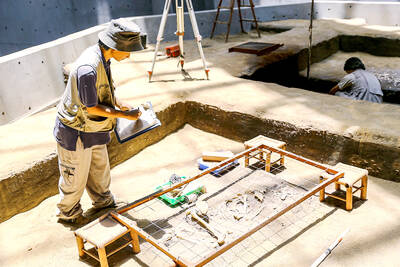
Writing of the finds at the ancient iron-working site of Shihsanhang (十 三行) in New Taipei City’s Bali District (八里), archaeologist Tsang Cheng-hwa (臧振華) of the Academia Sinica’s Institute of History and Philology observes: “One bronze bowl gilded with gold, together with copper coins and fragments of Tang and Song ceramics, were also found. These provide evidence for early contact between Taiwan aborigines and Chinese.” The Shihsanhang Web site from the Ministry of Culture says of the finds: “They were evidence that the residents of the area had a close trading relation with Chinese civilians, as the coins can be


 RSS
RSS