


The term “pirates” as used in Asia was a European term that, as scholar of Asian pirate history Robert J. Antony has observed, became globalized during the European colonial era. Indeed, European colonial administrators often contemptuously dismissed entire Asian peoples or polities as “pirates,” a term that in practice meant raiders not sanctioned by any European state. For example, an image of the American punitive action against the indigenous people in 1867 was styled in Harper’s Weekly as “Attack of United States Marines and Sailors on the pirates of the island of Formosa, East Indies.”
The status of such raiders in the late Ming and early Manchu (Qing) eras was analogous. Large groups of sea bandits operated within, outside of and alongside the legal order, though sometimes the empires would incorporate them by giving them appointments as public officials. These sea raiders often appear in history as throwaway references to pre-modern Taiwan as a pirate-infested island, in older narratives that depict history as commencing with the arrival of the Dutch.
Who were those pirates? They were the first of many organized criminals who exploited the stateless international status of the island, a recurrent theme in Taiwan history. This theme manifests itself in a variety of ways: as the widespread western recognition in the 19th century that the Manchu hold on the island did not extend to the east; as James Horn attempting to establish a colony-state on the east coast in the late 1860s; as Japan sending troops to southern Taiwan in the 1874 because the Manchus were reluctant to claim the area; right down to the money launderers, scammers and art thieves of today.
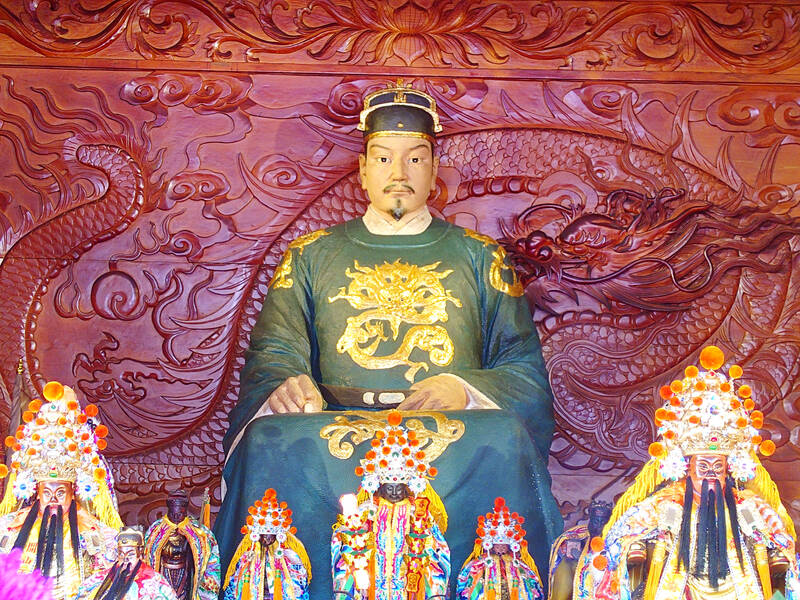
Photo: Hung Jui-chin, Taipei Times
KOXINGA
While the name and pirate status of Cheng Cheng-kung (鄭成功, also known as Koxinga, a Dutch corruption of one his titles, 國姓爺) is celebrated, he was but one of many non-state sanctioned battle leaders to attempt to establish a kingdom on Taiwan in the pre-industrial era. The difference was that Koxinga was successful.
History has left little record of Koxinga’s peers, who like him traded and raided across Asian waters. In the 1570s Lin Feng (林鳳, also known as Limahong) appears in history as a pirate lord commanding a fleet of ships that operated across the waters of southern China and far into the South China Sea.
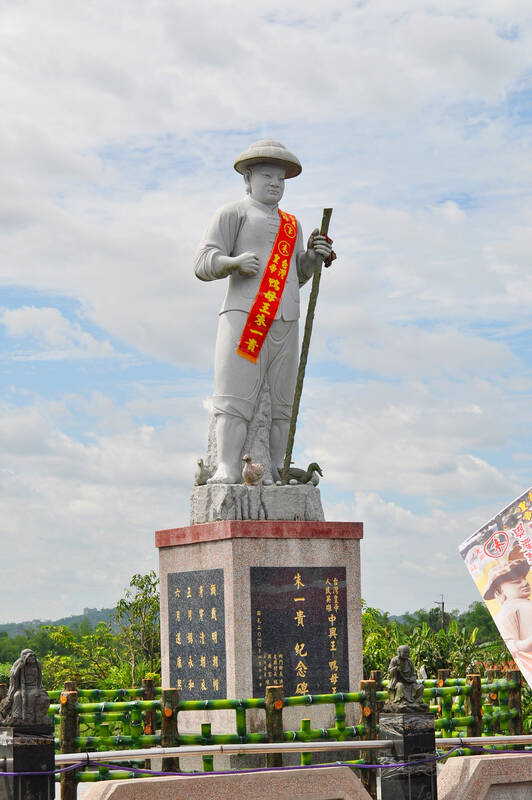
Photo: Wang Shu-hsiu, Taipei Times
“From bases on Taiwan, Lin’s fleets sallied forth with the monsoons each year to plunder shipping across the entire South China Sea,” Antony writes. Scholars locate his base in the Penghu Archipelago.
One of the first things Koxinga did after establishing his miniature imperial state on Taiwan was raid northern Luzon and threaten Manila. He was not the first to think of that. In 1572 Lin Feng established a fortified base on Luzon. In 1574 he raided Hainan Island and then attacked Manila, leaving from a base in Penghu (possibly Makung, a key base for Japanese pirates). There, a contemporary account says, he made himself lord over the city, collecting tribute from the inhabitants.
In doing this, Lin showed the same territorial ambitions that drove other sea raiders of the period, from the Portuguese to Koxinga. According to contemporary chroniclers, Lin brought his best men and ships, including 1,500 women, obviously intending to establish a lasting presence away from the Ming navy. A century later the chronicler Gaspar de San Agustin described these pirate groups as organized, autonomous societies (“republica muy entera y bien formada”). Moreover, Lin’s actions are yet another example of the geostrategic imperative by which forward bases in Taiwan lead almost inevitably to attacks on Luzon.
Photo: Wang Shu-hsiu, Taipei Times
Juan de Salcedo, “the last of the conquistadores,” had only recently wrested Manila from the grip of the Sultan of Brunei, in 1567. He had been in northern Luzon extending the Spanish crown’s holdings, but hurried back. After bitter fighting he threw Lin out of Manila. He followed Lin north to Pangasinan, where he besieged the pirate leader for four months. Lin surrendered and escaped, leaving his subordinates to beg for mercy. After 1580 he fades out of history, to flash briefly in a record from 1589 where it is said he controls an island and plunders from there.
TSAI CHIEN
At the end of the 18th century the Manchu Empire was in the throes of political and climatic upheaval, beset by famines and revolts. In Vietnam the Tay Son rebellion was ongoing and many Chinese pirates allied with it or used northern Vietnam as a base. Piracy reached a peak. Tsai Chien (蔡牽), a pirate based in southern Fujian, gradually began to dominate the seas between the China coast and Taiwan between 1800 and 1804. He ran a giant organization of pirates, with a fleet of over 100 vessels and deep connections to local secret societies.
Like the organized pirates before him, he began to develop territorial ambitions. In 1805 and 1806 he attacked Taiwan, intending to take over the island and use it as a base. He used a force of 5,000 men to raid Changhua, Luermen and Donggang.
“With apparent popular support, he proclaimed himself the ‘Majestic Warrior King Who Subdues the Sea’ as a preliminary to establishing his own kingdom on the island,” Antony writes.
The Manchu forces and local militias defeated him in 1806. He escaped back to Fujian, bought more ships and continued to raid across the area, including Taiwan, but was eventually killed in 1809.
To Tsai Chien, Taiwan must have appeared stateless. At that time most of the island lay outside Manchu control. He probably knew that the Lin Shuangwen (林爽文) rebellion had just been defeated in 1788 and calculated that a small force of disciplined men with popular support could sweep the Manchus off the island. Lest that sound like a dream, recall that Koxinga brought 20,000 men to take Anping from the Dutch. Similarly Chu Yi-kuei (朱一貴), whom Tsai was likely to have heard of, began a rebellion in 1721 that established him as King on Taiwan with a few hundred men.
For pirates, Taiwan was not just a base, but also a market. Koxinga’s son, Cheng Jing (鄭經), took over his father’s emerging state. He allied himself with pirates operating in the seas off China to gain ships and men to fight the Manchus. One of them, who was nicknamed Stinky Red Meat, plundered and looted along the coast of China. He was especially fond of abducting women, whom he sold in Taiwan. Although in popular lore pirates steal gold and jewels, and are sometimes regarded or celebrated by locals as Robin Hood-style bandits, in Asia their most lucrative booty was human beings, who were sold into slavery across the region.
In 1622 another well-organized pirate group attacked Macau, but they failed to take the city. Instead they seized the Penghu Islands. They plundered villages and kidnapped hundreds of people to sell as slaves. Ill-cared for, many of the kidnapping victims died before they could be sold.
In 1624, taking note of Taiwan’s statelessness, they took Anping in Tainan and built a fort, which they finished in 1634. We call it Fort Zeelandia.
Notes from Central Taiwan is a column written by long-term resident Michael Turton, who provides incisive commentary informed by three decades of living in and writing about his adoptive country. The views expressed here are his own.

Yesterday, the Democratic Progressive Party (DPP) nominated legislator Puma Shen (沈伯洋) as their Taipei mayoral candidate, the Chinese Nationalist Party (KMT) put their stamp of approval on Wei Ping-cheng (魏平政) as their candidate for Changhua County commissioner and former legislator Tsai Pi-ru (蔡壁如) of the Taiwan People’s Party (TPP) has begun the process to also run in Changhua, though she has not yet been formally nominated. All three news items are bizarre. The DPP has struggled with settling on a Taipei nominee. The only candidate who declared interest was Enoch Wu (吳怡農), but the party seemed determined to nominate anyone

In a sudden move last week, opposition lawmakers of the Chinese Nationalist Party (KMT) and Taiwan People’s Party (TPP) passed a NT$780 billion special defense budget as a preemptive measure to stop either Chinese leader Xi Jinping (習近平) or US President Donald Trump from blocking US arms sales to Taiwan at their summit in Beijing, said KMT heavyweight Jaw Shaw-kong (趙少康), speaking to the Taipei Foreign Correspondents Club on Wednesday night in Taipei. The 76-year-old Jaw, a political talk show host who ran as the KMT’s vice presidential candidate in 2024, says that he personally brokered the deal to resolve
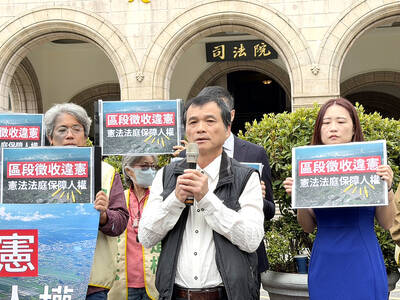
What government project has expropriated the most land in Taiwan? According to local media reports, it is the Taoyuan Aerotropolis, eating 2,500 hectares of land in its first phase, with more to come. Forty thousand people are expected to be displaced by the project. Naturally that enormous land grab is generating powerful pushback. Last week Chen Chien-ho (陳健和), a local resident of Jhuwei Borough (竹圍) in Taoyuan City’s Dayuan District (大園) filed a petition for constitutional review of the project after losing his case at the Taipei Administrative Court. The Administrative Court found in favor of nine other local landowners, but

The Chinese Nationalist Party (KMT) and its sock puppet, the Taiwan People’s Party (TPP), passed their version of the government’s proposed supplementary defense spending bill last week, engendering much commentary. While all eyes were on the defense budget, the PRC’s assault on Taiwan was advancing on other fronts. The removal of domestic drone production and other technologies critical to the nation’s asymmetrical defenses from the list of items purchased in the “compromise” bill shows how the KMT-TPP alliance appears to be serving the People’s Republic of China (PRC). Ironically, the cuts will impact industries heavily represented by tech firms in areas run


 RSS
RSS