


It’s a bold filmmaking choice to have a countdown clock on the screen for most of your movie.
In the best-case scenario for a movie like Mercy, in which a Los Angeles detective has to prove his innocence to an artificial intelligence judge within said time limit, it heightens the tension. Who hasn’t gotten sweaty palms in, say, a Mission: Impossible movie when the bomb is ticking down and Tom Cruise still hasn’t cleared the building? Why not just extend it for the duration?
Perhaps in a better movie it might have worked. Sadly in Mercy, it’s an ever-present reminder of just how much longer you must endure until you too are free of Chris Pratt, Rebecca Ferguson and that chair.
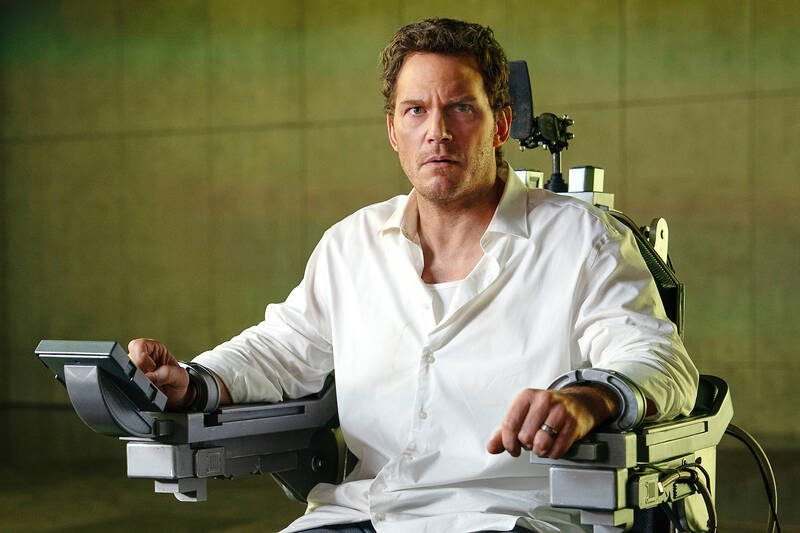
Photo: AP
In Mercy’s near-future Los Angeles, AI has been adopted by law enforcement and the judicial system to more efficiently clean up the city’s crime and blight problem. It’s a potent and not too far-flung idea that might have been a fascinating and provocative premise for a movie attempting to grapple with the implications of so-called progress that had the potential to be a worthy companion to another Cruise movie, Minority Report. But that would have required a more serious script than screenwriter Marco van Belle’s and more vision than filmmaker Timur Bekmambetov managed to muster.
When Pratt’s character, Chris Raven, wakes up, barefoot and strapped into an electric chair sitting in the middle of an oddly large room that looks a bit like the holodeck, he’s informed by an IMAX-sized AI judge (Ferguson) that he has 90 minutes to prove he didn’t kill his wife (Annabelle Wallis). In this world, the incarcerated are guilty until proved innocent. They’ve cut lawyers and juries out of the equation as well. Instead, the accused have everyone’s digital footprint at their disposal to help build their own case. For Raven, that means everything from ring cam footage to his teenage daughter’s secret Instagram account.
Unfortunately for Raven, he woke up with some gaps in his memory between angrily busting into his home to confront his wife about something and being arrested and bludgeoned at a bar later that day. Raven was also one of the original champions of the AI judge system, which in a more curious script might have resulted in some real stakes. This story is more hung up on increasingly tortured plot contrivances, however, including Raven’s drinking problem following the death of a partner killed on the job. To its credit, the story does really keep it ambiguous as to whether Raven did it or not, but to say that it earns any sort of investment in the outcome is a stretch.
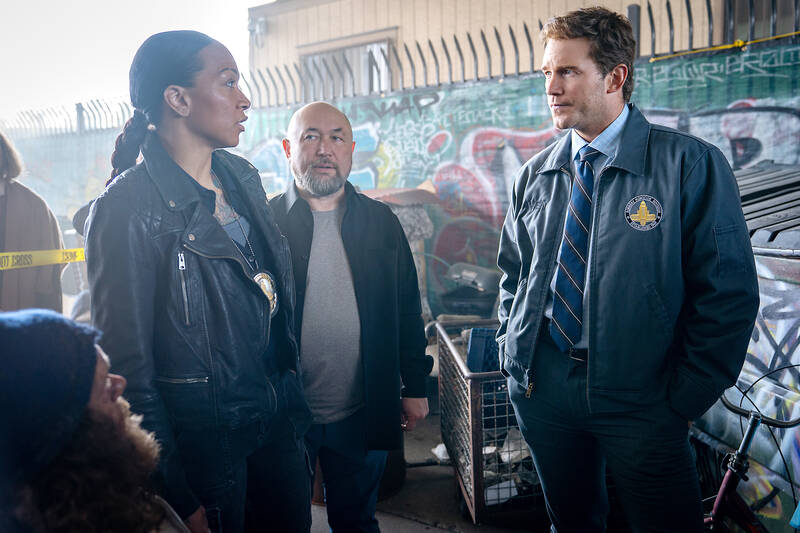
Photo: AP
One of the most confounding choices is to have a real actor playing the AI judge. Wouldn’t it have been more interesting and provocative to use an AI creation as the impartial Judge Maddox instead of stripping Ferguson of all emotion and charisma in the role? At times, it feels as tedious as watching a stranger’s increasingly frustrating call with a robotic customer service representative play out in real time.
For how reliant this movie is on screens and keeping Pratt alone, one might assume that Mercy was a socially distanced, COVID-era leftover instead of something made in 2024. Kali Reis, playing another LAPD agent named Jaq who decides to help Raven investigate on the ground is the one that gets to be out in the real-world chasing leads and hunches. But for the most part, she’s seen only through FaceTime and bodycam footage. Like Raven, we’re largely stuck in the chair watching things play out on multiple screens, acutely aware of just how much time is left.

By global standards, the traffic congestion that afflicts Taiwan’s urban areas isn’t horrific. But nor is it something the country can be proud of. According to TomTom, a Dutch developer of location and navigation technologies, last year Taiwan was the sixth most congested country in Asia. Of the 492 towns and cities included in its rankings last year, Taipei was the 74th most congested. Taoyuan ranked 105th, while Hsinchu County (121st), Taichung (142nd), Tainan (173rd), New Taipei City (227th), Kaohsiung (241st) and Keelung (302nd) also featured on the list. Four Japanese cities have slower traffic than Taipei. (Seoul, which has some
Taiwan’s semiconductor industry consumes electricity at rates that would strain most national grids. Taiwan Semiconductor Manufacturing Co (TSMC) alone accounted for more than 9 percent, or 2,590 megawatts (MW), of the nation’s power demand last year. The factories that produce chips for the world’s phones and servers run around the clock. They cannot tolerate blackouts. Yet Taiwan imports 97 percent of its energy, with liquefied natural gas reserves measured in days. Underground, Taiwan has options. Studies from National Taiwan University estimate recoverable geothermal resources at more than 33,000 MW. Current installed capacity stands below 10 MW. OBSTACLES Despite Taiwan’s significant geothermal potential, the

In our discussions of tourism in Taiwan we often criticize the government’s addiction to promoting food and shopping, while ignoring Taiwan’s underdeveloped trekking and adventure travel opportunities. This discussion, however, is decidedly land-focused. When was the last time a port entered into it? Last week I encountered journalist and travel writer Cameron Dueck, who had sailed to Taiwan in 2023-24, and was full of tales. Like everyone who visits, he and his partner Fiona Ching loved our island nation and had nothing but wonderful experiences on land. But he had little positive to say about the way Taiwan has organized its

The entire Li Zhenxiu (李貞秀) saga has been an ugly, complicated mess. Born in China’s Hunan Province, she moved to work in Shenzhen, where she met her future Taiwanese husband. Most accounts have her arriving in Taiwan and marrying somewhere between 1993 and 1999. She built a successful career in Taiwan in the tech industry before founding her own company. She also served in high-ranking positions on various environmentally-focused tech associations. She says she was inspired by the founding of the Taiwan People’s Party (TPP) in 2019 by Ko Wen-je (柯文哲), and began volunteering for the party soon after. Ko


 RSS
RSS