


Jan. 26 to Feb. 1
Nearly 90 years after it was last recorded, the Basay language was taught in a classroom for the first time in September last year. Over the following three months, students learned its sounds along with the customs and folktales of the Ketagalan people, who once spoke it across northern Taiwan.
Although each Ketagalan settlement had its own language, Basay functioned as a common trade language. By the late 19th century, it had largely fallen out of daily use as speakers shifted to Hoklo (commonly known as Taiwanese), surviving only in fragments remembered by the elderly.
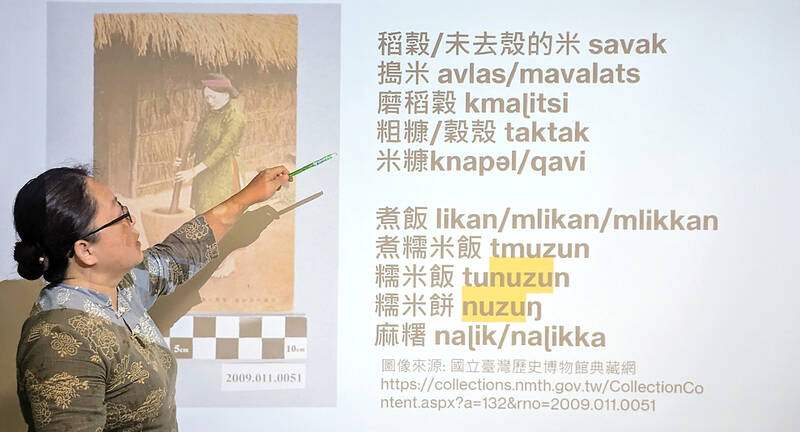
Photo: Han Cheung, Taipei Times
In 1936, Japanese anthropologist and linguist Erin Asai located two women who still remembered Basay and recorded a substantial corpus of folk tales and songs. The recordings sat in university archives for decades until they were digitized, giving modern Ketagalan the first clear sense of how the language sounded. Today, they form the basis of new teaching materials.
The Ketagalan were further assimilated and dispersed as Taipei expanded, many now living in apartment buildings and uncertain or unaware of their identity. Teachers Rosey Peng (彭凌, Ketagalan name Avas) and Chen Chin-wan (陳金萬) hope that by learning Basay together, they can reclaim a sense of community — although the classes are open to anyone interested.
“It’s a platform for people to meet and connect, and for possible descendants to find their way home,” Peng says.
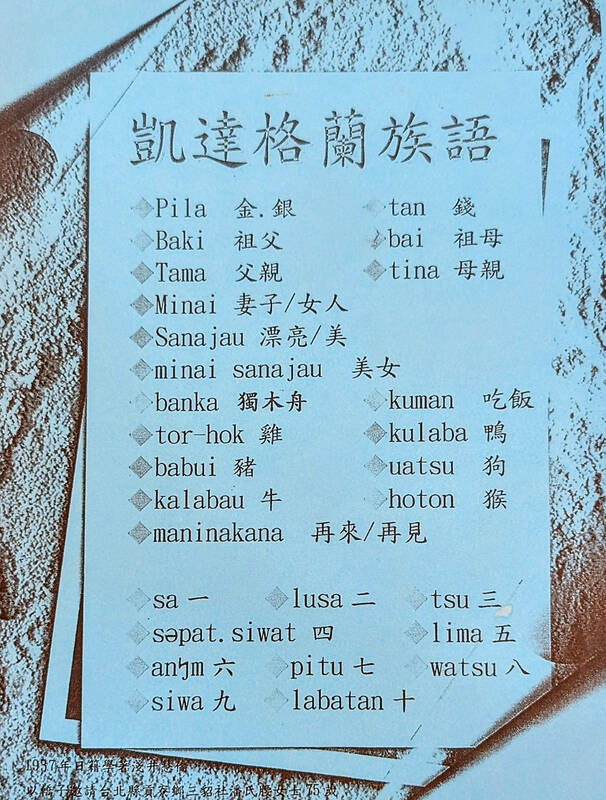
Photo courtesy of Chen Kun-mu
HISTORICAL RECORDS
Basay was first mentioned in 1632 by Spanish missionary Jacinto Esquivel, who claimed that it was widely understood across Taiwan — likely an overstatement. It’s believed to have been spoken in today’s Taipei, New Taipei City, Keelung and parts of Yilan, although individual settlements such as Kipatauw in Beitou had their own related languages. Basay speakers along the Keelung coast were skilled navigators who controlled regional trade, and other groups may have learned it for commerce.
Esquivel published a vocabulary of the Indigenous peoples living in and around the area that is today known as Tamsui District (淡水), but the manuscript remains lost. No record of Taipei’s Indigenous languages appeared again until 1896, when Japanese anthropologist Kanori Ino visited settlements in Taipei and Yilan, collecting a handful of words per location from elderly residents.
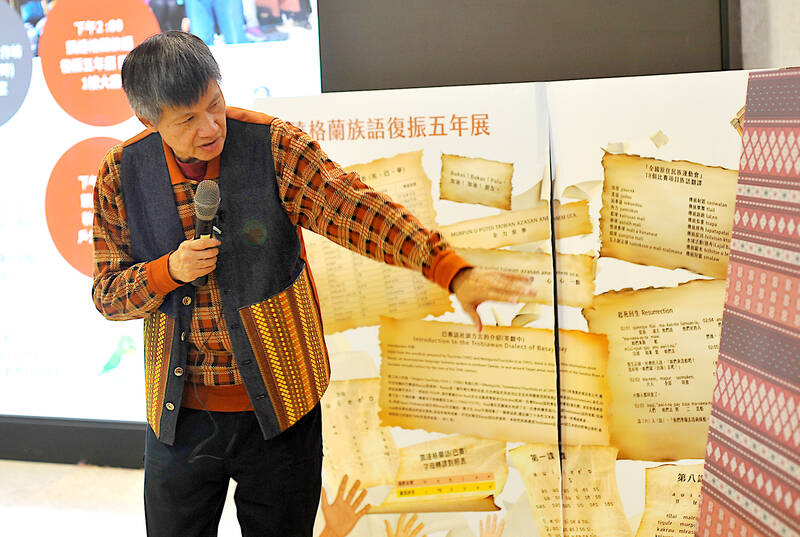
Photo: Han Cheung, Taipei Times
Some of these terms lingered long even after the language ceased to be used. Kipatauw church elder Pan Hui-an (潘慧安), 88, recalls his family using Indigenous words for certain items, while Baode Temple (保德宮) director Pan Kuo-liang (潘國良) remembers his grandmother speaking phrases he could not understand.
Asai likely first arrived in Taiwan in 1927 to conduct field research, writes musicologist Lin Ching-tsai (林清財). Over the following years, he worked with Taihoku Imperial University professor Naoyoshi Ogawa to document indigenous languages across Taiwan. In 1936, he succeeded Ogawa after the latter retired.
In October 1936, Asai met 75-year-old Pan Shih-yao (潘氏腰), who lived in the settlement of Sinshe (新社) in Gongliao District (貢寮), New Taipei City. She provided nearly 1,000 words, several sentences and two short texts. Six decades later, her great-grandson Pan Yao-chang (潘耀璋) would become one of the earliest leading figures in the Ketagalan revival movement.
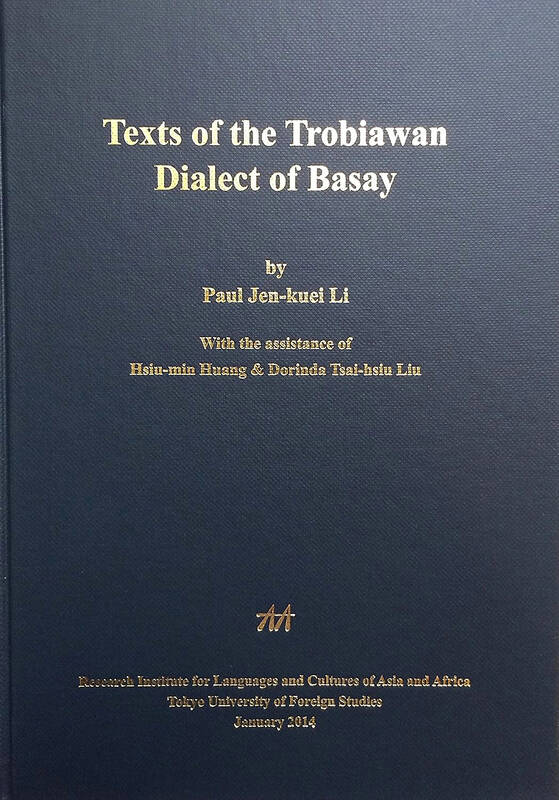
Photo courtesy of Amazon
In December, Asai located 69-year-old Ipay in Yilan County, a fluent speaker of the Trobiawan dialect of Basay. He collected a word list, more than a dozen folktales and myths, and numerous songs. After a month and a half of recording, Ipay fell ill and died in March 1937.
EARLY REVIVAL EFFORTS
Asai never published his Basay data. However, linguists Shigeru Tsuchida, Yukihiro Yamada and Tsunekazu Moriguchi in 1991 organized his materials into a dictionary. This text, along with Ino’s word lists, was used by Ketagalan activists in the early 2000s to study the language.
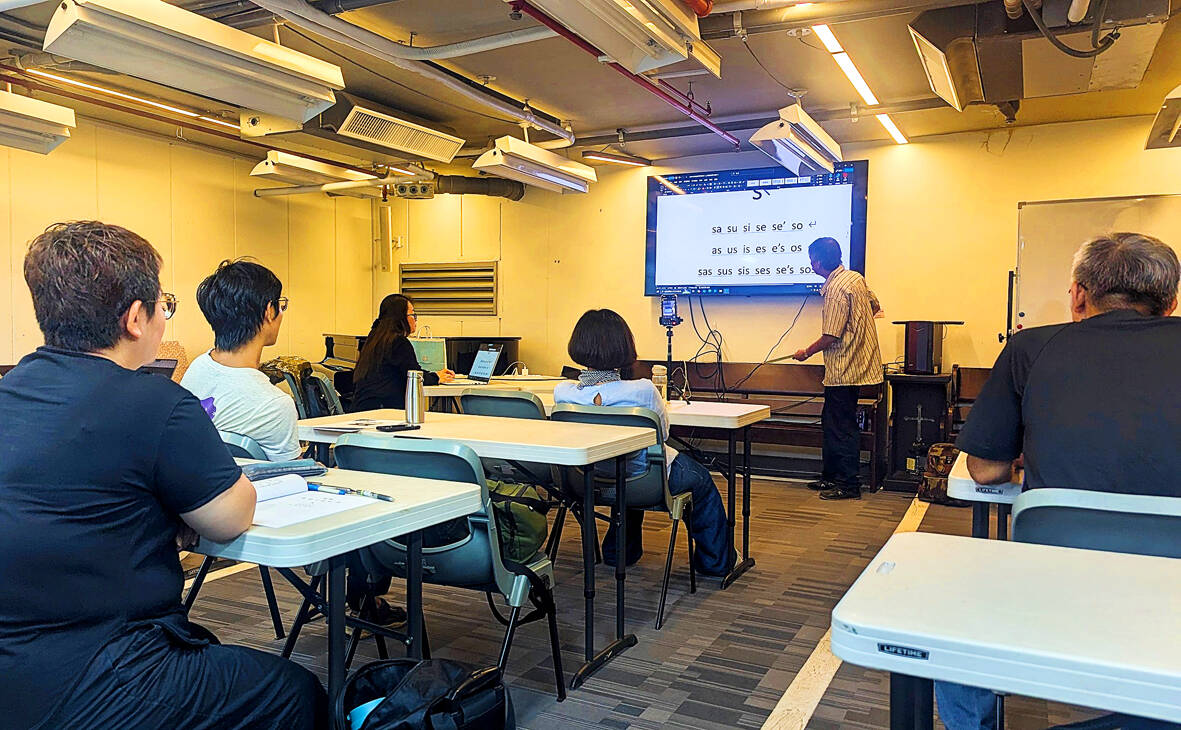
Photo: Han Cheung, Taipei Times
A turning point came when Ketagalan descendant Chen Chin-wan visited linguist Paul Jen-kuei Li (李壬癸) and discovered that he had published the book Texts of the Trobiawan Dialect of Basay in 2014. Analyzing Ipay’s data, Li had compiled a word-for-word grammatical analysis of the texts with translations in English and Chinese.
“I’m not a language expert, so this made me surprised, happy and a little scared,” Chen says. “But once I knew what we had, I felt a responsibility to act. We started from scratch just like that.”
Chen brought the book to Pan Hui-an and other Ketagalan elders at Independence Presbyterian Church in Xinbeitou, where they began studying it together. They read the text sentence by sentence, and progress was slow. Then the COVID-19 pandemic brought this effort to a halt.
Later, Chen began working with Peng and the Cognitive Approach Development Association for Indigenous Language Education (默示原住民語教學發展協會). Peng became involved in Ketagalan revival efforts after discovering that her great-great-great-grandfather had been the headman of Cattayo (also spelled Tatayou), a former settlement along the Keelung River in today’s Songshan District (松山) in Taipei. She also has Kipatauw and Litsiouck ancestry.
The recordings had not been accessible as they were on fragile wax cylinder records, but the group later found that they had been digitized and were available at National Taiwan University. For the first time, they could hear what Basay actually sounded like.
TEACHING THE LANGUAGE
Peng draws from the vivid stories and cultural details in the Trobiawan texts and other historic materials to bring Basay language and culture to life in her talks and classes. From Ketagalan food and drink habits to marriage customs, and folk tales such as “The Deceased Daughter Cooked for her Parents” and “Transforming into a Bird,” these materials offer a glimpse into a lost culture. Spanish-era texts record the Basay word masimanamananur, an activity where community members air grievances in public after drinking.
“These cultural details are what draw people to the language,” Peng says. “When people see what’s interesting and impressive about the Ketagalan, they feel proud and connected, and then they want to learn more.”
Only about 10 of the 30 or so students in last year’s class were Ketagalan or searching for their roots, Chen says, while the rest were linguistics students, scholars and others interested in Indigenous culture. Peng says this mix has made the classes more of a collaborative experience, with students and teachers working together to solve linguistic problems.
The language is still a work in progress. While the stories contain vivid, emotional sentences, many basic words and greetings are missing. When a term is absent, Peng and Chen draw from other regional languages such as Kipatauw, and when that fails they may create new words.
The goal, Peng and Chen say, is that one day people will be able to engage in simple daily conversations in Basay. It will take time, but the classes are a start.
“I have confidence,” Peng says. “As long as Taiwan exists, future generations will keep studying [Basay], finding more pieces of the puzzle and continue passing it on.”
Taiwan in Time, a column about Taiwan’s history that is published every Sunday, spotlights important or interesting events around the nation that either have anniversaries this week or are tied to current events.

Taiwan’s English education system is being pulled apart by three opposing forces. Bilingual Nation 2030 pulls students toward English and global communication. Artificial Intelligence (AI) readiness pulls them toward digital judgment, verification and AI-mediated work. But Taiwan’s old exam culture pulls them back toward memorization, grammar drills, timed reading and correct answers. If the education system keeps using old exams to define success, it risks producing graduates who are neither genuinely bilingual nor genuinely AI-ready, but trained for tasks machines can already perform. The first force is Bilingual Nation 2030. Launched in 2018, the policy aimed to “help Taiwan’s workforce connect
It seems every few days one bumps into one of those “real man” comments in which Taiwan is urged to “face reality” or similar, and “make a deal,” with the speaker implying that soon it will be too late. “Deal” advocates always present themselves as having a superior grip on reality, and the manly ability to make the “hard choice.” Their testosterone-laden language often echoes that of Taiwan sellout advocates. Note that such commentary always specifies a process (“make a deal, work with, make progress”), never the end state of what occupation by a violent authoritarian colonialist state will entail. In
June 1 to June 7 "If all Taiwanese were as afraid of dying as you, then what would happen?” Physician Shih Chiang-nan (施江南) reportedly said this to his wife Chen Chiao-tung (陳焦桐) after she urged him to stop intervening on behalf of Taiwanese soldiers stranded overseas after serving in the Japanese Army during World War II. Shih had clashed with high-ranking officials over the issue, engaged in several heated arguments with Taiwan governor-general Chen Yi (陳儀) and allegedly shouted at general Ko Yuan-fen (柯遠芬), chief of staff of the Taiwan Garrison Command, over

“Taiwan’s Opposition Leader Comes to US With a Message Straight Out of Beijing” read a May 31 headline in the Wall Street Journal. Top US administration officials and members of Congress almost certainly read the WSJ, and if there was a bullet point takeaway that people in Washington should absorb ahead of Chinese Nationalist Party (KMT) Chair Cheng Li-wun’s (鄭麗文) arrival in DC on June 9, that headline is it. The last few columns have discussed this very topic, and the timing is not coincidental. While those top officials likely do not read the Taipei Times, judging by the number


 RSS
RSS